
ACCOUNTABILITY, DEVOLUTION AND POLITICAL REFORMS
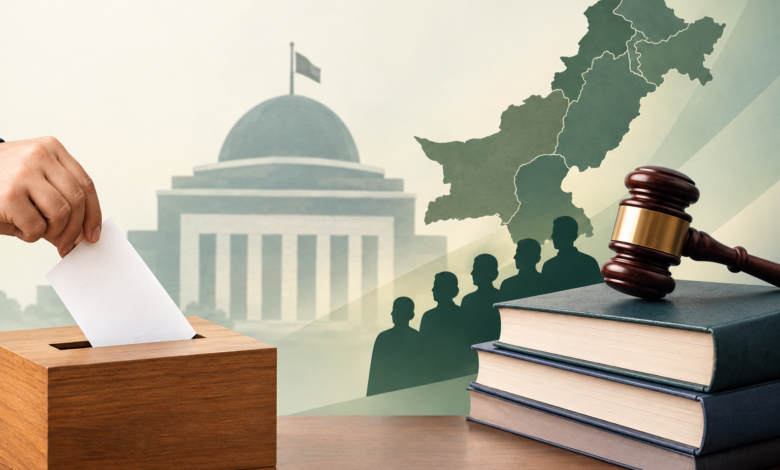
Looking back on Pakistan’s half-a-century, the political process looks like a roller-coaster moving from civil rule to military regime and vice versa; real political stability has remained elusive. Civil governments failed, among other reasons, for incompetence, corruption, lack of accountability, and absence of responsiveness to the people’s aspirations and problems. Military interventions have equally failed, not only for their inability to rectify the causes that were responsible for the successive eclipse of civil rule but also because of the price the nation had to pay in the form of abridgment of liberties, compromises on constitutionalism, damaging the image of Pakistan abroad, and dangers and pitfalls of politicization of the armed forces. This game of musical chairs must end.
What lies at the root of the crisis? It is submitted that the real malaise comes from the fact that although we have introduced a constitutional superstructure, the real system of governance from top to bottom in the country has not changed from its original colonial character. Despite several elections and the imposition and suspension of three constitutions, effective transfer of power to the people has not taken place. They are only at the receiving end of rule, and not the real actors in the political arena. The responsibility for this sad state of affairs largely rests upon the political leaderships, these organizations, and civil and military Bonapartism. Change of system as well as change of leadership seems to be the real need of the hour. In my view, we had constitutions without constitutionalism and rule without rule of law. No effort was made to implement the constitution, respect the laws, and create institutions, processes, and traditions to ensure governance in accordance with the letter and spirit of the constitution and law. Those who had been taking solemn oaths on the constitution were never serious about honoring that oath and had only very little realization of what the implications of that oath are.
I do not think we can resolve this deep and structured crisis through any shortcut or military surgical operations. There is no alternative to a genuine political process. Legitimacy can come only through national consensus and participation of the people in decision-making. Leadership must come from the people and by their free choice. All efforts to impose solutions from the above are destined to fail, even if they may have some intrinsic merit or may provide temporary respite. Process is as important as content. That is why, in my view, it is through respecting the framework of the 1973 Constitution that a solution to our problems must be worked out.
The system of elections would have to be changed. Past experiences have abundantly shown that election processes in the country have been so tainted and polluted that they could not bring up the real leadership of the people. It was the vested interests alone who successfully manipulated, maneuvered, and managed to climb up the ladder of power. A few hundred families have dominated the political scene, whatever be the name of the party or nature of the regime in power. In the case of Pakistan, it seems some kind of a “hereditary” or “clan democracy”, if democracy that can be called, has replaced the hereditary monarchy of the past. That goes against the spirit of democracy and constitutes the real obstacle to good governance. Merit and the people’s well-being are the first victims of this state of affairs. Constitution becomes a worthless piece of paper if people who have to implement it are insensitive to the demands of democracy and know that they can have their way by avoiding the people and making all institutions serve their personal ends. Reform and restructuring of the electoral system and early elections under the new system seem to me the only alternative. My suggestions in this respect are as follows:
- Freedom of opinion, expression and association, along with respect for human rights and independence of the judiciary must be preserved and protected. They constitute the first prerequisites for healthy change.
- Promotion of a genuine multi-party system, which means that the parties should be democratically organized, running their affairs through active member participation, elections within the parties at all levels, and effective mechanisms for consultation, decision-making, and accountability, if necessary, even by law. To keep the number of parties within manageable limits, only those parties should be accepted as national parties that get a minimum representation in the parliament or provincial assemblies. For the National Assembly, there could also be a condition that every national party must have a certain minimum representation from every province or at least from three of the four provinces.
- Tenure of National and Provincial Assemblies should be reduced to four years and the number of seats in each case at least doubled.
- The system of Proportional Representation, at least for 50% of the seats, should be introduced at all levels. The electoral unit could be the province or even each division on the basis of multi-member constituencies to ensure proper regional representation.
- Reform of electoral laws and development of operational mechanisms through which implementation of articles 62 and 63 of the Constitution could be ensured.
- Complete independence of the Election Commission. Its members should work full time. The Commission should also have financial independence. It should ensure the availability of an efficient machinery at all times for elections free from malpractices. The Commission should be responsible for the preparation and maintenance of correct voters’ lists, their regular updating, and creating effective safeguards against bogus voting and monitoring of election expenses National identity card, preferably with photo, should be made compulsory for voting.
- Implementation of the provincial autonomy contained in the constitution and effective devolution of power towards provinces and local bodies. This devolution of power should mean not only distribution of political power and authority but also transfer of financial power, so that effective decision-making could take place at every constitutional terminal: local government, provinces and Federation. The basic administrative and developmental unit would be the district, with an elected head and a clear line of authority and responsibility in respect of administration, development, education, social services and public utilities.
- Pakistani politics has been tainted and polluted by divisiveness and polarization. There is a need to build bridges and explore avenues of cooperation so as to create national consensus at least on some major issues. Islam, being the raison d’etre of Pakistan and the very foundation of our society, is above all dispute. It is also our national identity. Islam stands for justice, peace, and service for mankind. Rule of law, respect for human rights, and shura are the soul and breath of an Islamic polity. Islam can be implemented only through democratic processes, through active participation of the people in governance at all levels, and by strengthening and promoting universal education and well-being of the people. Islamic commitment and vision and democratic ethos and processes are the pillars on which the future rests; all differences of opinion can be resolved through dialogue and discussion. Where there is no consensus, everyone should be prepared to respect the view of the majority, without in any way suppressing the opinions of those who disagree. Violence should have no place in resolving political issues. It is only through dialogue and mutual accommodation that all difficulties and problems can be resolved.
The real test of our maturity lies in political leadership’s preparedness to learn lessons from the past and resolve problems not by resorting to confrontation but by mutual cooperation. Let us commit to work for what is common between us and respect each other where we differ. It is only in this spirit that the democratic process can take root in the country, where we as a nation have already wasted over half a century, while others have stolen a march ahead of us. Let me warn, in the words of Iqbal, with little modification.