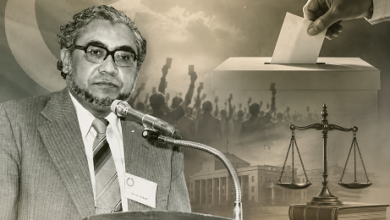

Professor Khurshid Ahmad’s Views on the Strategic Relationship between India and Pakistan
Foundational Parameters of the Relationship
Professor Khurshid Ahmad consistently emphasized that the core determinant of the India–Pakistan relationship is the Kashmir dispute. According to Professor Khurshid, peace and stability in South Asia cannot be achieved “without progress for the resolution of the Kashmir issue, and India reciprocating Pakistan’s flexibility”.
Professor Khurshid regarded any attempt to build “mutual dependencies” between the two states as unrealistic and detrimental unless these foundational issues were addressed. He viewed such efforts as potentially compromising Pakistan’s sovereignty and its vision as an independent, self-reliant state that upholds the dignity of the Muslim world and maintains a balance of power in the region.
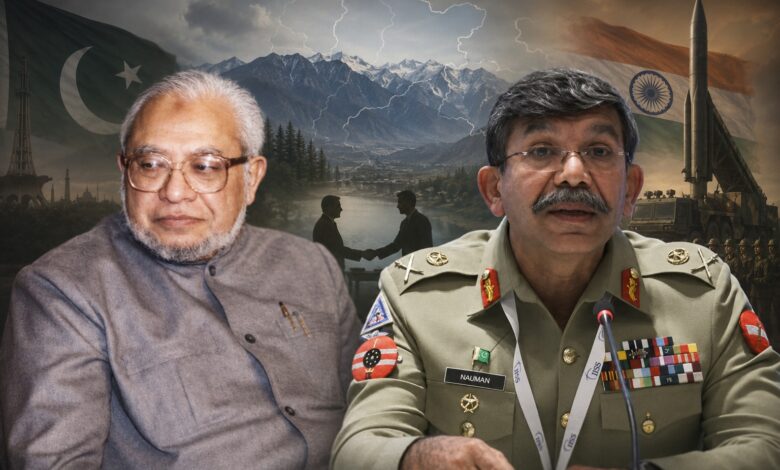
This insistence on sovereignty and a hard-nosed balance of power was directly echoed at the Shangri-La Dialogue. Lt. Gen. Nauman Zakaria’s address reinforced that Pakistan’s current posture—particularly through conventional and conventional-hybrid responses—has been designed precisely to protect this sovereignty, explicitly stating that these measures have “effectively debunked the notion of space for war in South Asia.”
Territorial Proximity and Strategic Sensitivity
Given the territorial proximity of India and Pakistan, Professor Khurshid saw the relationship as inherently delicate and strategically charged. The shared borders, historical conflicts, and unresolved territorial disputes—especially over Jammu and Kashmir—created a constant state of strategic vulnerability.
Professor Khurshid’s writings in Tarjuman-ul-Quran (1997) noted that the geographical closeness of the two nuclear-armed states magnified the stakes of every diplomatic or military move, making restraint and justice-based resolution essential for long-term peace.
In the modern era, this “constant state of strategic vulnerability” caused by proximity has been hyper-accelerated. At the summit, Lt. Gen. Zakaria highlighted that the proliferation of advanced technologies, precision-guided weapons, and drones has severely compressed decision-making timelines. Under a nuclear shadow, this proximity means the risk of strategic miscalculation is higher than ever, modernizing Professor Khurshid’s warning about the magnified stakes of geographic closeness.
Conventional Asymmetry, Balance of Power, and Missile Development
Professor Khurshid was deeply concerned about the conventional military asymmetry between India and Pakistan. He argued that India’s hegemonistic designs had to be “contained and countered” to ensure regional stability. In his view, Pakistan’s strategic policy should aim to preserve a credible balance of power, not through aggression but through self-reliance, national dignity, and strategic prudence.
This emphasis on maintaining a strategic balance implicitly extended to the technological and missile domains. His reference to ensuring a “balance of power in the region” indicates his recognition that advancements in missile ranges and defense technologies could alter deterrence dynamics. He viewed technological parity not as an arms race but as a strategic necessity to prevent coercion and maintain mutual deterrence in the subcontinent.
This exact ideological transition from “technological parity” to institutional reality is embodied in Pakistan’s defense architecture today. Lt. Gen. Zakaria spoke on the global stage as the Commander of Pakistan’s newly raised Army Rocket Force Command. This command acts as the literal operationalization of Professor Khurshid’s vision: maintaining a credible, self-reliant conventional and technological balance of power to prevent external coercion and ensure robust mutual deterrence without slipping into an aggressive, unsustainable arms race.
Hybrid Warfare and Political Strategy
Professor Khurshid’s critique of India’s “hegemonistic designs” and his insistence on parliamentary oversight of foreign policy suggest an awareness of non-conventional and multi-dimensional threats. He demanded that “the Parliament should discuss the Indo-Pakistan relationship threadbare and lay down detailed guidelines for the executive to pursue”. This reflects his belief that Pakistan’s response to India must be comprehensive, integrating political, diplomatic, and informational dimensions—key elements of what is now termed hybrid warfare.
Today, these non-conventional threats have fully matured into hybrid-conventional security dilemmas. The contemporary military leadership’s brief at Singapore acknowledged that addressing these multi-dimensional challenges requires a whole-of-nation clarity. Professor Khurshid’s demand for structural guidelines matches the modern institutional understanding that hybrid threats cannot be fought with kinetic military power alone, but require strong political, institutional, and diplomatic resilience.
Dialogue, Confidence Building, and Reciprocity
Professor Khurshid supported dialogue and confidence-building measures (CBMs) but criticized their one-sided nature, noting that “Pakistan was doing all, while the Indian attitude towards Pakistan and the major issues, particularly Kashmir, remains unchanged”. For Professor Khurshid, genuine peace required reciprocity, justice, and sincerity—not symbolic gestures or unilateral concessions. He viewed dialogue as meaningful only when it addressed core disputes and strategic imbalances.
While modern statecraft actively echoes Professor Khurshid’s frustration with one-sided concessions, it simultaneously elevates the critical necessity of communication channels. At the Shangri-La Dialogue, Lt. Gen. Zakaria emphatically stated that even during times of acute geopolitical rivalry and gridlock, “dialogue must never collapse.” The modern framework builds on Professor Khurshid’s principle by calling for institutional transparency mechanisms and direct strategic communication to manage the crises caused by India’s lack of reciprocity, ensuring that a lack of political sincerity does not accidentally trigger a catastrophic kinetic escalation.
Conclusion
In essence, Professor Khurshid Ahmad’s perspective on the India–Pakistan strategic relationship was principled, security-conscious, and justice-oriented. When juxtaposed with modern military diplomacy at the Shangri-La Dialogue, his legacy remains highly prescriptive. Kashmir remains the moral and political cornerstone of bilateral peace. The Balance of Power—now highly sophisticated through the Army Rocket Force Command—remains a strategic necessity to deny “space for war” and counter conventional asymmetry. Dialogue must be reciprocal and rooted in justice, but structurally maintained through robust transparency mechanisms to avoid technological miscalculation in a compressed strategic environment. Strategic Autonomy and self-reliance remain vital for Pakistan’s dignity and survival. His vision combined realism with moral conviction, seeking a South Asia where peace was not imposed by power but built upon justice, balance, and mutual respect.