
ISLAM AND THE NEW WORLD ORDER
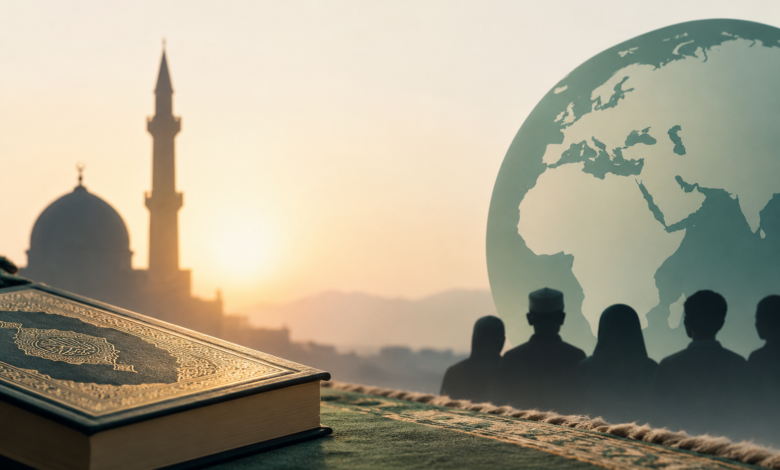
Islamic resurgence is unique as well as universal, because in Islam there is unity with diversity and variation that does not destroy uniqueness. Islam is a universal religion. There is nothing like Arab Islam, Pakistani Islam, Iranian Islam, or Turkish Islam within the Islamic universalism; there is unity but not uniformity.
There are certain distinct features that are common everywhere, but they never exhaust the richness of the movement. For example, Arabic is the language of the Qur’an but not necessarily spoken by all Muslims. Although every Muslim learns at least some Arabic, it is not less Islamic to speak other languages and to use them as instruments for developing ideas, which conform to Islamic norms.
Muslims are self-critical; they re-examine the superficial manifestations of social life and go back to the first principles, as expressed in the Qur’an and the Sunnah of the Prophet (Peace Be Upon Him). This may involve disregarding some of those symbols that have become part of the religious tradition, for example, certain customs or even certain details of jurisprudence. ‘Going back to the roots’ is the spirit behind current resurgence.
This return to the sources acts as a liberating force. Within Islam it initiates an invigorating, dynamic process. Going back to fundamentals does not produce fundamentalism of the kind that leads to retrogressive situations. Rather, it brings a freshness of approach, producing a new commitment, a new dynamism, a new flexibility, and a new ability to face challenges. People are now rediscovering Islam as a source of civilisation and culture, a factor that ought to be influencing the shape of society.
In our view, the contemporary phase involves moving away from a slavish imitation of Western models and becoming discriminating in what we use or adapt. In many ways, we can benefit from Western experience, but we do not intend to become instruments for the imposition of alien cultures.
Of course, not all Muslim societies have the same attitude towards Western culture. Those countries, which were, sometime back, pioneers of Westernisation, are now in the vanguard of Islamic resurgence. While in the countries that seemed to be lagging behind and were stuck to their traditions are the people who are still enthusiastic about Western prototypes and models.
It is often suggested whether Muslim countries can really afford to reject certain choices in development, technology, and so forth if these would enable them to build communal prosperity and add to the possibilities of human development. This kind of question epitomises all the confusion on this issue. Let us set the record straight: we have no problem with development and technology. The real issue is what type of development? Is it going to be mere economic development or total human development, logical, economic, social, moral, or ideological, leading to a just social order? Do we visualise development in the context of individual states, or do we have a vision of the development of the Islamic Ummah? Would this mean going back on recent history, for example, by trying to undo the existence of the Muslim nation-states, or would it mean that the Muslim countries would only concentrate on carving out a new future for the Ummah?
There is no going back in history; in fact, we want to go ahead in a much more creative way than our recent predecessors. We can accept the nation-state as a starting point, although it is not the Muslim ideal. It constitutes the present-day reality, and we do not want to dismantle political systems in an arbitrary manner. We want to bring about a greater sense of unity in the Islamic ummah, greater cooperation, and increasing integration between the different Muslim states. Under Islamic idealism every nation-state would gradually become an ideological state, and these would go on to make up the common wealth of Islam.
The West has failed to see the strength and potential of the Islamic movement. It has chosen to denigrate it as fundamentalist, fanatic, anti-Western, and anachronistic. It appears that the West is once again committing the fatal mistake of looking upon others belonging of a different paradigm from the prism of its own distorted categories of thought and history. For sure, this increases the divide between the two people.
Through this ill-divided approach, great violence is being done to humanity. It is also bound to misinform the Western people and policymakers about the true nature of Islamic resurgence, as they are being forced to see them in the light of a particular unhappy chapter of their own history.
Being a future-oriented movement, the Islamic movement has nothing in common with the fundamentalist approach of the Christian groups. It has shown great awareness of the problems of modernity and the challenges of technology, and its emphasis on the original sources of Islam, the Qur’an and Sunnah, imparts to its approach a flexibility to innovate, which is conspicuous by its absence in the approach of the conservatives who stick to a particular school of Fiqh (jurisprudence). All these possibilities are ignored by analysts who try to see the contemporary Islamic world in categories that are not relevant to it.
The present Muslim mind cannot be understood properly unless we realise that their self-understanding of their predicament is deeper than a mere political anguish. Unfortunately, efforts to understand the Islamic resurgence are often too facile and biased. The theory that the Islamic resurgence is just a result of rapid developmental efforts, particularly in the case of Iran, is at best simplistic. Yes, the development syndrome has its own problems, but it would be an oversimplification to assume that the Muslims’ response to forces of resurgence is attributed to tensions created by efforts to achieve quick economic development through technology transfer.
Such a diagnosis betrays abysmal ignorance of the ethos of the Muslim society; similarly, reducing the resurgence to just an angry reaction of people against Western imperialism is equally misleading. That there is a reaction against imperialism is no doubt true. However, more than a political fury, it is a creative urge to be our own selves. A much deeper cause is dissatisfaction with the ideas and values, the institutions, and the system of government imported from the West and imposed upon them. It is a dissatisfaction with their own leadership, which they associate with Western interests. It is a multidimensional phenomenon. On the one hand, it is a historical expression of the concerns as well as the aspirations of the people based primarily upon internal and indigenous factors. On the other hand, it is also a response to an external challenge, the challenge of post-colonial incursions in Muslim society.
The Islamic movement is a critique of the Muslim status quo. It is also a critique of the dominant culture of our times, the Western culture and civilisation, which are prevalent in many of the Muslim countries. And it is a critique from a different base and from a different point of reference, the Qur’an and Sunnah of the Prophet Muhammad (Peace Be Upon Him).
Most importantly, it calls for the reawakening of faith, a dimension not found in Western writings; they assume that it is just a question of political and social rearrangements. The social order is definitely important, but the starting point is reawakening and strengthening of faith and rebuilding of the individual’s moral personality. There is an upsurge of spirituality and idealism, generating a new sense of direction and a commitment to reconstruct their world, whatever the sacrifice may be.
The model of leadership during the period of colonial domination and post-colonial manipulation has been one that just looked after personal interests.
That is why Muslim society has become so devoid of moral values and rife with corruption. Exploitation has become a way of life in part of the world. Muslims have their own weaknesses, and they suffered many reverses as part of the global situation. But the explosion of corruption, which is so visible in the present-day Muslim world, is a new phenomenon. They relate to the impact of secularisation and Westernisation resulting in the loss of individual morality and of social ethics, which had historically been based upon Tawhid (the unicity of God) and loyalty to the Sunnah of the Prophet (PBUH). The secularists in post-colonial Muslim societies tried to superimpose the values of Western liberalism on Muslim peoples, which has thrown them into a moral wilderness, weakening the hold of traditional values over private and public conduct. The zeal to win the rat race and the socioeconomic exploitation have become the order of the day, mostly in the name of economic development and material progress. Islamic resurgence represents a rebellion against this state of affairs. It stands for a reaffirmation of Islamic morality and a rededication of the sources of the ummah—material as well as human—to the achievement of social justice and self-reliance. Muslim youth have been inspired by a new vision to rebuild their individual and social lives in accordance with the ideals and principles given Islam and to strive to establish a new social order, not only within their own countries but also to see that a new world order is established, ensuring peace, dignity, and justice to all the oppressed of the world.
The Islamic resurgence is primarily an internal, indigenous, positive, and ideological movement within Muslim society. It is bound to come into contact, even clash with certain forces in the international arena. The close contact of the West, particularly through colonial rule, is relevant but not the most decisive factor in producing the Islamic response.
So conflict there may be. But the Muslim criticism of their civilisation is not primarily an exercise in political confrontation.
The real competition would be at the level of two cultures and civilisations, one based upon Islamic values and the other on the values of materialism, nationalism and liberalism, both political and economic. Had Western culture been based on Christianity, on eternal values of morality, or on faith, the language and modus operandi of the contact and competition would have been different. But that is not the case. The choice is between the divine principle and a secular materialist culture. And there is no reason to believe that this competition should be seen by all well-meaning human beings merely in terms of the geopolitical boundaries of the West and the East or even in terms of Christianity versus Islam. In fact, all those human beings anywhere in the world who are concerned over the spiritual and moral crisis of our times should heave a sigh of relief over Islamic resurgence and not be put off or scared by it.
Once the nature of the conflict on the value level and culture is clarified, there is a political dimension to the situation that we must not ignore. There is nothing pathologically anti-Western in the Muslim resurgence. It is neither pro- nor anti-West on the political relationship between Western countries and the Muslim world, despite the loathsome legacy of colonialism, which has the potential to mar these relationships. If China and the United States can have friendly relations without sharing a common culture and politico-economic system, why not the West and the Muslim world? Much depends upon how the West looks at this phenomenon of Islamic resurgence and wants to come to terms with it. If in the Muslim mind, Western powers remain associated with efforts to impose the Western model on Muslim society, keeping Muslims tied to the system of Western domination at national and international levels and thus destabilising Muslim culture and society directly or indirectly, then, of course, the tension will increase. Differences are bound to multiply. And if things are not resolved peacefully through dialogue and understanding, through respecting each other’s rights and genuine concerns, they are destined to be resolved otherwise. But if, on the other hand, we accept that this is a pluralistic world, that Western culture can coexist with other cultures without expecting to dominate them, that others need not necessarily be looked upon as enemies but as potential friends, then there is a genuine possibility that we can learn to live with our differences. If we follow this approach, we can discover a common ground. This is the key to the future world order. Are we prepared to accept coexistence, even pro-existence, of all cultures, religions, and nations? If the answer is yes, the future is bright.