
A CREATIVE RESPONSE TO WESTERN IDEOLOGY
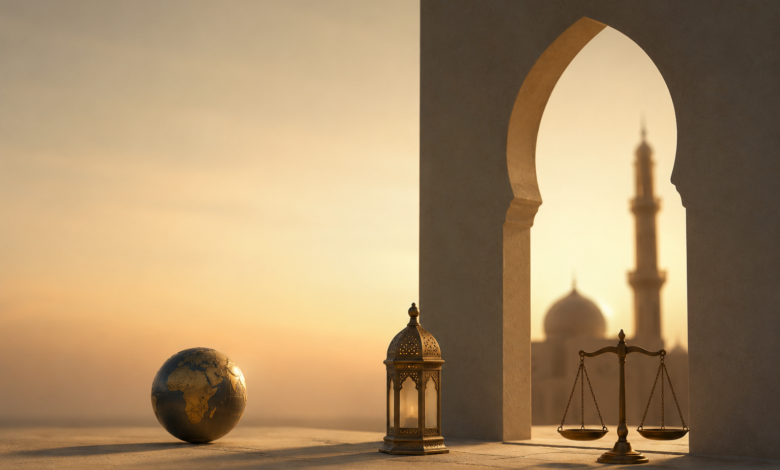
Whatever the ultimate impact of the contemporary movement of Islamic resurgence and whatever the principal or peripheral irritants at home or abroad, it is difficult to ignore a development that is influencing the very language of cultural dialogue in our times. An old and neglected theme has moved to the center of the debate; the relevance of God and his guidance to the politico-economic situation of mankind.
Civilization the politico economic systems obtaining in these countries are based on Western models. This is the contradiction which the resurgent Islam has tried to challenge.
Contemporary Islamic resurgence is neither a transient political articulation of militant Islam nor simply an angry outburst against Western nations. On the contrary, it heralds the Muslims’ positive and creative response to the ideological challenge of Western civilization. For the Muslim world it is an attempt to try to reconstruct society by drawing upon its Own rich but neglected religious and cultural sources.
The ultimate objective of this exercise is to establish a new and just social order in which the material and the spiritual aspects are welded together and in which “progress” and “prayer” do not represent two watertight compartments but prayer acts as a stepping stone to human progress.
Western is based on the principle of separation of religion and State: Man is assumed to be self-sufficient, God does not matter, as far as the social, political, economic, and technological aspects of human civilization are concerned. At best, He can worship in one’s personal life. The affairs of society and state are to be conducted according to Man’s discretion. Conquest of nature has become the chief target for human effort, and the stream of civilization runs without reference to the values and principles communicated to mankind by God through his prophets.
The Muslim world is no exception to this state of affairs. The mechanics of government and society developed in the last 200 years or so were steeped in secularism. The last three decades have witnessed the emergence of over 40 independent Muslim states but Islam is a complete way of life and the divergence between this belief and the social reality lies at the root of the tension that permeates the Muslim world today. Resurgent Islam represents a new approach that is to strive to reconstruct the Society and state in accordance with Islamic ideals and values and the needs of contemporary life.
What type of polity does Islam want to establish? The idealized Islamic state neither conforms to the Western standards of liberalism wherein there is no place for 24 set of absolute values to constitute the framework for the operation of popular will nor to European or Eastern totalitarians wherein the integrity of the individual is compromised in the name of collective authority.
The tons philosophic of the Islamic found state are God’s Sovereignty, human responsibility and the oneness of the Muslim Ummah community. Sovereignty not only means judgment of His but also lays down principle that divine law supreme and that the values. principles, and priorities are to be based on divine revelation.
10 reconstructions of Society on the values brotherhood of truth and justice. Within the value framework provided by the divine law, Man is free to experiment and innovate, to articulate his creative genius, and to make optimal use of all that been provided in the universe.
The individual who constitutes the fundamental unit of society and his freedom, education, and salvation in the main concerns of Islamic policy. In the final analysis the Success of the depends system on the faith and commitment of the individual. and his sense of moral and social accountability.
The Islamic state operates on the principle of shura (mutual consultation). The Prophet of Islam established a political order in which hereditary monarchy and despotism had no place. The primitive Islamic caliphate was based on popular acceptance.
The Muslim community may be seen as one international brotherhood. The ideal political and spiritual arrangement is one where the community. operates under one leadership, but even when that is not possible close cooperation between all Muslim countries is intended as an essential principle of Islamic life. The Islamic state is an ideological state. Participation of the people in the political process as its lifeblood and mutual consultation is its operational mechanism.
A variety of structures can be built to translate these values and principles into practice in the modern age. Islam does not in spite of appearances to the contrary tie its followers particular historic-political structure in its entirety. There is a built- in flexibility in the system, which enables the modern Muslim to make experiments and evolve new arrangements to achieve these socio-political ideals. His main problem is to transform the social system he has inherited from the colonial period and to give it an Islamic character.
Western democracy has succeeded in giving the individual a positive role in the system: it has yet to make a reality of his actual participation in the process of decision-making at different levels of the policy and economy. Resurgent Islam wants not only to weld together the religious and secular approaches so as to temper political power with moral integrity and social justice, but also to see that the involvement of the individual is not confined to the casting of a faceless vote but includes his actual participation in the process of power. The Islamic revolutionary committees in present may still seem to be.