

Syed Qutb—The Martyr of Islam
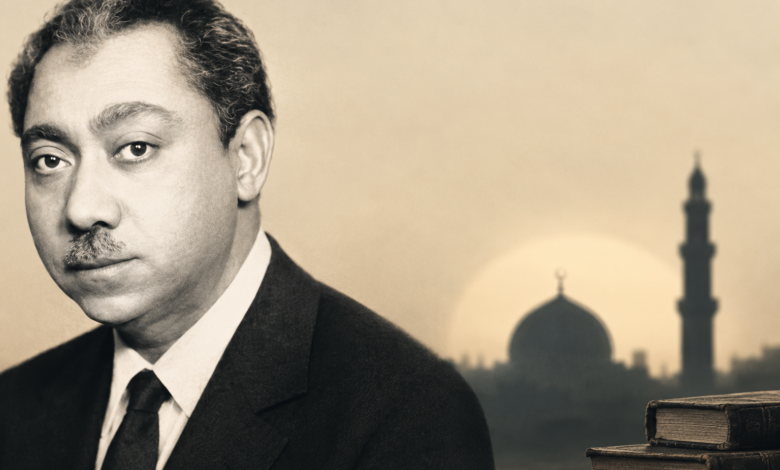
Twenty-ninth of August, 1966 marks the end of a glorious chapter in the intellectual history of the Arab World. It was on this day that Syed Qutb, one of the most powerful Muslim writers of the present-day Arab World, was hanged in Egypt. The great example of dedication and unflinching devotion to the cause of Islam set by Syed Qutb has caught the imagination of the Muslims throughout the world, while those who caused his death have earned eternal damnation.
Syed Qutb was born in Musha, a small town in Egypt, in 1903. His father was a farmer. His mother was a very pious and religious-minded lady who wanted her offspring to become true and devoted Muslims. Syed Qutb’s younger brother, Muhammad Qutb, is also a writer of repute. His famous book, “Islam the Misunderstood Religion,” has earned international recognition as an excellent exposition of the socio-economic teachings of Islam. Syed Qutb’s sister, Hameeda Qutb, is also a well-known writer who has contributed important writings on various aspects of the Islamic way of life. She was also associated with the Islamic movement in Egypt and suffered for this association along with her valiant brothers.
Syed Qutb got his early education at his home and committed the whole Quran to memory at a very young age. He obtained his Secondary School Certificate from the Tajheezia-e-Darul-Uloom and was admitted to the Institute of Higher Learning at Cairo in 1929. He graduated from the Institute in 1933 with specialization in education. He started his career with the Government as Inspector of Schools and continued to be in that post up to 1952. It was during this period that he was introduced to the Ikhwanul Muslimoon. During 1946 to 1948, he serialized his most outstanding work under the title of ”Social Justice in Islam”. Thereafter, his life became the life of a missionary. He was first imprisoned in 1954 and remained in jail until 1964. In 1965, he was again arrested. After subjecting him to inhuman torture for a year, he was hanged on 29th August 1966.
Syed Qutb is one of the few personalities of the twentieth century whose name will always be remembered in human history. He was one of the most ardent and active workers in this century’s revivalist movement in Islam. Apart from his intellectual and academic contributions, he laid his life for the success and glory of Islam. He launched a vigorous struggle against atheism, secularism, and socialism. It has been rightly pointed out that while Hassan-ul-Banna Shaheed was the founder of the Islamic movement in the Arab World, it was Syed Qutb who poured life and blood into it. Both of them achieved eternal fame and glory for their invaluable sacrifices in the cause of Islam. Hasan-ul-Banna was the man who had sowed the seed of the Islamic movement, and Syed Qutb watered this seed with his pen and blood to see that it flourishes into a big tree so as to provide comfortable shade to the troubled humanity.
The real contribution of Syed Qutb lies in his realization that there is no shortcut to Islamic revolution. He was of the firm opinion that no Islamic revolution could be brought about with mere slogans and emotional calls, even though these are supported by sincerity of purpose. He firmly believed that the major prerequisite for an Islamic revolution was an all-embracing intellectual and educational revolution. He, therefore, launched an organized and well-planned intellectual struggle in every walk of life to establish the supremacy of Islam over other ideologies of the modern times. He was fully aware of the impact of the anti-Islamic forces operating in the Muslim society. He firmly believed that the Muslim society’s capacity to face the anti-Islamic intellectual and political challenges cannot be enhanced without inaugurating a vigorous cultural revolution within the Muslim society itself. He was conscious of the ills and diseases from which the present Muslim society was suffering.
Hasan-ul-Banna Shaheed and his comrades had already paved the way to start an Islamic movement in the Arab World. He had kindled a light of hope and enthusiasm in the Muslim youth and had aroused them to wage an active struggle for the cause of Islam. But this struggle needed an intellectual support. Although a general intellectual frame-work had already been provided by Hassan-al-Banna Shaheed and his team of workers, what was now needed, was a detailed exposition of the Islamic ideology and its implications in every walk of life with definite solutions of the social, economic, political and moral problems of our times.
The Islamic movement in the Arab World was indeed full of life and dynamism due to the strength of its faith and devotion towards Islam. But the situation demanded something more than that. What was now required was a strong and rational basis for the faith and devotion. This challenge was ably met by the Muslim scholars after the Second World War. The next decade witnessed the scholarly and thought-provoking literary writings of Mohammad Ghazali, Syed Qutb, Mohammad Qutb, Abdul Qadir Uooda and others. They met this challenge with great intellectual vigor and produced Islamic literature which was quite unprecedented in quality as well as in quantity in the recent history of Islam. This literature concerned itself not only with the classical religious issues but also with the contemporary economic, political, and social problems of our time. It gave a new dimension to the Islamic movement in the Arab World. Unfortunately, the Islamic movement had to face a number of crises during this period; the coming decade was a decade of repression and oppression for the Islamic movement in the Arab World. Only future historians will make objective judgements about the consequences and implications of this period, but apparently, the movement had a great setback during this period. The speed with which the Islamic movement was capturing ground in different Arab countries slowed down for quite some time; it seemed that the vacuum created by the absence of the Islamic forces would not be filled in the near future.
At this critical juncture, Syed Qutb raised his powerful and impressive voice from behind the bars. Syed Qutb was undergoing rigorous imprisonment at that time. But he was not sitting idly in the jail. The solitude of jail had provided him with an opportunity to meditate at length over the problems of Islamic revival in modern times. It is not to suggest that the jail provided him with an experience of intellectual metamorphosis, though this experience had certain significant impacts upon his personality, his way of looking at things, his thoughts and his style. His writings of this period indeed laid the foundation for another intellectual revolution in the Arab World. He set an example through his sacrifices for those who were hesitant in the path of Islam. He kindled the light of hope in the hearts of those who had lost all hope. As a matter of fact, the emergence of Islamic spirit in the Arab youth during the last ten years owes its origin to the writings and sufferings of Syed Qutb Shaheed. He is, indeed, the real architect of the Islamic Renaissance in the Arab World.
Syed Qutb was one of the most prolific writers in the recent history of Islam. His writings are marked by his depth of thought as well as the breadth and variety of subjects he undertakes to tackle. His ideas are clear and unambiguous; his approach to the problems is rational and, at the same time, evokes an emotional response on the part of the reader. His style is possessive and refreshing. His writings may sometimes give an impression of his concern for “form”, style, and other literary charms in Abbas Mahmood-ul-Aqqad’s tradition of the “Islamic Romantic School”. But a deep and careful study reveals his philosophic bent of mind. He attempts to resolve the contradictions and conflicts of our age in the framework of Islam with an exceptional perception and clarity. He had the passions of a romantic poet, logical consistency of a philosopher, and the stark realism of a social scientist. Syed Qutb Shaheed was, in fact, following the literary style of the Quran. The Quran discusses the problems of logic, philosophy, economics, and other disciplines without indulging in the technicalities of their jargon and thus achieves a unique combination of rational as well as emotional appeal in its style.