
Cooperation Between Christians & Muslims

In the name of Allah, the Merciful, the Mercy-Giving.
SAY: “People of the Book, (let us) rally to common terms, to be binding on both, us and you, that we shall worship only God {alone) and associate nothing else with Him, nor shall any of us take others as lords instead of God” (The Qur’an 3: 64)
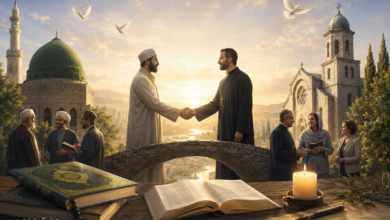
Perhaps this is the first time that a Muslim has acted as a coeditor for a special issue of the IRM. On the face of it, this may appear to be a small step, yet it may go a long way in improving the state of religious coexistence; moving from coexistence towards pro-existence and greater co-operation between the family of Abraham (peace be upon him). The initiative for the present effort came from the Commission on World Mission and Evangelism of the World Council of Churches and the IRM, to which the Muslims have responded in good faith.
After working on this project for almost one year, I, for one, have no regrets for having entered these uncharted waters. We met and worked together as people committed to serve God alone, and as persons resolved to live in accordance with the religious values and traditions, we firmly believe in. We hold no brief for syncretism, nor were we interested in producing compromises on matters of religious and moral countries.
Similarly, we did not enter the consultation with a view to scoring points on each other. We met with the objective of understanding each other’s position more sympathetically, of identifying the areas of agreement and disagreement and of trying to build mutual trust so as to coordinate our response to threats and challenges that beset humanity today. Instead of merely talking about each other, we have tried to talk to each other, however haltingly.
That is why we, instead of producing an impersonal collection of scholarly papers, have tried to collect around one table a few distinguished religious leaders of the two faiths and invite them to face each other as much as the real issues that confront them. The fruits of this lively encounter are presented in this special issue on Christian Mission and Islamic Da’wah.
It is our considered opinion that the right approach in Christian-Muslim dialogue is to face the problems and issues that unite or divide us. These issues are legion: religious, theological, historical, socio-cultural, and political. As mission da’wah represents the outreach of one’s religious tradition to the other and as the role of Christian missions in the Muslim world is regarded by the Muslims to be the root of estrangement between the Christian and the Muslim worlds, the conference on mission and da’wah provided a natural point of departure for a meaningful dialogue.
Although there have been moments of stress and strain, expressions of human weakness and pugnacity, even wars and political encounters, Christians and Muslims have lived side by side in the Muslim world, on the whole, in peace and harmony with each other, ever since the final revelation of Islam in the seventh century.
But with the arrival of the Christian missionaries in the company of European colonizers, a new chapter began in Muslim-Christian relationships. That some of them might have been motivated by the best of spiritual intentions is not among the points in dispute. But the overall Muslim experience of the Christian mission was such that it failed to commend itself as something noble and holy. Any dispassionate evaluation of the experience would that what has been achieved is a loss for Islam and religion as such, and not a gain, for Christianity, the real beneficiaries being the three of secularism, materialism and of moral insensitivity. The Muslim critique can be summed up in four points:
- Gross and flagrant misrepresentation of the teachings of Islam and of the life and message of the Prophet Muhammad (peace be upon him). Instead of examining Islam as it is. a totally unreal picture of Islam was connected and used to denigrate Islam and Muslims. Although the high watermark of this type of approach to the study of Islam has passed, the effort still persists, even though in law profile and under many a disguise.
- The methodology of Christian mission concentrated upon influencing the objects in a state of weakness and helplessness. Instead of direct invitation approaches were made to those who were disadvantaged, exploiting their weaknesses for the sake of proselytism. The poor, the sick and the immature were made special targets of economic assistance, medical aid, and education. Many a Christian mission acted as an organic part of colonialism and cultural imperialism. All this was a very unfair way to bring people to any religion.
- Whatever the ultimate aim, subversion of the faith and culture of Islam seems to have been the prime target of the Christian missionary enterprise. Nationalism, secularism, modernism, socialism, even communism was fostered, supported and encouraged. While the revival of Islam and the strengthening of Islamic moral life among the Muslims were, and even now are looked upon as anathema.
- Muslims were treated as a political rival and as such subjected to overt and covert discrimination and repression. Their just causes fail to evoke any significant moral response from the Christian world. Western Christendom’s attitude towards the Palestine problem in general and towards Jerusalem in particular, for example agonizes Muslims. Majority rule is denied to Muslims in a number of African countries. The sufferings of the Muslims in such places as Eritrea, Mindanao, Kashmir, Patani, to mention only a few, fail sufficiently to arouse the moral conscience of the Christian, world. Muslims are puzzled when they compare the relative lack of Christian concern over the increasing de-Christianization of the Christian world with their obsession with what amounts to de-Islamization of the Muslim world.
This being the nature of the Muslim concern it was but natural that any meaningful dialogue must begin with a review of the Christian and Muslim positions in respect of the whole experience of mission and da’wah. The Conference concentrated upon two major aspects of the problem; the fundamental position of Islam and Christianity in respect of da’wah, and mission and the Christian and Muslim experience of each other’s missionary da’wah activity. Both religions are light-sharing. But there are differences in the way they offer their message to others and, at a deeper level, in the way they concern themselves with the world.
The two sections on the nature and concept of the Christian mission and Islamic da’wah and the discussions that follow bring this into sharp focus. The missionary experience of the two communities too has its disparities. A careful perusal of the material presented here will show that three issues emerge distinctly from the debate.
First, there has been widespread abuse of Christian diakonia and something effective needs to be done to bring an end to that. Secondly, the whole question of secularism and westernization has to be studied in the context of religious historical traditions of Islam and Christianity. Greater sensitivity needs to be shown to differences in the religious ideals and the historical situations of the Christian West and the Muslim world. Thirdly, although human freedom is even more essential for the flowering of man’s spiritual and religious life than for this political existence, freedom becomes meaningful only within a framework of commitments and responsibilities. As such, equal concern should be shown towards the freedom and integrity of the individual and the solidarity of the community.
With these key issues in perspective, the importance of the Conference statement becomes clear. Although representing the consensus of a few persons, its significance lies in the fact that it can. show the way to a more universal consensus. Its uniqueness lies in the spirit of frankness and fairness in which it is. offered. It represents an attitude of loyalty to God and not necessarily to one’s ”tribe”‘ acceptance of facts, whether pleasant or unpleasant; and respect for the viewpoint and the feelings of others. With such an approach, man can move towards a new world of mutuality and preexistence. If this is what we are aiming at. then the Chambesy statement could be a milestone.
What about the future? The Chambesy spirit and the concrete suggestions it frames represent a first step on a long and arduous road men of goodwill from Christianity and Islam will have to tread if they want to change Christian-Muslim relations for the better.
The Mini consensus evolved at Chambesy deserves to be widened as well as deepened. It contains the seeds from which the tree of some universal consensus can grow. To deepen the consensus, efforts should be made to organize a series of conferences, seminars, conventions and colloquia at different levels with a view to developing better understanding of each other’s religious and historical tradition; To frame ethical rules governing dialogue, co-operation and even healthy competition; to jointly produce works of serious scholarship and frank encounters and to participates jointly in centers and institutions devoted to serving these purposes along with widening and deepening the consensus, effective step- should be taken to implement the proposals contained in the statement.
This is an area where organizations like the World Council of Churches, the Vatican, the Islamic Secretariat, the Muslim World League, the Call of Islam Society, the Islamic Council of Europe and the like can make some significant contribution not only in healing the wounds and clearing the debris but also in building new bridges to bring the family of Abraham closer in love and mutual trust. If the Chambesy Conference and the present efforts of the IRM, the Islamic Foundation and the Centre for the Study of Islam and Christian-Muslim Relations in Europe could make. some opening in that direction, this small step could be the precursor of a great change.
There is no God except Him and Allah is great, Allah is great and all praises are for Allah). From all sides, Muslim move to the prayer ground and this scene present a unique demonstration of unity, power, and majesty of Muslim Ummah. After offering the prayers, their hearts spurt with rejoicing. They greet and embrace each other sinking away all their petty feuds and frictions, if any.
They visit each other’s place and share feast with each other. Sweetmeat, meat and gifts are exchanged. It is all love affections good wishes, etc. for each other and malice or animosity towards none. On this happy and august occasion, every effort is made by fortunate brother to share his joys with less fortunate ones. Poorer sections of Muslims are thus not allowed to suffer from the sense of deprivation. It leads to even distribution of wealth, peace and tranquility. This is the way to bind Muslims into unity transcending family and local ties.
Another unique feature of Bids is that these are celebrated, in all months of western calendar and it makes them free from the influence of non-Islamic rites. But it is most unfortunate and painful that Muslims, having influenced by the non-Islamic forces, care little for their own noble and sublime principles. Despite modern scientific progress and technical advancement, they observe Eid on different dates even at one place. It makes a mockery of the great sacred institution of Eid.
A high powered commission comprising Muslim scientists, astrologers, and Ulema should be constituted to make a thorough study of this problem and formulate a uniform policy in this respect. We urge upon the Islamic Secretariat to take up the assignment of removing this discord from the rank of Ummah.