
Kashmir at the U.N and beyond
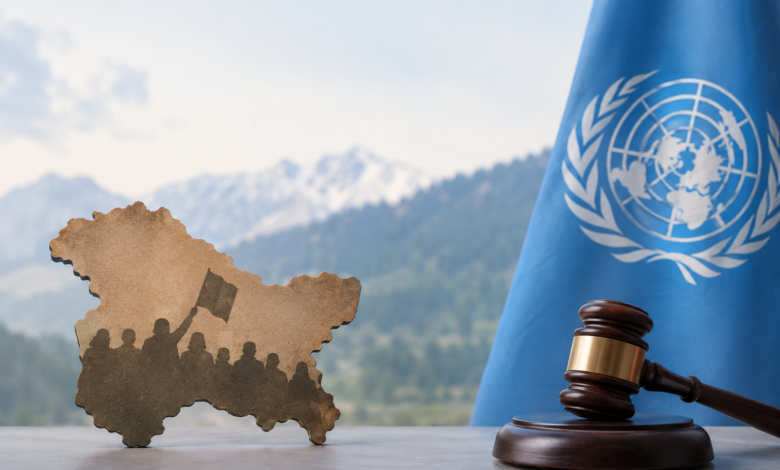
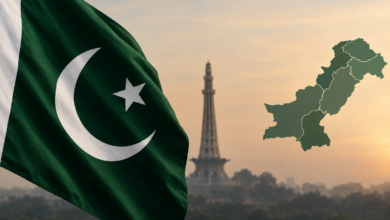
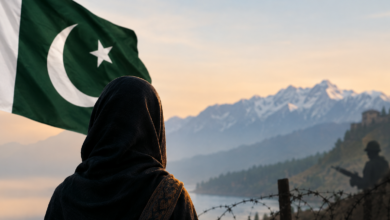
The Kashmir issue has been brought to the forefront of world agenda by the heroic national resistance movement waged particularly for the last five years in the Indian occupied Kashmir. Indian forces of occupation moved into the beautiful valley of Kashmir on 26th October, 1947 and have ever since held it under its thumb with wanton use of brute force. For the valley’s population of around 4 million, where the real concentration of Indian forces is, there are 580,000 Indian armed personnel (army and border security forces). This is the highest concentration of an occupying power in human history: one armed personnel for every eight civilians, men, women and children! Between 40,000 to 50,000 people have been martyred and over 60,000 permanently disabled during the last five years. India is trying to suppress by state terror a mass movement of national uprising, demanding the fulfilment of U.N. Resolutions and of the Indian commitments to give them the opportunity to decide their political future via free and fair plebiscite under the U.N. auspices.
There are three dimensions to the problem: first, gross violation of human rights in Jammu and Kashmir by the forces of Indian occupation; secondly, the fact that this human rights situation is a cause-related phenomenon. The fundamental issue is Kashmiri people national movement for their rights of self-determination under UN Resolutions; and finally, the threat to security in South Asia posed by this conflict which, if escalates, can spark off war in a region that houses over a billion people over one-fifth of the human race.
India took Kashmir dispute to the U.N. in December 1947. A resolution was passed by the Security Council on 21st April, 1948 recommending the holding of a plebiscite to decide the future of Jammu and Kashmir. United Nations Commission on India and Pakistan was established to ensure the implementation of this resolution. The Commission passed two resolutions on 13th August, 1948 and 5th January, 1949, which were accepted by India and Pakistan. The 13th August, 1948 resolution committed both India and Pakistan, and the U.N. about the future status of Jammu and Kashmir. It said: “The governments of India and Pakistan reaffirm their wish that the future status of the state of Jammu and Kashmir shall be determined in accordance with the will of the people.”
When India tried to seek a constitutional declaration from an unrepresentative “Constituent Assembly” declaring Kashmir an integral part of India, the Security Council in a resolution on 24th January, 1957, rejected that declaration and reaffirmed that the future of Jammu and Kashmir is yet to be decided in accordance with earlier U.N. Resolutions. On 10th May, 1964, the President of the Security Council once again affirmed that “the Pakistan-India question (on Kashmir) remains on the agenda of the Security Council.” The U.N. Secretary General has referred to the rising Indo-Pakistan tensions on Kashmir in his September, 1994 report (paras 541) in the following words: “Relations between India and Pakistan are still marred by their dispute over Jammu and Kashmir, one of the oldest unresolved conflicts still on the United Nation agenda. The United Nations Military Observer Group in India and Pakistan (UNMOGIP) has continued in its efforts to monitor the ceasefire line in Jammu and Kashmir, as it has since 1949. India and Pakistan have affirmed their commitment to respect the ceasefire line and to peaceful resolution of the issue in accordance with the Simla Agreement of 1972. Nonetheless, the level of tension in Jammu and Kashmir has increased considerably in recent years.”
In this background, the issue is not to bring Jammu and Kashmir on the U.N. agenda; the real issue is to re-activate the issue and bring about enough pressure on India to stop the gross and wanton violation of human rights is Jammu and Kashmir and to agree to modalities for the implementation of the U.N. Resolutions, giving to the people of Jammu and Kashmir an opportunity to exercise their right to decide their future. Simla Agreement, although entered into in a climate of duress, affirms the supremacy of the U.N. Charter, records that the agreement “by both sides” is “without prejudice to the recognised position of either sides,” and envisages a “final solution” to the dispute about the state of Jammu and Kashmir. As such the Accord cannot be used as an exercise for continued Indian occupation of the state and avoidance of its final solution through reference to the will of the people.
President Clinton, in his address to the General Assembly in 1993, referred to the human rights violations in Kashmir. Pakistan seized upon that and moved a resolution in Committee No. 3 (which deals with human rights issues) highlighting the grim situation in Kashmir. Five member states, including Pakistan, sponsored the resolution. The Government of Pakistan withdrew the resolution under alleged “friendly pressure”. This was debacle one. The issue was again raised at the U.N. Commission on Human Rights at Geneva in 1994. But again at the last moment, on the alleged initiative of some friendly countries, the resolution was not pressed for vote, with the result that it became infructuous. This was debate too. Any hope that India would come to the negotiating table for any genuine and meaningful dialogue did not materialise. Once the pressure is released, India begins to harp on its claim that Jammu Kashmir are “an integral part”. It refuses to recognise it as a disputed territory. This position is a non-starter. Unless India accepts Kashmir as a disputed territory, dialogue is meaningless.
There are only two ways to force India to agree to work out a solution; first, pressure from the resistance movement in occupied Kashmir, and, secondly, diplomatic, political and economic pressure of the world. The fact is that the U.N. resolutions have been lying in cold storage; it is the sacrifice and struggle of the Kashmiri people that has brought the issue to world forums. The U.S. Assistant Secretary of State is reported to have said in Delhi that it is the situation in (Indian- held) Jammu and Kashmir which forces the world to realise that there is a dispute around.
Pakistan and its OIC friends tried to reactivate the issue at the U.N. during the current General Assembly session. OIC held an extraordinary conference at Islamabad in September, 1994 to consider its strategy for Bosnia and Kashmir. In this 7th Extraordinary Conference, an OIC Contact Group for Jammu and Kashmir was formed at the initiative of the OIC Secretary General. This OIC Contact Group (consisting of Pakistan, Turkey, Saudi Arabia and Niger) resolved to bring the issue on the agenda of the First Committee (which deals with the question of nuclear non- proliferation, disarmament and security) in the light of the U.N. Secretary General’s Annual Report, emphasising the increase in tension between India and Pakistan on this issue. The resolution was weak and toothless; it only tried to bring some pressure on India to come up for genuine dialogue and also to invoke the U.N. good offices to make this possible. It did not mention the gruesome human rights situation in India and the brutal use of state-terror machine against civilian populations engaged a political movement. There was no mention of earlier U.N. Resolutions and the Kashmiri people’s right of self-determination. It did not reflect even the minimum position of Pakistan. That is why Pakistan was not a sponsor of the resolution, which was to be co-sponsored by seven OIC countries with a view to simply reactivate the issue at the U.N. level. India mobilised all its diplomatic strength to defeat this move. Indian Deputy Foreign Minister called some 22 OIC ambassadors in Delhi to dissuade them from supporting the resolution. Indian missions abroad became active in all the capitals of the world. High powered delegations were sent to impartant countries. To take an instance, Canada was visited by three Indian Cabinet Ministers within the short span of three weeks. A highly efficient and powerful delegation was active at the U.N. Despite all these efforts, this time the support for the OIC move was far better than what happened at Geneva. Majority of the OIC countries and a number of non Muslim counties had promised to vote in favour of the resolution. The real threat to the resolution was the possibility of abstention by a majority of the countries and also from the alternate strategy of India to bring a “No Action Motion” to make the resolution unoperational. The fight was very close. It was my objective assessment that if the resolution was to come to vote, it could have been carried by a few votes. The Government of Pakistan, however, was under very heavy pressure from the USA and Europe. Some of the Muslim counties were also lukewarm despite their support of the earlier OIC Resolution in September, 1994. In the midst of an intensive psychological war, those at the helm of the Foreign Office, and the President and Prime Minister on their advice, succumbed to this pressure. Nawabzada Nasrullah Khan and myself were firm till the last moment. Senator Shafqat Mahmood was also very positive till the last moment. In our view, the chances of success of the resolution were marginally greater. But what is more important, it was my considered opinion that the real issue was not one more resolution at the U.N. The real issue was display of our determination and resolve to stand by the Kashmiri people and their heroic struggle. Even defeat of the resolution would have enhanced our moral position and exposed those who talk of human rights and people’s right to self-determination, but when it comes to taking position on real issues, they turn out to be no better than pawns in the game of world politics. What pains me is that even the Government of Pakistan failed to show that resolve which are expected of it.
The Kashmir issue has been brought on world agenda by the struggle of the Kashmiri people and it would be decided Insha’ Allah in the streets of Jammu and Kashmir. Kashmir, as The Economist (London), surmised is no longer ruled by India, it is only controlled by it. Even The Times of India (May 6, 1992: Report by P. Bidwani) confessed “that New Delhi’s writ on longer runs in the valley despite its over-whelming military presence.” The future of Kashmir would be decided by the people of Kashmir and not in the chambers of the U.N. The Government and the people of Pakistan must show complete solidarity with the national resistance movement in Kashmir and extend all possible support to it. That is the real answer. That is the only strategy in consonance with the interests and ambitions of the people of Kashmir and Pakistan. Success or defeat at particular international forum is not the real issue the purpose of active political effort at these platforms is to mobilise world opinion, exert continuous pressure on India and show our resolve and commitment to the cause whatever be the price. Half way exercises do not serve the purpose. It is unfortunate that the Government and its foreign office have failed to clearly understand the real purpose of political effort and lobbying at the international platforms. Mobilization of world opinion, particularly in a climate that has totally changed in the light of the disappearance of cold war politics, is a challenging task. It calls for long period planning and continuous and ceaseless effort. It is not a one-shot operation. Pakistan’s foreign policy lacks direction as well as prudent and efficient management. When I tried to contact Pakistan missions in different capitals, I was astonished to find that we had no ambassadors in Canada and Malaysia. Sudan has been without an ambassador for the last three years. Even where we have a mission, its contact with the political leaderships of the country is often very weak. There are no proper and regular briefings on Kashmir issue. Even the delegation at the U.N. was not fully involved in decision-making. The Government was being fed with advice by the foreign office based more on its biases than on facts. The Government was more concerned with domestic political moods and reactions and lacked a clear strategic perception of certain political initiatives and their credibility fall outs. Eleven days I spent in the U.N. have left me with the impression that while some of our younger diplomats have greater commitment and better perception of what is to be done and what is expected of certain moves, the leadership at the Foreign Office lives in a make-believe world of its own. Let me conclude by drawing a few lessons for the future:
- The issue of the future of Jammu and Kashmir is a matter of life and death for both, the people of Jammu and Kashmir the people of Pakistan. The defence of Jammu and Kashmir is the defence of Pakistan an loss of Jammu and Kashmir, God forbid, would be fatal to Pakistan. As such, there is a need for a clear, well-thought out national policy of Kashmir. Short period and long period strategies have to be formulated in the light of this policy. A battle won or a battle lost is meaningless- the strategy is to win the war and to fight unwaveringly till the war is won.
- The real struggle is in the streets of Jammu and Kashmir. The Government and the people of Pakistan must commit themselves unreservedly to all possible support for this struggle. It is a question of our existence and our future. Appeasement of this or that power would be a recipe for disaster. Mutual wranglings by political parties would harm the cause. Despite past failures national consensus on Kashmir is the need of the hour.
- Changed world conditions underscore the need for a reformulation of our foreign policy priorities and development of new initiatives to win friends and reduce strains, tensions and animosities.