
KASHMIR: OPPRESSORS AND THE OPPRESSED
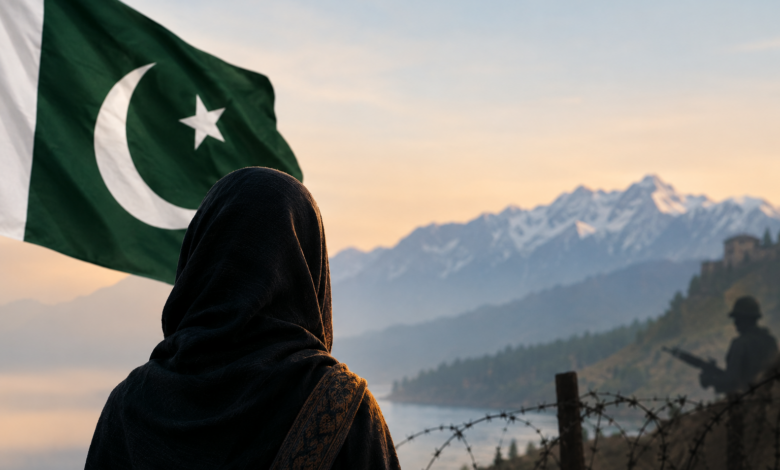
The people of Jammu and Kashmir and the people of Pakistan are interlinked with each other in unbreakable bonds of history, religion, geography, economy, culture, and ethics. Their destinies are common, and their hearts throb in unison. If the people of Kashmir look up to us with a sense of affiliation and hope, they have every right to do so. The people of Pakistan gained independence six decades earlier, and the people of Kashmir are still fighting for freedom. If the leadership in Pakistan has failed to be of any tangible help to them, it is definitely a matter of shame not only for the leadership but also for the entire Pakistani nation, who has suffered, such a regime so passively so long.
Musharraf’s regime has been guilty of criminal negligence and apathy on the issue of Kashmir. The leadership that surrenders the nation’s destiny into others’ hands cannot be expected to take decisions independently. In this backdrop, the message addressed by the veteran leader of the people of Jammu and Kashmir, Syed Ali Shah Jilani, to the people of Pakistan on the auspicious eve of Eid al-Adh’ha, 21 December 2007, has touched the hearts of every conscientious Pakistani. Syed Jilani said:
“Neither the oppression and tyranny of India could cow down the people of Kashmir, nor the apathy and betrayal of the Pakistani rulers would ever deter us from our goal. Pakistan is the fortress of Islam. Unfortunately, however, the custodians of this fortress are following the policy of continuous retreat. We are Pakistanis from day one and would continue to fight till the last drop of our blood for the sake of Pakistan’s integrity, safety and completion of the partition agenda. As you will be going through my message, the Islamic Republic of Pakistan would definitely be busy celebrating the Eid. I can clearly see the land of my dreams blooming with joy in my vision. Before the birth of Pakistan, I spent my early days in Lahore for primary education. Even after a lapse of 60 years, the scenes of those lanes, streets, and side-alleys are vivid in my memory. There is no doubt that we love Pakistan to the extent of madness, and this love is not due to the love of a piece of land, colour, cast or language. This is the love that emanates from the bonds of Islam in which Allah subhānahū wa ta’ālā has tied us together. I am sincerely of the view that if it is not possible for the time-being to resolve the Kashmir issue according to the Kashmiri people’s aspirations and desires, we may better wait for an opportune moment instead of inflicting on them an undesirable solution. Neither are we exhausted nor have lost courage. We remain undeterred. Our young, old, and the honorable womenfolk are continuing the struggle resolutely and with courage. I offer Eid felicitations to the people of Pakistan on behalf of myself, the Hurriyat Conference and the steadfast people of the State of Jammu and Kashmir.”
The message instills within us hope, resolve, and a spirit of sacrifice in line with the spirit of the occasion. It also shows us the way how to brave the storm and do our bit for the Kashmir cause. Viewed from social, sociological, political, and economic perspectives, the Kashmir cause is, in fact, the cause of Pakistan’s life and death. Allama Iqbal, in his remarkable lines on Kashmir, regretting its pathetic socio-political condition, and had lamented that the ‘Little Iran’ (Iran-I-Sagheer) should remain hapless and in chain. He gave us a message similar to that of Syed Jilani to rise up from our apathy and move forward in line with the Shabbiri tradition (the tradition of sacrifice set by Imam Hussain).
On 25 December we celebrated yet another event of national significance, i.e., the birth anniversary of the Quaid-I-Azam, as has been customary with us every year. The need of the hour is, however, that we should keep before ourselves the Quaid’s vision on Kashmir and renew the pledge to save our ‘jugular vein’ from the clutches of the oppressor. How sad it is that our rulers are totally oblivious to this vision and its imperative needs. Unmindful of the people’s aspirations, they continue pursuing pro-India policy. Not that they have no respect for popular sentiments on Kashmir; they are apparently too myopic to see the adverse impact of such a policy on the country’s economy, polity, civilization and culture.
In the following paragraphs, I am reproducing some telling excerpts from the Quaid’s statements and messages, which so vividly bring home to us the facts that Syed Jilani has spoken now. His words actually reflect what the Quaid said much earlier. These sayings of the Quaid should serve as eye-openers to help us ponder and think how long are we going to put up with the rulers, who yearly celebrate his anniversary with traditional fanfare and go to personally lay the wreath on his mausoleum but fail to do what he would have desired them to do.
Addressing the All-India Muslim League’s session in Patna on 26 December 1938, the Quaid said:
“Let me ask the Congress, what are they doing in Kashmir? The Arya Samajists, the Hindu Mahasabha and the Congress nationalists, as also the press, subservient press of the Congress, why are they silent about the affairs of the Kashmir State? Is it because the vast majority of the subject people of Kashmir State are Muslim?” (Speeches, Statements & Messages of the Quaid-e-Azam, collected and edited by Khurshid Ahmad Khan Yusufi, vol.II, p.913)
Replying to the address of welcome by the Muslim Students’ Federation in 1944, the Quaid-I-Azam reaffirmed to the Muslims of the State of Jammu and Kashmir that:
“Muslims do not go by geographic boundaries. This is why the Muslims of India are ready to come to your help. If you are subjected to oppression and maltreatment, we cannot remain silent spectators. In such an eventuality, the Muslims of British India would at once be at your service, because this is our duty as Muslims.”
Our rulers today are afraid of the very word Jihad. They do not just feel shy of mentioning it but have borrowed the epithet ‘terrorism’ from their foreign patrons and do not feel ashamed of labeling those as ‘terrorists’ who are fighting for their birth right, the independence of their land. We owe our liberated part of Kashmir and, in fact, the resurrection of the Kashmir issue to the Mujahideen. The valiant fighters from our tribal areas, whose elders gave us the vast tract of land extending from Gilgit and Baltistan to the banks of River Tawi at the cost of their precious life and blood, stand today badly brutalized. Their innocent men, women and children were killed in their own homes and schools by no enemy fire but by the poundings of Pakistan’s own gunship helicopters and artillery. These brave warriors for the cause of freedom, who have traditionally remained loyal to Pakistan and all its national causes, have been reduced to the status of terrorists and militants. Reacting to the Indian Governor General Mountbatten’s demand to take action against the ‘invading tribesmen’ from Pakistan for their participation in the Kashmir Jihad at the call of the oppressed people of the State, the Quaid-I-Azam declined the demand and said:
“We are not ready to accept this responsibility. Nor can we put the tribesmen under pressure to leave Kashmir. The Muslims of Kashmir, engaged in Jihad against the oppressive Dogra rule of Hari Singh, needed help, and our tribesmen, being bound in ties of faith with their Kashmiri brethren, rushed to their help. We are not willing, therefore, to interfere in any manner in the matter. For the Mujahideen it is a war of liberation, and no freedom-loving country can strengthen the hands of the enemies of those fighting for their independence. How can we force tribesmen whom the British government failed to subdue? They are engaged in a just struggle and for a right cause.” (Rash’haat-I-Quaid, by Najmah Mansoor, Al-Abd Publications, Sargodha, 1992, pp. 167-168)
The Quaid did not just send Mountbatten a befitting reply, he also explained to him the crux of the matter: “Kashmir is a part of Pakistan not just economically and socially, its accession to Pakistan is essential from the political point view as well”, he said. He further told Mountbatten:
“The people (of Kashmir) have repeatedly appealed to the Maharaja to join Pakistan. But his reaction was always adverse, and he tried to crush the people’s voice by brute force. This compelled the people to respond with whatever force they could muster. When the Maharaja could not bear the brunt and saw power slipping out of his hands, he rushed to join India. Factually, it is not Kashmir, but it is Hari Singh who has joined India. Now that the people of Kashmir have been forced to take up arms against Hari Singh’s decision of accession, it would not only be farcical but also ridiculous to ask them to exercise their will whether they wished to join Pakistan or India.” (Rash’haat-I-Quaid, by Najmah Mansoor, Al-Abd Publications, pp. 167-168)
In a press statement following his talks with Kashmiri Muslim Leaders, the Quaid said (11 July 1947):
“I hope that the Maharaja and the Prime Minister of Kashmir will realize the fast-changing circumstances and the wisdom demands that the feelings and sentiments of the Muslims, who form 80 percent of the population, should not be ignored, much less hurt.” (Quaid-I-Azam Muhammad Ali Jinnah: Speeches and Statements – 1947-48, pp 23-24)
Sharply reacting to the Maharaja’s press statement accusing Pakistan of alleged involvement in the occupied State, the Quaid-I-Azam reminded him:
“The course which your government is pursuing in suppressing the Muslims in every way, the atrocities which are being committed by your troops and which are driving Muslims out of the State, the various indications given in the Press, particularly the release to the press of your Prime Minister’s telegram addressed to me containing unfounded allegations and threat to enlist outside assistance, show clearly that the real aim of your government’s policy is to seek an opportunity to join the Indian Dominion as a coup d’etat by securing the intervention and assistance of that Dominion. This policy is naturally creating deep resentment and grave apprehension among your subjects, 85 percent of whom are Muslims.” (Quaid-I-Azam Muhammad Ali Jinnah: Speeches and Statements – 1947-48, telegraphic message to the Maharaja of Kashmir, 26 Oct, 1947, p.91)
Dr. Ilahi Bakhsh, personal physician to the Quaid, in his memoirs, Quaid-I-Azam kay Aakhri Ayyam, quoted him elucidating his policy on Kashmir in following words:
“Kashmir is Pakistan’s jugular vein, politically and military. No self-respecting country or nation can for a moment offer its jugular vein to the enemy sword. Kashmir is a part of Pakistan, and as such it can never be separated from it. The Kashmir issue is extremely serious, but no justice-loving nation or country can overlook the fact that it is a part of Pakistan socially, morally, culturally, civilizational, geographically, and economically. Whenever one would look at the map, this fact would be glaringly evident to him.”
This is the Kashmir policy, which the founding father has bequeathed to us, and which would continue to enjoy popular consensus, both in Pakistan and Kashmir. It is in pursuance of this policy that the people of Jammu and Kashmir have been engaged in their war of liberation since 1947 and for which they continue offering sacrifice till date. Our present rulers are guilty of a great betrayal of the Kashmir cause. They have deviated from this policy and continue taking dictation from their mentors abroad, as a result of which they have greatly disappointed the people of the occupied State. We must thank Allah subhanahu wa taalathat the people of Jammu and Kashmir have not yet lost courage and remain resolute to fight till the last drop of their blood, irrespective of what the Pakistani rulers do or do not. The situation demands the Pakistani nation to see if it can ignore even the call of the Holy Quran to side with its oppressed brethren:
“How is it that you do not fight in the way of Allah and in support of the helpless men, women and children who pray: ‘Our Lord, bring us out of this land whose people are oppressors and appoint for us from yourself, a protector, and appoint for us from yourself a helper’?
“Those who have faith fight in the Way of Allah, while those who disbelieve fight in the way of taghut (Satan). Fight, then, against the fellows of Satan. Surely Satan’s strategy is weak.” (Surah: 4, Al-Nisa, Ayat. 75 & 76)