
KEMALIST TURKEY
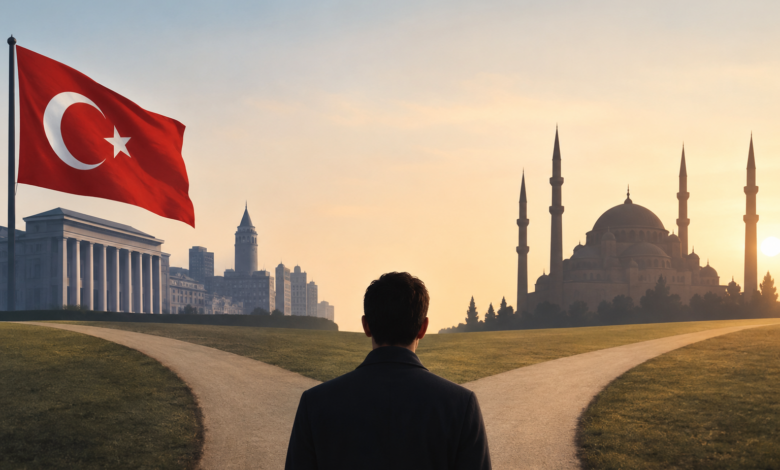
The article was penned in the last week of January, much before the recent pact between Turkey and Pakistan was concluded, and this article discusses the problem in principle and makes no reference to the said pact. The kernel of the problem discussed here is: imitation of Turkey in the cultural field, which is tantamount to aping the West but in a more stupid way.
Turkey’s destiny is writ large on the horizon. Its mission is as clear as anything. The problem before her is not to choose between Kemalism. Communism or any other ‘”ism”. The problem before her is to translate the Islamic ideology into the terms of reality, to establish the Islamic way of life. Both do not stand at the same point of their history!
Western Civilization A Mirage
Turkey decided to WESTERNISE in the early twenties, a period when Western civilization was at its zenith, when hopes were high, and the inherent fallacies of that secular civilization had not manifested themselves. The outer sheen of scientific progress had dazzled the eyes of all and sundry, and everybody was willy-nilly singing the hymns in praise of Europe. But now the tide has taken a turn. The weaknesses of Western civilization have become manifest. The tree has borne fruit, and the fruits are bitter! The disaster which has been spelled by the secular principles of the West have even baffled the sons of this civilization. The bottom has been knocked off their ideology. They are at their wits’ end.
In the words of Mathew Arnold;
“the world which seems
To lie before us, like a land of dreams,
So various, so beautiful, so new. Hath really neither joy, nor love, nor light,
Nor certitude, nor peace, nor help for pain,
And we are here, as on a darkling plain
Swept, with confused alarms of struggle and (light,
Where ignorant armies clash by night.”
Today the historian says that the century has failed to solve the problems of man. J. J. Saunders observes that:
“Five centuries have now passed away since the reawakening of cultural life in Italy, which we know as the Renaissance, ushered in the most brilliant and fruitful period of Western European history. Today the universal mastery in science, in thought, in art and in literature, which our continent seemed to have attained in the nineteenth century, is threatened by assault from without, by disintegration from within. Faith in unlimited and uninterrupted progress is dimmed; the world war destroyed the hopes of perpetual peace and prosperity; national hates and rivalries are intensified rather than diminished, and the gloomy prophesies of “the decline of the West” are something more than the fancies of a few eccentric philosophers”
All great minds see these days as perilous. Spongier believes that West is at the winter of civilization; Fisher, the present ago is witnessing the death-rattle of European civilization; Sorkin, that we are at the end of sensate culture; Berdyeav, at the end of the days of reason illumined by faith; Toynbee at the last period of crises; Lipman, at an hour when man feels it is no longer wise, necessary or useful to pass on to succeeding generations the good religious heritage of the past. Mumford has even said:
“Today every human being is living through an apocalypse of violence. Now, for the first time in human history there is no spot on earth where the innocent man may find refuge. Something else has been disclosed to our unwary eyes. The rottenness of our civilization itself. If our civilization should perish. This will come about in fact, because it was not good enough to survive.”
Can any sane person say that the cultural atmosphere is the same today? When the West itself is discarding those very principles, what sense is there in adopting them in the East? Are we to learn from the experience of others, or should we also follow blindly into the pit?
Geographical Location
Geographically, Turkey is sandwiched between Europe and f the Middle East. She directly came in contact with the West. The influence of Europe was direct and penetrating and the not-work of “Committees of Union and Progress” played the lioness’ role in introducing West to the masses and the intelligentsia. Moreover, in Turkey there was no popular movement for Islam. Night had fallen over the forces working for Islamic Revival. The forces of darkness and evil were, on the other hand, very active and trying their level best to drift the people away from Islam. It is not possible to deal here with the systematic and calculated process of secularisation of Turkey, but readers may refer to the recent thesis of Dr. Uriel Heyd, on “Foundations of Turkish Nationalism” a work on which he has been awarded a Ph. D. This work is a marvelous study of that process.
Intellectual Transformation
How misleading and scandalous were the notions of Turkey’s leaders of thought can be are easily understood from the teaching of Zia Gokalp, the spiritual father of Modern Turkey, who reinterprets the Kalma as:
“In the bodies there is multiplicity.
In the hearts there is Unity,
There are no individuals; there is (only) society.
There is no God but Allah.”
Society is Allah, is his view. He “proves” from the Quran that secularism is right. Dr. Uril Heyd writes:
“Now the time has come, Gokalp maintains, to separate the spheres of activity of the secular and religious authority. The legislative powers of the nation should not be limited by common law. There can be no strong and independent state ‘which does not make its laws itself, but regards them as sent from heaven and as unchangeable’ (see poem Mesihat). Although this principle is in obvious contradiction to the essence of Islam, Gokalp claims support for it from the Quran, which says: Obey the word of God and the word of the Prophet and those in authority among you.’ Gokalp comments: In matters of belief and worship, the Quran and Sunnah decides, and in case of doubt the Muslim has to ask for the advice of a Mufti. But legislation is the function of the secular authorities (Ululemir) the state.”. (Foundations of Turkish Nationalism p. 89)
In Turkey, Islam was a pious relic of the past, and no renaissance movement was existent. With Pakistan, the case in otherwise. Pakistan owes its existense to the religious urge of the people to see Islam bloom and rule the destiny of this country. The literary endeavours of Allama Iqbal and Maulana Maudoodi and a host of other Islamic thinkers and the religious complexion of the Pakistan Movement have set history on another course—it is advancing towards Islam. And here, the Westernised Muslims have to seek refuge under the shelter of Islam and the Islamic constitution. Are the conditions not radically different?