
THE PROMISE OF A BRIGHT FUTURE
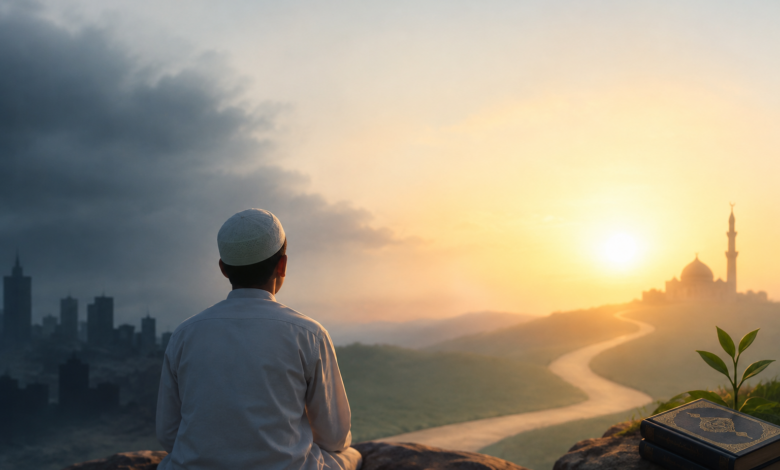
It would not be an exaggeration to say that whomever you talk to about the struggle of life these days would almost invariably state that the situation is very bad, there is darkness all around, and, with the exception of a few, everyone is in the throes of problems, helplessness, and despair. The situation has come to such a pass that what was even unthinkable in the Muslim society, that is, committing suicide and going for self-immolation, is not only happening now but also registering an increase with each passing day. Is it misplaced, then, to talk of ‘bright future’ in these dismal conditions?
The truth is that the need of having a concept of the future, especially a better and bright future, and the determination to march toward it becomes even more manifest in conditions of despair and despondency. Without the resolve to make the future better than the present, and readiness to strive for this purpose, there remains no possibility for darkness giving way to light, for the situation to become better. The very incidence of darkness and gloom necessitates that there should be a desire to improve the situation, to look for brighter prospects, and to work toward that end. The way to improvement and progress is opened by determination and struggle to mold the situation along the right direction; it does not come by surrendering and giving in the face of adverse conditions. This is the way to live truly; to rise from low levels to high places, to change the lot of one’s own and other oppressed nations.
There is no other way to this, especially for a Muslim individual, a Muslim country, and the Ummah, the Muslim community, as a whole. It is, however, necessary for us to have a correct perception of ‘bright future’ and a true understanding of the factors and steps that are needed to make the future bright; a realization that we have not only to struggle for making this perception of ‘bright future’ a reality, but we also have to meet all its demands. Therefore, along with a true discernment of the nature and extent of decline and adverse conditions, it is necessary to have a real understanding of the required strategy for the realization of the cherished goal of a ‘bright future’.
A Real Perception of Future:
The first question is: What is future? We should first know the scope and dimensions of the ‘bright future’ we are talking about. This world is a temporary abode. Not only for individuals, but for nations as well, it has ‘limited opportunities’. If there really is a future, it is in the hereafter (Akhira), which would stay forever. Therefore, success in the hereafter is the real success. Yet, success in the hereafter depends on the right ordering and disciplining of mortal life in this world. The world is like a field for cultivation, while its harvest, the end product or fruit or, to use the contemporary corporate term, its market, is Akhira. It needs to be understood fully well that only that future is bright that turns out to be bright in the hereafter (Akhira). May Allah protect us against the future that is ‘doomed’ in the hereafter!
When we contemplate this subject, individually or collectively, as a group or a nation, as a Pakistani or a member of the Muslim community, we should realize that real success lies in the life in the hereafter. We should, for that reason, aim for it. Whatever the difficulties in this worldly life, whatever hardships we may have to face, and whatever problems and troubles we may come across, even our apparent failures and disappointments are all transient, temporary, and unreal. Since it is the success in the life in the hereafter that is the real success, the ‘bright future’ we are looking to, talking about, and praying for is the success in the hereafter.
It is one of Allah’s blessings on us that, knowing our weaknesses, He shows in this temporal world signs and glimpses of the real success in the hereafter; we may enjoy a share of that in this world. This is why an important aspect of Islam’s revolutionary message and mission is that the development of life in this world, attainment of justice and good in this life and their domination may become a prelude to success in the hereafter. This message and mission are different from other religions and philosophies, because it gives tidings of
‘lose not heart, nor fall into despair, for you must gain mastery if you are true in Faith’
That means: you can achieve success in this world as well, provided you adopt the character and posture of true believers. Conditions can change here too, darkness can give way to light, the earth can ooze out its wealth for you, and the sky can shower its treasures on you, and thus, this life can be a starting point for success in the life in the hereafter. While the end is in the life in the hereafter, a start can be made from here, since it is a flow and a continuation of life. From this perspective, to desire for a bright future in this world, too long for it, and pray, to struggle and strive for it is, in fact, a part of Islam’s mission.
In the light of the Qur’an, this is why we have been given the mission and goal in the form of the prayer:
“Our Lord! Give us good in this world and good in the Hereafter, and defend us from the torment of the fire.”
Qur’an has given this good tiding to those who observe piety:
“If the people of the towns had but believed and feared God, we should indeed have opened out to them all kinds of blessings from heaven and earth; but they rejected (the truth), and We brought them to book for their misdeeds.”
About the struggle between the truth and the falsehood, Allah’s promise is unequivocal:
And say:
“Truth has arrived, and Falsehood perished; for Falsehood is (by its nature) bound to perish.”
It is Allah’s ordained law and histories witness that:
“We hurl Truth against Falsehood, and it knocks out its brain, and behold, Falsehood does perish.”
Allah’s promise is:
“Already has Our Word been passed before (this) to Our Servants sent (by us), that they would certainly be assisted, and that our forces surely must conquer. So, turn you away from them for a little while, and watch them (how they fare), and they soon shall see (how you fare)! Do they wish (indeed) to hurry on Our Punishment? But when it descends into the open space before them, evil will be the morning for those who were warned (and heeded not)! So, turn you away from them for a little while, and watch them (how they fare), and they soon shall see (how you fare)!”
The Holy Prophet (pbuh) and the Islamic movement are addressed and reminded that:
“Call to mind when you were a small (band) despised through the land, and afraid that men might despoil and kidnap you; but He provided a safe asylum for you, strengthened you with His aid, and gave you good things for sustenance, that you might be grateful.”
The tiding of domination of the Truth is given in all revealed books:
“Before this we wrote in the Psalms, after the Message (given to Moses): My servants, the righteous, shall inherit the earth. Verily in this (Qur’an) is a Message for people who would (truly) worship God. We sent you (O Muhammad!) as a Mercy for all creatures.”
Success in this worldly life, as well as tests and trials, are bound to happen for the believers:
“It may be that your Lord will destroy your enemy and make you inheritors in the earth; so, He may try you by your deeds.”
This struggle between the truth and the falsehood is strewn with ups and downs. Success and failure both are encountered, and the goal is not achieved without going through this process. Yet, the struggle that is waged with loyalty and perseverance will ultimately result in success:
“If a wound has touched you, be sure a similar wound has touched the other people. Such days (of varying fortunes) we give to men and men by turns: that God may know those that believe, and they He may take to Himself from your rank’s witnesses (to Truth).”
Waves of opposition only increase the believers’ determination and resolve, trust and belief; and when they show perseverance, Allah’s blessings come to their aid, and they emerge successful and victorious:
“Those to whom people said, ‘a great army is gathering against you, so be fearful of them’, but it (only) increased their Faith, and they said, ‘for us God suffices, and He is the best disposer of affairs.’ And they returned with Grace and Bounty from God: no harm ever touched them, for they followed the good pleasure of God; and God is the Lord of bounties unbounded.”
It is also Allah’s promise:
“Their intention is to extinguish God’s Light (by blowing) with their mouths, but God will complete (the revelation of) His Light, even though the Unbelievers may detest (it). It is He Who has sent His Apostle with Guidance and the Religion of Truth, that he may proclaim it over all others, even though the Pagans may detest (it).”
Then, the Believers are called for Jihad, which is a means to and guarantee of great success, and promised ‘another’ favour:
“And another (favour He will bestow), which you do love: help from God and a speedy victory. So, give the Glad Tidings to the Believers.”
Difficulties and hardships certainly come in the way, but if we persist in our struggle with complete trust in Allah and do not swerve, Allah gives relief and paves the way for success:
“After a difficulty, God will soon grant relief.”
The most important thing is not to fall into despair, to keep trust in Allah, and to continue to struggle in all circumstances. The biggest source of strength for believers and Muslims is their association with Allah, who has promised a bright future for the believers and the pious everywhere, here or hereafter. If the believers struggle in a proper way, they would achieve success in this mortal world as well, in addition to the real success they would meet in the hereafter. So, however adverse and difficult might be the circumstances, there is no room for despair for Muslims. In the words of the Holy Qur’an, the doors of Allah’s mercy are always open, so a Muslim should not lapse into despair, since it may also lead to disbelief! A true believer always keeps his eyes on Allah’s promise, His aid and support, His protection and shelter, His pleasure and blessings. And this is what makes every moment of his life bright and every step a step towards a bright future. This is why success in this life, if it is meant as a sequence to the success in the hereafter, is itself a cherished item as a means to the real success. It is something not to be disregarded or overlooked. Yet, it is the success in the hereafter that provides the standard, and that should be cherished as the real goal. It is because if our whole life here is spent in difficulties for achieving success in the hereafter, this would not be a failure. It is rather a move forward towards light, a bright future, and the real success. It is, however, Allah’s big favour, his munificence and kindness, that, for our weakness, He did not put us in trials beyond our strength and endurance. With due regard to the nature of man, He has promised us power and authority. To proclaim the Religion of Truth over all others is His Will and a promise made to us. These all things are destined to be our lot; they are part of our history and our struggle.
A believer should not give into fear or doubt, even for a moment, about the reality of a bright future. There are, of course, difficulties, problems, and hardships, but, along with this, there is the strength that a believer derives from his Faith, trust in God, His promise, ‘despair not of the mercy of God’; not only to dream about a bright future but to struggle for it are all part of the Muslim character. So, however trying might be the circumstances, however gloomy a situation might appear, our eyes should be fixed at the bright future that Islam holds for us.
Is it not a fact that when our Prophet (pbuh) started this mission, began to spread this message, he and his companions faced unprecedented hardships. Abu Zar Ghifari was tortured for embracing Islam. Another man comes from afar and accepts the call of Islam, and the Holy Prophet (pbuh) asks him to go back to his town and wait for the time when this religion would prevail all around. The Prophet (pbuh) addresses the leaders of the tribe of Quraish and says: Should not I tell you a ‘creed’ by which you would rule the Arab and the rest of the world? It is a time when Muslims were being tortured; suppression and oppression had reached such an extent that Companions of the standing of Khabab could not help wondering: O Prophet of Allah! When will come Allah’s aid? And the Prophet would reply: Khabab! Have you become tired so soon! Don’t you know what ordeal the people before you went through? Their flesh was separated from their bones with iron combs and their bodies were cut into two from head to toe with blades, but they persevered in the way of Allah. What needs to be noticed here is that the Holy Prophet (pbuh) did not stop here, but said: By God! A time would come when a lone traveler would travel from Suna to Hadhr-Maut without fear or terror; he would have no fear save Allah’s. History bears it out that such a time did come when the condition of ‘provision of food against hunger, and security against fear of danger’ prevailed everywhere.
Then, there was a time when the Holy Prophet (pbuh) had to leave Makkah. Apparently, these were very trying times when one’s own homeland had to be abandoned. Yet, when Suraqah reached the Holy Prophet (pbuh) after a long chase that also transformed his life, the Holy Prophet gave him the glad tidings of being given the gold ornaments of (the Persian ruler) Kisra. The contrast of the trying times with the confidence with which Kisra’s gold wristlets are being promised is worth pondering. Then, the history did bear witness to the fact that the wristlets were really given to that man! By Allah’s will!
My talk about a bright future is not a figment and invention of some poetic imagination. Allah’s book and His Prophet’s teachings both assure us that people who are given the wealth of Faith never give in to despair or fear, howsoever adverse and unfavorable the circumstances might appear.
History’s Witness:
A glance at history would reveal that ups and downs, rise and fall of nations, high and low points, episodes of successes and failures, and the unending sequence of victories and defeats are all present as a view of Allah’s promise. In the known history, we find stories of at least 36 great civilizations that all passed through these phases. At its peak time, every civilization saw itself as the greatest with no competitor or challenger to its position. But history saw it disintegrating and falling apart as other civilizations emerged to replace it. The flow of time with ‘days of varying fortunes’ continues still. Prophet Eisa, the Christ, had told the truth when he said that many who are advancing ahead would lag behind and many who are lagging behind would move ahead.
Qur’an says that ups and downs and phases of success and failure, of growth and decline, of life and death visit nations. History shows this amply clearly that times never remain the same; neither the rise nor the fall is lasting, circumstances keep changing all the time. So, living through a certain situation, it is wrong to think that we are destined to live with it, that there is no way out of it; we are doomed to this situation, and we can live only as subjects of others! Whoever casts a glance at history cannot give in to such a mistaken notion.
Not the whole history, but just have a glance at the recent history. There are many people, and I include myself among them, who themselves witnessed the might of the British Empire, which considered itself the ruler of the world, and thought that it had a claim on power and domination in the world. It was so haughty that it invented a new idiom in the English language: Sun never sets on the British Empire. For its domination over one-fourth of the world, it felt it was in a position to claim that the sun never sets in its domain. If it sets in one place, it rises from another!
But then, we saw that the Empire soon became an episode of the past, in a matter of a few years. From the position of a superpower, it was reduced to a kingdom over just one and a half isles. Now, the sun does not rise in its realm for many weeks at a stretch!
The Empire had also introduced a new phrase in the English language: Britannia rules the waves. But we all witnessed that ‘Britannia had to waive the rule’ soon, when the sea got out of its control! So, these are the high and low points, twists and turns, which show how the arrogance of the arrogant meets its fall and how oppressed people can come to power. These are the signs for everyone to see!
Only recently, America and Soviet Russia were competing with each other as superpowers. We have not forgotten the episode when the Soviet leader Khrushchev put his feet on the table in the hall of the United Nations and said: I have come here to bury capitalism. Then, what we saw was that the Soviet Union disintegrated itself. So, domination of a power at a certain period of time is not something that, for a moment, should be considered ‘everlasting’. Power, authority, and domination are all transient. We have ourselves witnessed this for a fact, and I am sure we will still witness many similar episodes with our own eyes. It is, therefore, incorrect to say that such and such power would retain its domination, simply because it happens to hold power for the time being.
Now, go through the history of your own country. Is it not a fact that in his very first statement, a dictator (Sikandar Mirza), after usurping power and amok with it, had bragged to ‘send these Maulvis to the other side of the river in boats.’ But what actually happened? Maulvis are still here, while he himself had to leave the country within one month’s time! Every ruler claimed that ‘his seat was strong, and no one could shake it’. But let us find out which seat did really last for long? Whether you look in the larger background of history or view the events of contemporary times at the global level, or count the ‘turn’ of times in your own country, there is no room or reason for despair and despondency anywhere!
There is no denying that darkness does prevail at times, defeats do confront people, but there is always a possibility of rise after every fall, of success after every failure, of victory after every humiliation. Did not the Holy Prophet (pbuh) himself face embarrassment at Uhud after the high mark at Badr? Is it not a fact that Makkah was conquered after the Hudaibiyah? Did not Hunain happen after the conquest of Makkah? These turns, ups and downs, are part of life. But to consider any of these to mean that nothing would now change, to lose heart, to give in to despair is not a Muslim’s character. Those who know the history, who have an understanding of the ups and downs in human life, would never entertain this notion. Why should we commit the blunder of according a permanent and lasting status to something that is only temporal and transient? We should view the event in its actual context, and in its light should determine our attitude, plan, and strategy.
A Positive View:
Contemplating on these irrefutable facts and Allah’s promise that Truth will prevail and Falsehood will perish, we should never forget that it is also a reality that we need to continually assess the situation with utmost honesty and without any letup. No individual or nation can meet the demands of time by indulging in wishful thinking. This is the reason why Allah Himself commented in the Qur’an on the events that happened during the lifetime of the Holy Prophet (pbuh), held accountability, and taught lessons for the future. There is wisdom behind incorporating these comments into the Holy Qur’an, so that men do not fall prey to wishful thinking. We have been told that, even in the presence of the Holy Prophet, when people ignore realities, deviate from the prescribed path, or slack in their duties, tables can be turned on them; a hard-won near victory can end up in an embarrassing situation and defeat. Similarly, by heeding to the call of the Messenger, an apparent defeat can be turned into a resounding victory. These all things have been preserved in the Holy Qur’an so that we could determine our way of thinking, assess the prevailing situation in all circumstances, carry out stock-taking and hold our own accountability, discern the demands of the time, and chalk out our course of action and our strategy.
These days we are passing through a critical phase. Yet, it has some positive aspects in its folds. One of these positive aspects is the numerical strength of Muslims in the world, which, with about 1400 million people, accounts for one-fifth of the world’s total population. This is no small thing. We have just emerged from under the oppressive colonial rule of 250-300 years. The whole Muslim world was under the colonial rule, and we were not allowed to breathe freely. But, before our own eyes, the clutches of colonialism became loose, shadows of slavery and subjugation gave way to freedom, and 57 independent Muslim states emerged on the map of the world. Some 900 million Muslims live in these independent states, while 400-450 million live in the form of 90-95 Muslim communities in non-Muslim countries. This numerical strength is an important reality in all respects. Such a big number and their strength play an important role in deciding the future of the world economically, militarily, and ideologically in all respects.
Also, have a look at their geographic location. About 33 percent of the world’s total area is under the Muslim rule. This whole expanse is rich in natural resources. We hold almost 80 percent of the world’s energy resources. All the important routes, with respect to economic and military viewpoints, pass through these regions. Whether the passages are through the land, the oceans, or the air, Muslim countries hold a central position.
Yet, it is also a fact that what we are calling ‘independence’ is not a real independence. Only outwardly, in legal and political terms, we have come out of the colonial yoke. But its influence on thought, civilizational view, imbalance in military and economic power, along with the current trends of globalization and the emergence of a global system in which a superpower dominates militarily and politically while the Western civilization pervades thought and culture, science and technology for all these factors, Muslim countries’ independence could not become real independence. In other words, colonial domination has not yet ended fully.
In the meantime, colonial domination has undergone a basic change, which is important to understand. It can be said with certainty that a country cannot keep the world under its control, no matter how strong it might be militarily. We have been at the receiving end, and paying the price for what Mr. Bush has been doing for the last four or four and a quarter years. Yet, whether in Afghanistan or in Iraq, the superpower has not been able to do all that it wanted to do and is compelled to admit its limitations of power. It cannot do all that it wants to do merely on the notion of its might; where it has managed to get some control with brute use of force, its hold of power is at best shaky and very limited, and it has been paying a heavy price for it. It faces resistance everywhere, which is becoming more and more effective and assuming a national character. The might of a superpower can be checked by putting up resistance, not by surrendering to it and accepting its slavery. While the events of 9/11 have many negative results, it is also a fact that it has not been possible for the superpower to have its way in all fields. Have a look at the war against terrorism, and you would feel that the world has become more insecure than it was before 9/11. The resort to brutal use of force and indiscriminate bloodshed has ruined the whole Afghanistan. About 20,000-25,000 people were killed in Afghanistan, whereas more than 100,000 citizens were martyred in Iraq. Yet, the superpower itself is not secure in either country in spite of its applying all its might and pouring all its resources.
Then, also see how a wave of awakening has been sweeping across the globe. In every poll survey, America’s increasing unpopularity and hatred against it are seen on the rise. In countries whose governments have allied themselves with it, Turkey being just an example, surveys show that 80 percent of the population is against it. In Germany and France, 60 and 70 percent of people express their displeasure and anguish against American and Russian policies. Its staunchest ally, Britain, is witnessing multitudes of people condemning American and British governments. I have myself seen how people have registered their protest there. On the second anniversary of attacks on Iraq on 19 March 2005, massive protest rallies were held throughout Europe against this illegal war.
Though our present military regime has sided with Bush in this regard, public sentiment is quite different in all parts of the country. Newsweek had recorded an interesting and attention-grabbing incident that when the commander of a Pakistani military unit that had killed 10 Afghans got himself killed, and his body was taken to his village, his father refused to participate in his funeral prayers. When the correspondent of the Newsweek asked him why he did so, he said that he had sent his son to the army with high hopes and great expectations, but not for killing Muslims. If Bush wanted to join his funeral, he might do so, but his own father could not offer prayers for the traitor! It is neither an isolated incident nor just one father’s story; it reflects the approach of the whole nation. This is how the whole Ummah, Muslims all over the world, thinks.
In the same way, Robert Fisk, correspondent of the Independent, has written an article on Afghanistan, in which he says that wherever he went, he saw tombs of people killed in US bombing. People come to these tombs in large numbers, where Fridays present the scene of large-scale congregation, and American troops do not dare to come out. See public reaction. While America has apparently gained control, blood is spilled, but people have not been subdued. We should keep in view both the positive and the negative, dark and bright aspects. We should not be obsessed or preoccupied with just one dimension. In spite of all the destruction, I see the prospects of a bright future.
However, I want to say that this bright future will not come on its own. It is Allah’s ordained law that change comes in the wake of continuous struggle, sacrifice, and steadfastness.
“This is Allah’s Will and His law, which he does not alter: No change will you find in God’s way (of dealing); no turning off will you find in God’s way (of dealing).”
What has been ordained is that you would have to strive for this bright future. You and I have to play our role, only then the future will be bright, and nothing would be able to stop it from being bright. But if we fail to play our role, or give in to despair, then this future will not be bright, it will be dark.
In every business, profit and loss both are the possibility. At times, losses occur continuously. After bankruptcy, shops are locked, and factories are closed. But does this not happen when men make efforts for profit after facing a loss? Having a loss in one business, you opt for some different business. If this is your approach in your business life, why do you adopt a different approach in political, cultural, religious life?
Being Conscious of Our Objective and Purpose:
We are destined to have a bright future, but only when we give it its due. This demands two things. The first is self-accountability; we honestly examine the causes of weakness. Then, we chalk out the right strategy for facing the challenges of the time.
Consciousness about the destination and objective—vision and view—of life are a must for struggle and its success. In more open terms, I can say that what matters is one’s Faith and Faith-based view of life and targets in life. Becoming weak in these matters is the biggest problem and biggest failure. This is what has happened to Muslims today: Allah’s book, His Prophet’s role model, our own history, efforts and sacrifices, and services and achievements of Muslim luminaries are all there to guide and inspire us, but practically we have divided life into compartments. I am not talking of those who have gone so far from religion that they hold this world their be-all and end-all; I am talking of those who offer prayers, who observe fasting, who prostrate before Allah, who give alms and charity in the way of Allah, yet they do not care that their prayers should influence their individual and collective lives. Do we discharge our responsibility by just offering prayers? Is it not so that Allah, who has required us to offer prayers, also says that: Prayer restrains from shameful and unjust deeds. Does not our prayer obligate it on us to shape our whole lives according to the commands of Allah?
We make elaborate arrangements for the advent of the month of Ramadan, arrange for Sehri (meal to start the fast) and Iftar (eat to open fast), celebrate Eid, but forget that fasting is meant to cultivate piety; that fasting is observed to uphold Allah’s Will. Qur’an has described its purpose as expressing our gratitude for the guidance we have been given in the shape of the Qur’an:
“To glorify Him in that He has guided you, so that you shall be grateful.”
In other words, fasting is to spread the message of the Qur’an, to establish the rule of Allah, and to get active in establishing Deen in the world.
Our Faith and determination to shape our lives according to the Faith is the first foundation of our strength. The need is to introspect ourselves to know the condition of our Faith, to be conscious of its demands, purpose of life, its vision and targets, and the relation between Faith and deeds. There is no concept in Islam of Faith without practice. Just as practice is impossible without Faith, Faith is incomplete without practice. Both go together. Therefore, our first major weakness is the lack of consciousness for Faith, view of life, targets in life, and destination. If we could correct this, the rest of the matters can take the right direction. Until it gets right, the dream of a bright future will remain an elusive—never to materialize.
Moral Strength:
The second basic thing, after Faith, is moral strength. Moral strength stems from Faith, and all rites of worship provide the means to cultivate it. This is the strength that teaches man not to tolerate transgression and oppression, but to challenge it. This is why Qur’an is categorical in asserting that, with high moral standing, each one of you would counter ten enemies and, with lesser moral strength, each one of you would be able to counter two enemies. (If there are twenty amongst you, patient and persevering, they will vanquish two hundred; if a hundred, they will vanquish a thousand of the Unbelievers—He knows that there is a weak spot in you, so if there are a hundred of you, they will vanquish two hundred, and if a thousand, they will vanquish two thousand). Yet, our condition is such that we cannot face even one enemy. So, our second major weakness is the lack of moral strength, which stems from Faith and sincere worship of Allah, from performing the duty of enjoining the right and forbidding the wrong, and from calling to the right path, and it grows with our sacrifices we offer in this way.
Material Resources:
The third important factor is material power. If you show carelessness in acquiring material strength and power and do not prepare yourself for standing up to the enemy, you cannot win the game merely by relying on the strength of your belief and morality. Islam calls for a realistic understanding of a given situation and stresses on giving due regard to the laws of nature.
It is Islam’s hallmark that it has combined Faith, moral strength, and material power into a unity. Allah has commanded:
“Against them make ready your strength to the utmost of your power, including steeds of war, to strike terror into (the hearts of) the enemies of God and your enemies, and others whom you may not know, but God does know.”
The command to be ready and to keep horses for war is not restricted to keeping horses; it is rather a command to have a grasp on contemporary economics, science, and technology. In a beautiful manner, the Qur’an says that you should make ready your strength as much as may instill awe and fear in the hearts of the enemy, which is not only your enemy but of God’s as well, and it includes those whom you may not even know, but God knows!
Reform of the collective system requires material power. If this power is used for upholding Allah’s Will, and is utilized for witness of truth, it becomes an act of worship. This is not seeking after the world; this is not materialism, because Allah has given all this to us so that we utilize it for those moral objectives and for the spread of the worldview that are enjoined upon us as a condition of our claim to Allah’s vicegerency on the earth.
Decline of Society and Leadership:
After the mention of these three main factors, I want to say it again that while our society still retains a lot of good in its folds, in individuals, as many like me, who have been to many parts of the world, can bear it out with me, we should also admit that Muslim society, Muslims’ system of social justice, law and morality, economy and education, are all in the state of decline. There is no use covering it up! We should realize that these are in the throes of decline. Reform of society and the state and their reconstruction is a must if we are to have a bright future. Individual uprightness is not enough; enjoining the good, suppressing the evil, organizing the society and state according to the demands of Islamic Shariah, galvanize them for this purpose are also necessary for success in the hereafter.
Then we come to the fifth factor, which is the rot that has befallen Muslims’ leadership. Here, I am using the term ‘leadership’ in its broadest sense, which includes family head, teacher, and head of an educational institution, those who occupy positions for devising economic policies, leaders in the society, and political leadership. A major problem of the Muslim world today is the rot that has set in their leadership and their being removed from the cherished standards that Islam provides. Weaknesses of the common lot are not as big a problem as the decay of the leadership. However weak the common people might have become in practicing Islamic instructions, the ideal of all their desires and aspirations remains the same: the era of the Prophet and of his righteous caliphs. If you ask an illiterate old woman about the system she wants, she would tell you she wants that system of justice that Caliph Umar had given to the world. This realization is alive among the masses. But of leadership! Its direction, its allegiance, its priorities are all rotten. There is a wide gulf between the people and their leadership; rather, there is a conflict between them. The situation has become so bad that some in leadership positions go to the extent of saying that, with the start of cutting off the hands of thieves, the whole nation would become one of handicaps. They see in the nation their own reflection! They feel no hesitation in ridiculing Islamic traditions—like beard and veil. This is a big problem, a lot of great profundity!
What is needed is a reform in all these five areas. If we ignore any of them, then ‘bright future’ can only be a desire; it cannot become a reality. None of these tasks is insurmountable, however. We have seen with our own eyes in these days of decline how people’s lives transform, how nations’ destinies are determined.
Two Examples:
When Malaysia got independence, the government of the day decided to continue the practice of the English and send school children to foreign countries for higher education. Three countries, Britain, Australia and America, were chosen for this purpose. Young people and school-going children were sent abroad in large numbers, with the view that they would return as Westernized and would spread the same lifestyle in their own country. This is how, it was thought, and Malaysians would continue to be under the yoke of slavery even after getting independence. But what did actually happen? Islamic movement there emerged from amongst the ranks of the same youth!
The experience of Algeria presents an even more surprising eye-opener. Our experience is of British colonialism, which was somewhat reasonable with its semblance of respect for the law and religious tolerance, as compared to the French, who ruined their occupied colonies not only politically and economically but also destroyed ethics, education, and even language. Algerian nation was deprived of its own Arabic language. In 1954-55, the head of the Algerian National Liberation Front came to Pakistan. I was the president of Islami Jamiat Tulaba. We went to see him in a hotel and took an Arabic translator with us. When we started talking with him, he said he could not talk in Arabic. Bring a French translator with you. Such were the conditions there!
A review of France’s media policy would disturb you because you would know that the obscene programs that were not shown in France were aired in Algeria, with the objective to destroy the whole society and give it in the throes of moral anarchy. But its reaction was such that resistance and the Islamic movement brought about a revolution in the minds and hearts of the nation. The Arabic language was revived, and the thirst for an Islamic system polled about 90 percent of the votes in favour of the Islamic Front (FIS) in the election of 1992.
Resistance:
The Real Force what Mr. Bush and his team wants to do now has always been the colonizers’ agenda: to change the system of education and secularize the schools. Jihad has been the target of the enemy’s attacks from the very first day; it is nothing new. You know that the first critical book on Islam that was written by a Christian in the second century of Hijrah targeted Jihad and the person of the Holy Prophet (pbuh). The Holy Prophet and Jihad have always been the target of attacks. Go through the history of the French, British, and Dutch colonialism, and you would find out that Jihad was the favorite target of all, be it Sansui’s movement, or Abdul Qadir’s in Algeria, or the movement in Somalia, or Syed Ahmad’s Jihad movement in the subcontinent. Everywhere, you would see, it was Jihad that foiled colonial powers’ agenda, and it was, therefore, Jihad that became their target. It is an old game; there is nothing new in it. At times, it seems that they may get along with what they want, but, in reality, the enemy’s onslaught never succeeded in altering the concept of Jihad or tainting the central position of the Prophet’s teachings. We know that even dramas of fictitious and false prophethood were staged. But nothing could slur the image of the religion of truth! Islam emerged even more powerful after every trial!
We have passed through quite difficult times in history. Perhaps the most difficult time was when the marauding armies of Genghis Khan and Halaku had reduced Baghdad to rubbles and Muslims were so hapless that, historians have recorded, if one Tatar would ask them to lie down so that he might bring his sword from his house to kill them, they would lie down until the Tatar brought his sword and slaughtered them! So miserable was the condition of Muslims. But then, the times changed. Within the next two hundred years, Islam conquered the minds and hearts of the same Tatars who had earlier conquered the Muslims! The Tatars who were spilling Muslims’ blood and pillaging their towns turned out to be totally different people. They were the rulers of Muslim lands for 400 years!
So, there is no reason to be fearful of the ups and downs of history. What is important is our attitude, action, and reaction. Slavery is not the name of being shackled and fettered in iron chains; it is about submitting to tyranny and transgression, losing the will to put up resistance to the forces of evil. Jihad is all about resistance; struggle to eliminate evil and cruel domination. Jihad is a must with pen, through speech and preaching, by spending wealth in the way of Allah, by sacrifices of life and material. These are but different forms of Jihad. The enemy wants to weaken the spirit of Jihad. Its target is our resolve to resist, our determination not to compromise with the evil, our will to face up to the challenge and not to surrender!
It is our resolve to struggle for the cause of truth and not to surrender before tyranny that is our real strength. If you have this, no force can enslave you. But if we showed weakness here, then we cannot rid ourselves of slavery, though we may have piles of gold, fat bank accounts full of dollars, and even stockpiles of weapons. So, if you ask me to answer in just one word what guarantees our bright future? I will say: Our resolve. Our resolve, determination, desire, and our resistance and commitment to accepting the path of Allah and His Prophet; to call to this path because this is what brightens our future both in this world and the hereafter.
Need for Unity:
Before I conclude, I want to draw your attention to a problem that we are faced with. One of the major dilemmas and challenges facing us today is our being divided along sectarian lines, our penchant to issue decrees against each other, our giving importance to petty issues and getting bogged down in details to the extent of overlooking the main principles. Our enemies are successfully exploiting our propensity to ignore the principles, foundations, and consensus points and, rather, indulge in petty, trivial, and irrelevant matters. This allows our opponents to get us involved in non-issues, rather than real issues, which we have to resolve mutually, being together and united. I want to give an example. America and its allies, after gaining control in Iraq, began to assert that the Shia majority and the Sunni minority in the country couldn’t live peacefully together. It is their dishonesty that Kurds, who form one-fifth of the population, are Sunnis, but they are not counted as Sunnis but as a separate entity, ‘Kurds’. Only the 22-23 percent Sunni Arabs are called Sunnis, while the rest of the population is counted as Shia. This is what we saw in Afghanistan. The population here was divided into Pashtuns and Persian-speaking Sunni and Shia, ethnic Tajik, Uzbek, and Hazara people, etc. This is what you can see even in Pakistan.
As I said earlier, it is necessary to have the right vision along with the belief. The principle that ‘what is important has to be given due importance, what is central has to be given central position’ is the main constituent of this vision. It means that we should concentrate on main consensus points, and be accommodative and tolerant in matters of details and petty differences. We should participate in discussions and dialogue, but what we need to understand is that getting lost in debate, becoming forgetful about the principles, and confusing the priorities leads to our own destruction. On the basis of my knowledge, I can tell you, honestly, that all the sects within the pale of Islam concur on 95 percent of issues, while their differences are on the rest of the 5 or 6 percent. If you really make a review of the Sunni-Shia differences, you would come to know that they differ, at the most, on 8-10 percent of issues, while they have consensus on a mighty 90 percent!
It is an irony that we ignore that common ground on 90 or 95 percent of issues, and fall prey to differences that are only on 5-10 percent of issues. We need not deny the existence of differences, but we should show tolerance and restraint in expressing our differences. If we could observe tolerance and be firm on common points, it would really be a great source of our strength. This is why I say that Fiqh does provide us with the law, guides us, and gives us a system of life; but Qur’an and Sunnah come before it, because it is based on these sources, then comes Fiqh, and history. If we could maintain this order, we would never decline. It would be a great tragedy for us if we happen to forget Qur’an, ignore Sunnah, overlook the common ground in Fiqh, but get entangled in trivia. It would be a recipe for disaster, for sure!
Imam Malik correctly diagnosed the problem when he said: What had reformed the Ummah in its initial phase would reform it in its later phases as well, i.e. Qur’an. Let’s, then, associate ourselves with the Qur’an, and rouse the urge to establish the reign of Islam. We are not to surrender to the forces of evil, but we are to raise resistance. If you study history, you will find out that all creativity comes from the encounter of the good with the evil, just as, in physics, energy is produced with friction. This struggle and encounter produce creativity in human life, and new sources of energy spring.
So, let’s march ahead with complete faith and conviction, belief and hope; make Allah’s aid our source of strength, awaken the people and galvanize them, since it is part as well as a condition for Allah’s aid to us:
“It is He who strengthened you with His aid and with (the company of) the Believers.”
We should always seek help from Allah, our Lord, keep faith in Him, and never fall into despair!