
Struggle in Kashmir-II Choice Before Pakistan
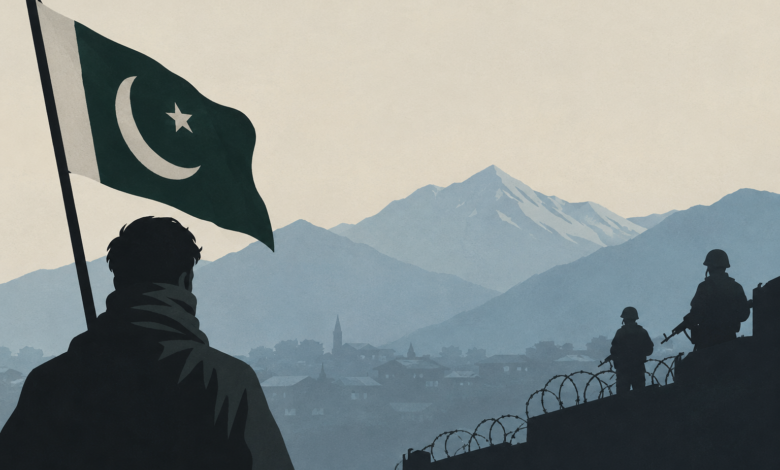
First India tried to cordon off the valley — all foreign correspondents were expelled and five draconian laws enacted. People from the outside world, international agencies, politicians, states men, journalists, aid agencies, Amnesty International and other human rights groups were not allowed to visit the valley, so that India could carry out a systematic process of repression, extermination and genocide.
Since then, about 20,000 to 35,000 people have been killed. Some 40,000 to 50,000 are missing and 45,000 have been imprisoned. An equal number of people has been disabled by torture. There are dozens of concentration camps and interrogation centers. About 3,000 women have been raped and thousands of houses razed to the ground. Crops have been burned and forests destroyed. The economy is in a shambles. A total of 480,000 Indian troops and border security forces personnel are posted in a valley whose population is four million: for every 10 civilians, there is one soldier with sophisticated arms. This is how the valley is governed.
The resistance in the valley has two major planks. First, a political alliance which was formed in early 1990 in which all major political forces like Jamaat-i-Islami, People’s League, Muslim Conference, People’s Conference, Ahle Hadith, Jamiat Ittehadul Muslimeen, Islamic Students League, Awami Majlis-e-Amal and Kashmir Bar Association joined hands. Initially, there were about 147 Mujahideen groups, but now there are only half a dozen major ones, with Hizbul Mujahideen as the largest and most effective group.
That India is unable to rule Kashmir has become very clear. I would refer to a few quotes. The human rights group of Lord Aubrey in its October 3, 1992, statement said: “India is unable to rule Kashmir. There are indiscriminate killings, large-scale torture, 17,000 killed in two-and-a-half years, 12,000 in prison and all means of torture are being used by Indian forces.”
Justice Tarkunde, who is retired judge of the Bombay High Court, says it would be very difficult to find in the majority of Muslim community anyone who does not passionately want complete independence from India.
Even Rajiv Gandhi, during a visit to Kashmir in April 1990 along with representatives of nine other political parties, said Kashmiris had changed beyond recognition.
An Indian journalist, Bidwani, in The Times of India of August 6, 1992, said the plain truth was that New Delhi’s writ no longer ran in the valley despite its overwhelming military presence.
London’s The Economist in its February 7, 1992, issue says India is in occupation but not in control. Delhi’s Statesman of August 14, 1992, noted: Excesses by security forces continue unabated.
Kuldip Nayar, who visited Kashmir in February 1992, wrote: “I have returned from Srinagar disturbed. There is a sea of change in the conditions prevailing now and what I saw during my last visit in January 1990. The city is cold and distant. The alienation is almost total.”
Let us now analyze where the resistance stands at the moment. Against Indian troops, there are some 25,000 to 30,000 Mujahedeen. Their arms, military power and technology muscle is enormous. What is it that has made Kashmir ungovernable? It is the indigenous movement involving not only Mujahedeen but the whole population. Men, women and children, all play as important a role as Hizbul Mujahedeen or anyone else. It is a national uprising, a political struggle for liberation even though they are unable to express themselves politically in the presence of forces and their repressive measures. Nonetheless, every funeral procession, every strike is a kind of vote against Indian rule.
Police in Kashmir are no longer under the control of Delhi or even the governor. The administration is paralyzed and most of the officials are siding with the Mujahedeen. Troops are demoralized. The fact is that Indian chief of the army staff had to make a statement banning the use of army for political or policing purposes. It was followed by an uproar in the Indian parliament and the Defense Minister had to hush up the matter. There were incidents where police and army clashed with each other. There were incidents where army personnel had to surrender to the Mujahedeen. The Kashmir Press recently reported the surrender of 10 troops before the Hizbul Mujahedeen.
The Indian economic cost in Kashmir has two dimensions. One is the burden on the Indian economy, which is over a hundred billion rupees a year with no hope of retrieval. Second, the people of Kashmir have refused to pay taxes, electricity or water charges. The tourist trade, fruit trade and other sources of income of both local population and Indian economy are suffering. The people have refused to keep deposit in Indian banks. They have withdrawn money from Indian banks and transferred it to Jammu and Kashmir Bank. This bank had to give Rs. 6,000 million overdraft to the Srinagar government to meet its expenses.
Despite being an indigenous national resistance, it has the moral support of the entire Islamic Ummah and complete political and diplomatic support of Pakistan. The movement has gained momentum. Now it is spreading to parts of Jammu which had been relatively peaceful in recent years.
Another noteworthy thing is that all the political elements who had been collaborating with India in the past, have dissociated themselves. A new, changed situation has emerged: I have seen advertisements in Srinagar newspapers in which hundreds of people would declare that though they were in the National Conference, in government and in Congress, they now stand with the people of Kashmir.
Even Dr Farooq Abdullah has said that if there were elections, he won’t contest. In fact, he cannot, for a revolutionary change has taken place. The old political leadership has either been made irrelevant or they have joined the new movement.
For this achievement, the Mujahedeen have paid a high price. Syed Ali Gilani has been in prison for 15 years. Over 200,000 political workers have been in prison and torture cells. Thousands have laid down their lives. Economy has been crippled. Governors Jag Mohan and Saxena in their official reports to the Prime Minister said that “by force we would not be able to keep Kashmir under our thumb.” That’s why a policy of appeasement and dialogue is being pursued and some of the top political leaders were released on March 29, 1992. Yet all politicians have come up with a common strategy: that they cannot be a party to the continuation of Indian occupation of Kashmir unless India was prepared to vacate occupation and allowed the future of the state to be decided in the light of UN resolutions.
On the question of independence, there are two things. The decision must lie with the people of Kashmir: Whatever they decide, we must respect it. But we also know that we are not operating in a vacuum. There is a long background, a very clear process which makes it patent that the whole struggle had been for a Muslim homeland: for a common, ideological and geopolitical destiny. Anything which drives a wedge therein would weaken all. The people of Kashmir want to join Pakistan. They hoist Pakistani flags. They have switched their watches to the Pakistani time. They say Islam and Pakistan are their destiny. Yet it is they who have to decide.
The Constitution of Pakistan has a very clear provision on this issue. Article 257 says: “When the people of State of Jammu and Kashmir decide to accede to Pakistan, the relationship between Pakistan and that state shall be determined in accordance with the wishes of the people of that state. The degree of autonomy, the relationship, the arrangement would be decided in accordance with the wishes of the people of that state.”
As our first choice, we should seek the vacation of Indian occupation. Afterwards, the degree of autonomy, independence and integration could be achieved through mutual consultation and in accordance with the wishes of the people of Jammu and Kashmir. Instead of wasting time in controversies, we should concentrate on this target. That is why the United Front pledged that they want revocation of Indian occupation and want Islam and Pakistan. That is a very clear-cut choice.