
An Article on the Death of Shah Ahmad Noorani
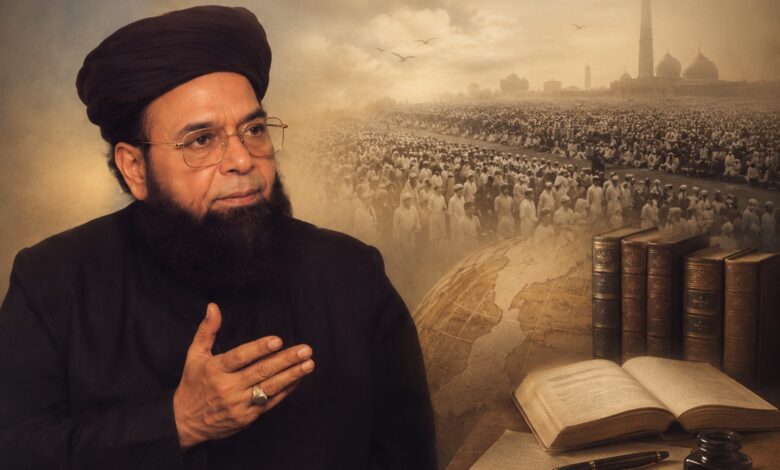
Death is a great leveler. It brings to an abrupt end all distinctions that are the stock-in-trade for human life. But there is one distinction that comes to light only when one breaths ones last: How people take that death? Every death brings wails of grief to the near and dear ones. But some deaths are mourned by the millions. Some funerals become virtual referendums through which throngs of people identify themselves with the causes for which the departed soul stood. 12 December 2003 witnessed such a popular referendum in Karachi in the form of the funeral prayer (Salat-al-Janazah) of Mawlana Shah Ahmad Noorani. In the 56 years history of Pakistan it was the third largest burial gathering in Karachi, competing with two earlier ones, that of the Quaid-e-Azam Muhammad Ali Jinnah in 1948 and of Maulana Shabbir Ahmad Usmani, a couple of years later.
Mawlana Shah Ahmad Noorani, Chairman, Muttaheda Majlis-e-Amal (Six Party Islamic Alliance) and Leader of the Opposition in the Senate of Pakistan breathed his last in Islamabad on 11th December 2003. Hale and hearty, we were together in the Senate meeting late in the night on 10th December. We had addressed a joint press conference on national issues in the Parliament building. He was supposed to join us on 12th at 12.00 p.m. for another meeting. While all were waiting for him, we received the sad news that he had stroke at 11.40 A.M and within half an hour, even before he could reach the hospital, he had traveled from the world of the mortals to the eternity. Inna Lillahe Wa inna ilaihi Rajioon (We are from Allah and to Him is our return).
Mawlana Shah Ahmad Noorani was born in Meerut (India) in April 1926 (Ramadhan al Mubarak 1346 H). His father Mawlana Shah Abdul Aleem Siddiqi and grandfather Mawlan’ Nazir Ahmad Siddiqui were renowned Islamic scholars whose fame and influence were not confined to the sub-continent. Mawlana Nazir Ahmad Siddiqui lived in Bombay and was the Khatib at its Grand Mosque Jamia Masjid. It may be mentioned in passing that the Quaid-e-Azam used to offer Eid prayers behind him and his wife Ratan Bai had embraced Islam in his presence. The Quaid had great respect for him and his son Mawlana Shah Abdul Aleem Siddiqui, whom he once called an ambassador of Islam, recognizing the missionary works he was doing all over the world.
Mawlana Shah Ahmad Noorani began his education at a mosque at the age of four and memorized the Quran by the time he was 8 years of age. After initial Quranic education he joined the mainstream education and graduated from International Arabic College, Meerut and Allahabad University. He had a great knack for learning languages and was familiar with seventeen languages. He was eloquent in Arabic, English, Persian, French and Swahili over and above his mother tongue Urdu. He took active part in the Pakistan Movement and dedicated himself to the mission of Islamic Dawah by joining with his father in his international missionary activities spread over some fifty countries of the world. After the death his father in 1954 he took over his mission later on he was elected as chairman of the world Islamic mission, a responsibility he shouldered till his last breath.
Maulana Noorani came in active politics in 1970, when he was elected to the National Assembly of Pakistan and ever since his contribution in making Pakistan a truly Islamic democratic State was immense. He played a leading role in the framing and particularly in shaping the Islamic character of the 1973 Constitution. He was a prime mover of the historic constitutional amendment that was unanimously passed by the two Houses of the parliament declaring Ahmadies non-Muslims. He along with Mian Tufail Muhammad, Mufti Mahmood and Prof. Ghafoor Ahmad piloted the Nizam-e-Mustafa Movement in 1977 that lead to the overthrow of the Bhutto regime. But perhaps his most over-arching and ever-lasting contribution lies in forging unity amongst all scholars of Islamic Thought in Pakistan both at the religious level in the form of Milli Yakjehati Council to contain and curb sectarianism, and at the political level, in the form of Muttahida Majlis-e-Amal, which has changed the complexion of politics in Pakistan.
My own first contact with Mawlana Shah Ahmad Noorani was rather indirect, when I met his illustrious father Mawlana Abdul Aleem Siddiqui through the good offices of his son-in-law and my respected friend and senior colleague Mawlana Dr. Fazlur Rahman Ansari, editor Voice of Islam, and lecturer in the University of Karachi. I was deeply impressed by the missionary activities of Mawlana Abdul Aleem Siddiqui and had learned a lot from the magazine al-Islam that was published under his patronage in the 1930’s from Singapore. It was my first meeting with him primarily to pay my respects to a great religious scholar and spiritual mentor. Shah Ahmad Noorani hardly spoke a word but his disciplined behavior in the presence of his father was the first impression. Then we met again and again in 1980’s and 1990’s, both in Pakistan and in the UK. He was kind enough to visit the Islamic Foundation in 1995. During the last few years because of the activities at the Milli Yakjehati Council and MMA we were spending hours together. Last one year in the Senate I was working very closely with him and was deeply impressed by his compassion, love, sagacity and prudence. He had enormous negotiating skills and could not only convince but convert his adversaries. Very soft spoken yet very firm in his conviction and convincing in his arguments. He was loved not merely by his Mends, even those who opposed him, respected him for his knowledge, integrity and humanity. There was a time when he was identified for his role as the leader of a particular school of thought, but it goes to his greatness that he later emerged as a bridge between all schools of thought and successfully, even miraculously forged unity among all Muslim schools of thought and political dispensations. This was achieved at the basis of the huge space of commonality and respect and tolerance on matters they differed. It was a popular allegation that Muslims belonging to different sects do not pray together in Pakistan. Under the banner of MMA Mawlana Noorani, Mawlan Fazlur Rehman, Qazi Hussain Ahmad, Allama Sajid Naqvi and others prayed together in public and demonstrated to all and sundry that what unites us is more important and crucial than where we may differ. This has opened a new chapter of unity and ecumenism in Pakistan. Mawlana Noorani’s contribution in this respect has been most prominent, and I am sure everlasting.
It may not be irrelevant to recollect that here was a time when there was tension between the Jamiat Ulama-e-Pakistan which he headed, the Jamaat-e-Islami (Amir: Qazi Hussain Ahmad) and Jamiat Ulama-e-Islam (Secretary General Mawlana Fazlur Rahman), but over the years all the three leaders set a new example by joining hands and paving the way for the unity of the Ummah. Mawlana Noorani’s services and contributions are a legion, but three of them came out distinctly. His love for the Quran and the Sunnah and the Sa’adah (good fortune) he had by reciting the whole of the Quran in Taravih for 65 years in the 77 years of his life; his missionary activities all over the world resulting in.