
Struggle in Kashmir Present State and Future Prospects
The Kashmir question has not come as a bolt from the blue today or in 1989. The issue relates to the Muslims of India’s resolve to carve out a homeland for them in the subcontinent. True, 45 years have passed but the issue has not changed. The question is how the people of Kashmir decide their political future according to their free will in fulfilment of the independence of India scheme agreed upon between India and Pakistan.
There are four parties to the dispute: most important, the people of Kashmir, who would be deciding their future, and we must respect their verdict. Other parties include Pakistan, India and the United Nations. Pakistan is directly concerned. The involvement of these four parties is essential and cannot be described as intervention or interference.
Kashmiris have never accepted the alleged accession as final. The same has been Pakistan’s position. But India’s position has been changing. Initially, it gave its commitment to hold a plebiscite. Then the drama of a constituent assembly was staged and later the Delhi agreement was struck. But the UN Security Council, in its resolution of December 1957, says that none of these is to be taken as a substitute for a plebiscite and the future of the state would be decided only through a referendum under the UN auspices. In 1962, when India faced a threat from China, it contacted Pakistan. The US and British ambassadors gave the word that India was prepared to settle the Kashmir issue according to the UN resolutions if Pakistan did not intervene at this stage. India again changed position in 1964 when Sheikh Abdullah came to Pakistan. They tried to find some alternative solution.
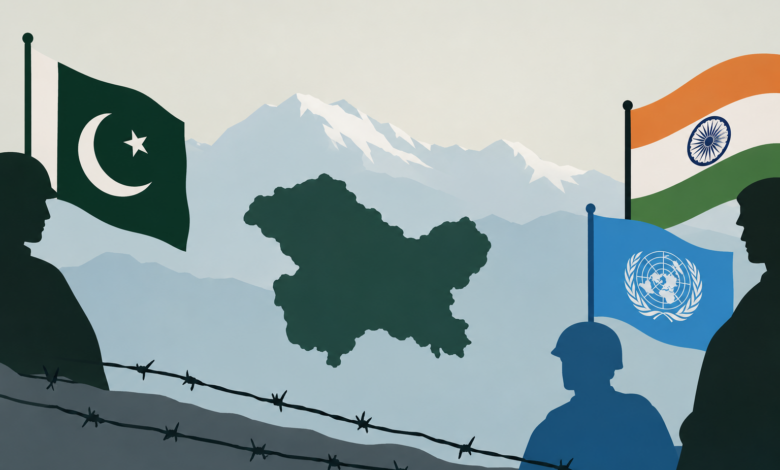
First, what I want to suggest is that despite India’s claims, Kashmir is a disputed territory. The issue is still on the UN agenda and the UN peacekeeping forces are deployed on both sides of the border. We must bury this bogey of separatism or secession and see the question of intervention in this context. Not only Pakistan has the right to intervene as a party but it is its duty. We would miserably fail in our duty if we choose to become a passive, unconcerned spectator. Even in international law, the narrow concept of nation-state and non-interference is changing. The Helsinki accord represents a fresh approach to all issues which are among the common concerns of humanity. If human rights are being violated, right of self determination is being denied, and national struggle for liberation is taking place, our sympathy, support and cooperation should be for those who are struggling.
I give two recent examples: one is the PLO. Though the PLO is dubbed as terrorist by some, it has been given an observer status in the UN; it is a member of the OIC and all the Muslim and Arab nations extend to it a state status. The second example is of African National Congress whose chief, Nelson Mandela, during a recent visit to Pakistan, was treated as head of a state.
Support for national struggles and national liberation movements is not intervention. See the liberation models of Pakistan and India, Algeria, Vietnam, Afghanistan, Palestine and now Kashmir. One will find that the right of a people to resist state terror and subjugation by mobilizing as much force as they can has now become an essential element of a national liberation struggle. The issue is that the people of Kashmir have to decide their political future according to the principles of the partition of the subcontinent. It cannot be delinked from that.
As far as Indian policy perspective is concerned, the evidence proves that there was a collusion between the British and the Indians in regard to Kashmir. The recent evidence that has come through the official papers of the Radcliffe Award conclusively shows that it was a political decision to provide India access to Kashmir for playing a particular role vis-a-vis China and Russia. Alastair Lamb, in one of his recent papers, says that Indian forces had reached Kashmir not on Oct 27, 1947, but on Oct. 26, the day the Maharaja wrote his initial letter. It was one day before that the alleged accession instrument was accepted. It has been a clear occupation, which continues.
Second, India has held Kashmir through brute force and military power. All the elections have been rigged. Even in the election to the so called 75-member constituent assembly, 73 returned unopposed. Sheikh Abdullah himself said that this was not the assembly he had been thinking of. The same was the case with all other elections.
The third point in Indian policy is very clear: India is making effort for total political integration of the state of Jammu and Kashmir into the Indian system and holding it in that position by force. Whenever there was the possibility of a major upset in that arrangement, there was direct intervention by Delhi.
Fourth, there has been economic subjugation creating dependence of the valley on India in such a manner that it could never move towards self-reliance. Its traditional sources of income or economic strength were so tailored that it became rooted in Indian interest.
Fifth, there has been a conscious effort for demographic change. It is not merely a BJP plan for the future; it is something on which active effort has been made during the last 40 years. The law of the land has been bypassed. In 1942, the Muslim population was 80 percent. In 1971, it was reduced to 67 per cent. The 1981 census put it at 63 percent (the last two figures relate only to occupied Kashmir).
Then, there has been a cultural invasion in the form of intrusion of Hindu mythology: in education, art, literature, entertainment and cultural life. A systematic plan has been on for desalination. These are major planks of Indian policy in Kashmir. Today’s resistance has to be understood in the context of these policy perspectives.
As to resistance, it has always been an issue of the Muslims of Jammu and Kashmir striving to protect their Islamic identity and finding a political way through which they could become free Muslims. Their first uprising was in 1931; the second in 1947—a very important event, for, on July 19, 1947, in a resolution of the Muslim Conference, 15 out of 21 elected Muslim members of Jammu and Kashmir gave their verdict. Then there was a mass uprising which was suppressed by the Dogra forces. It was in that context that the October 1947 episode took place.
Since partition, uprising has been very much there. In 1947-71 phase, the Muslims of Jammu and Kashmir had been politically, culturally, intellectually asserting themselves against Indian occupation and for their destiny with Pakistan. After 1971, there was a new realization among Kashmiris that they would continue to struggle even if Pakistan could not extend the support they had expected. Syed Gilani spelled out the strategy in 1972: Though Pakistan is not in a position now to help us achieve the freedom and our right to self-determination; we won’t give up our struggle. God is with us.
Four major Muslim parties, Jamaat-i-Islami, People’s League, Mahaz-e-Azadi and Islami Jamiat Tulba, forged unity in 1973-74. They developed a strategy which was expressed in one sentence: Solve Kashmir issue through Islamic revolution. Islam and Pakistan became the new symbol. There was not a day when the resistance was not active. People were going to jail. Indian prisons had been filled by students, youths, political workers and parliament members.
The year 1987 came as a turning point when the Muslim United Front was formed. It galvanized the entire population in a manner that all political analysts were sure that in any free elections the Front would win a clear majority. But thousands who worked as election agents and witnessed this election hoax became convinced that through the ballot they would not achieve their objective. Those who are active in Jehad today are the very people who had relied earlier on the ballot. Only four members were elected from the United Front. But in the very first assembly meeting, they moved a resolution for abrogation of the instrument of accession with India. When that failed, they resigned from the assembly and a mass movement began.
On August 14, 1988, the whole valley expressed solidarity with Pakistan and celebrated it as Pakistan Day with flags on every house and processions in every street. Next day, on August 15, on Indian Independence Day, there were black flags everywhere. On August 17, when President Zia ul Haq died in an air crash near Bahawalpur, the tragedy was mourned in the whole valley. The boycott of October 1989 elections was a historic event: a referendum in which 98 per cent people showed their unwillingness to stay with India. That was the day India adopted a policy of repression, turning a peaceful political movement into an armed struggle through state terror.
The period from October 1989 to January 1990 was of transition. From January 26, 1990, onwards, there was almost continuous curfew for eight months. The assembly was dissolved and governor’s rule imposed.
Despite India’s claims, Kashmir is a disputed territory. The issue is still on the UN agenda and the UN peacekeeping forces are deployed on both sides of the border.