
Enlightened Moderation – Serves West’s interests
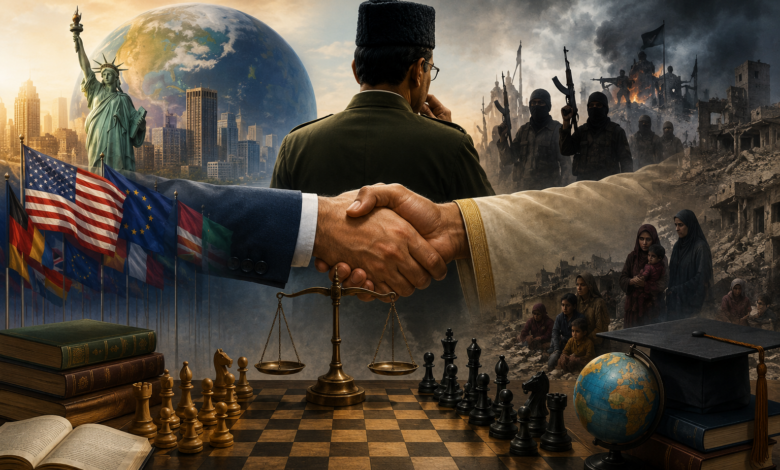
The reason advanced by General Musharraf for his strategy of ‘enlightened moderation’, in a recently published article, was spelt out thus: “The world has been passing through an extremely precarious situation since the beginning of the 1990s. The innocent people, especially my co-religionists, the Muslim brethren, are passing through a tragic situation at the hands of the extremists, terrorists and militants. This has compelled me to play my role for the betterment of this chaos-filled world”.
Through his ‘incisive vision’ he could also see that: “Those involved in the criminal acts of terrorism and extremism are Muslims and the unfortunate targets of their criminal acts also belong to the Muslim community.” He is, therefore, of the view that as a natural corollary of the situation, “the non-Muslims growingly feel, though due to misunderstanding, that Islam is a religion of intolerance, extremism and terrorism”.
On the basis of his analysis, General Musharraf asserts that the solution to this problem is that both the Muslim and the Non-Muslim worlds in their common interest should accept his strategy of “enlightened moderation”.
Addressing the West, especially the US, General Musharraf surmises: “All the political problems facing the Muslim world will have to be resolved justly and in a well-coordinated manner, and full cooperation is needed for the ‘socio-economic’ uplift of the deprived and the backward world of Islam”.
General Musharraf has declared the ‘jihadi movements’ of the Muslim world as an offshoot of the resistance movement against Russia’s colonial attack on Afghanistan. He views the post-1990 phenomenon of the so-called terrorism as part of the same development. He does not bother in his article to reflect on and explain the difference between jihad and the freedom movements and the phenomenon of terrorism and instead declares the new ‘trinity’ of ‘fundamentalism’, ‘extremism’ and ‘terrorism’, devised by the US intellectuals and propagandists, as the root cause of all problems.
His three-point programme of action is as follows:
1. Give up anything that the West views as ‘fundamentalism’, ‘extremism’ and ‘terrorism’ and follow the course of ‘enlightened moderation’.
2. Concentrate all energies on economic development, education, elimination of poverty and advancement in the fields of health, justice and fair play and with this end in view, follow the path of ‘modernism’, ‘democracy’ and ‘secularism’.
3. The OIC should be made more effective and dynamic so that the Muslim world may be able to face the challenges of the 21st century.
The article contains the following two points which are positive. One is that “the West, specially the US, will have to resolve all the political issues facing the Muslim world in a just and equitable manner and support this destitute and backward world in their economic development.” The second is when he asks the Muslim world to put its own house in order, for which it is counselled to spend “all its energies for eliminating poverty and developing its human resource through a pragmatic system of education, health care and social justice”.
There can be no two opinions about these points. But the background and the arguments on the basis of which he has floated his strategy of ‘enlightened moderation’ are based mostly on misinterpretation of facts. His write-up practically helps directly or indirectly in lending support to all the wrong and unjustified claims and reservations of the West against Islam and the Muslims. One would, therefore, like to submit the following for all the right-thinking and well-meaning intellectuals and scholars, including those from the West, to reflect and ponder: It is imperative to define what terrorism is; every attempt at the use of force cannot be called terrorism. Secondly, the acts of terrorism are committed not necessarily by individuals and organized groups alone, the governments too are involved in such acts. Today, such terrorist activities are those committed mostly by the governments. In fact, the incidents of terrorism committed on peoples/individuals are generally due to the blockade of all the avenues of peaceful political change and because of the indiscriminate and unjustified use of brute force by the *higher authorities and the state machinery of oppression and tyranny.
It appears from General Musharraf’s article that what he and the United States view as terrorism originated in 1990 as a result of the jihadi forces struggle in Afghanistan and the Russian retreat, coupled with the US indifference. The ground realities, however, speak otherwise. Terrorism has essentially been viewed as a form of popular reaction against the colonial and fascist European governments during which the non-state elements were compelled to launch their struggle with political objectives in view. At the various stages of human history, specially during the last century and a half, different movements rose in the countries of the West and elsewhere and followed the violent course to resist the colonial powers.
Martha Crenstard, in her book “Terrorism in Context”, published by Pennsylvania State University Press six years before the 9/11 episode, provides a detailed history of the dozens of terrorist movements in the West and the East. It also describes how political thinkers, particularly from the West and Latin America and the intellectuals from Africa, justified the armed struggles against imperial governments and oppressive rulers.
There is perhaps no region in the world which may not have witnessed during the last 150 years more than one such movements, which are now being labelled terrorism. Without sufficient awareness about these movements how they started, who led them, what was the result, how the leaders of these movements emerged not merely as national heroes but as history-making personalities General Musharraf should not have taken upon himself to write on such an important topic.
The ‘Jihad’ or the organized struggle by the Muslims in their self-defence is part of the same model which General Musharraf discussed in passing as the earlier period of Islam. Every Muslim country in present era, including Pakistan, resisted the imperialist powers through the weapons of ‘Jihad’. That is the reason why it has been the special target of denigration by the West, so much so that in our part of the world imperialism had to install a false ‘prophet’, and an imposter to pronounce the “cancellation” of this basic pillar of Islam. Algeria’s freedom movement is yet another bright chapter of the modern-day’s jihadi history.
The Palestinians’ Jihad against the Zionists began in 1948 and not from the Intifada (uprising) of the 1990s and the struggle is going on. Similarly, in Kashmir, jihad has begun not with the expulsion of the Soviets from Afghanistan; it has been an on-going struggle since October 1947. Our Northern Areas and Azad Kashmir got their liberation from the Indian occupation not because of any political charity or just by the stroke of chance. It goes to the credit of an indigenous well-organized and heroic Jihadi struggle of the Kashmiri people that the people today enjoy their freedom in the liberated areas.
I wish, the general had read the German research scholar Andrea Lueg, who in the last chapter of her book “The Next Threat’, while summing up the result of her research, admits: “Many of these terrible things have little to do with Islam but have other origins; and quite a few of these shocking phenomena also exist in ‘modern’ western societies. Fanaticism, for example, can have secular roots even when its bearers might deny this. Before we get hit up about the fanaticism of others, we should not deny the fanaticism of our own culture.”
As to fundamentalism, extremism and terrorism, it is a known fact of history that fundamentalism is a vague and purely American concept, having no connection with Islam or the Muslims. It was the offshoot of a Christian missionary movement, launched at the end of the 19th and the beginning of the 20th century, which is now being very conveniently thrust upon the Muslims.
Extremism is a human weakness, which may also be there among those in the West, among their politicians, military men and within certain groups or individuals. Rationally, there is no justification for linking it with the so-called fundamentalism or terrorism. Terrorism has its own causes, while extremism is an entirely different phenomenon. Terrorism may not invariably be the result of extremism and extremism may not always lead to terrorism.
It is strange that General Pervez Musharraf did not reflect for a moment what role the West and US intellectuals, specially Zionist writers, have played in ascribing fundamentalism and extremism to Islam and Muslims and the interests they have in such a malicious propaganda. The following excerpt from the book by Joshen Heppler and Andrea Lueg may be of interest:
“This book will not examine Islam but the West’s hostile view of Islam (or the perceived Islamic threat). One of our theories is that current vogue of popular literature about the Islamic threat has little to do with the supposed threat itself Islam and more to do with the western thinking, with a lacuna in our identity due to the end of the cold war. It is this aspect that interests us,”
Isn’t it surprising that while impartial scholars and intellectuals from Europe. are ready at least to review their stance, our own rulers feel no prick of conscience as they indulge in parroting their mentors in the West? And how logically these formidable mentors behave can be gauged by the way President Bush responded to the US commission report on 9/11. “The reason I keep insisting that there was a relationship between Iraq and Saddam and Al Qaeda is because there was a relationship between Iraq and Al Qaeda.”
President Musharraf’s article also fails to make even a passing reference to the phenomenon of state terrorism. No attempt has been made either to objectively reappraise the US role in promoting and patronizing terrorism and terrorist activities. Since the article was essentially addressed to the US readership, it could have very well been used to apprise the US public of the factual position.
There is now a growing segment of US intelligentsia which is openly critical of the US policies on terrorism. Intellectuals like Noam Chomsky are of the view that the United States has become a “rogue state”. The former US attorney general, Ramsay Clark, has written a number of books exposing America’s inhuman brutalities. There is also an international tribunals’ report on US war crimes before, during and after the first Gulf War of 1991. Based on this, Ramsay Clark brought out a comprehensive document under the name of “War Crimes”, duly supported by legal texts and necessary evidences. Dozens of books have since appeared world-wide providing irrefutable evidence that America has been playing an active role in promoting terrorism the world over.
Undoubtedly, advancement in the fields of economy and education is essential for the Muslim Ummah’s progress. But its rise and fall has not been due entirely to the material reasons. Islam’s strength lies in its universal message, its benign call, its golden principles and their practical models provided by our illustrious ancestors. Their moral strength was their real capital. The secret of our strength then lay in the unity of state and religion, human equality, supremacy of law, accountability of the rulers, allegiance to Shariah, prevalence of justice, social and economic equilibrium, strong institutions and an effective system of socio-economic accountability.
When these principles and values were abandoned, the luxuries of life and affluence started ruling the roost. Jihad, or the perpetual struggle against inimical forces, both within and without, and Ijtehad, or the scholarly endeavours for reinterpretation and application of the Divine Law, were given up and it was only then that the Muslim ummah became an easy prey for others.
Any reappraisal of the history of the Muslims’ rise and fall and the vicissitudes of life they have passed through that does not take into account this aspect cannot be called objective and realistic.
General Musharraf has also talked of economic progress, availability of justice, progress in the field of education and democracy. But can we ignore the basic question about the reasons for the Pakistani nation’s backwardness and the ultimate responsibility of the self-seeking privileged classes who have all along held the national resources in their hands and kept the nation deprived and hostage to their own whims? No doubt, the biggest hurdle in the way of democracy and progress has been the same elements, including our military rulers themselves.
Also today, we see that the forces causing the greatest damage to the Muslim world are no other than those known for being ‘Liberal’ and champions of ‘modernism’ and ‘secularism’. It is this very class of the Muslim ummah that has all along been hand in glove with the imperialist powers and who embarked on sucking their own communities’ blood after independence. ‘Modernism’ and its champions did some positive things in Europe. In the Muslim World, however, the secular and liberal leaderships have been responsible for its abject failure. General Musharraf rightly says that to eliminate terrorism the factors responsible for injustice and leading the people to extremism would have also to be looked into. Can the general tell us what efforts he himself has made to find out the causes leading to what he describes as extremism and terrorism and to remove from the country all the injustices and deprivations? The solution lies only in providing people with their basic rights, establishing a system of justice and strengthening democratic institutions through dialogue and the political process.
Gen Musharraf believes that secularism is not opposed to Islam, whereas it is contrary to Islam’s philosophy of life and negates the very raison detre of Pakistan. In case his statement is based on ignorance about the concept of secularism and its implications, it is an ignorance that cannot be “a bliss”. But if it is part of a deliberate manoeuvre, then the general should remember that whosoever amongst his predecessors from Iskandar Mirza to Ayub Khan has ventured to toe this line has eventually had to lick his own wounds. The real objective of the ‘New US religious order’ is to introduce in the Muslim world a system based on a division between the spiritual and the temporal and religion and politics.
This ‘new religious order’ seeks to promote an ascetic view of Islam that restricts religion to homes and mosques, while the entire affairs of life are run according to the precepts and ideologies. suited to the West. It is an order that aims at holding the Shariah in abeyance and Jihad abrogated. Let us be very clear that such a development would be contrary to the will of Allah (swt) and the precepts of his Last Messenger (PBUH).