
Present Crisis and The New Emerging Order
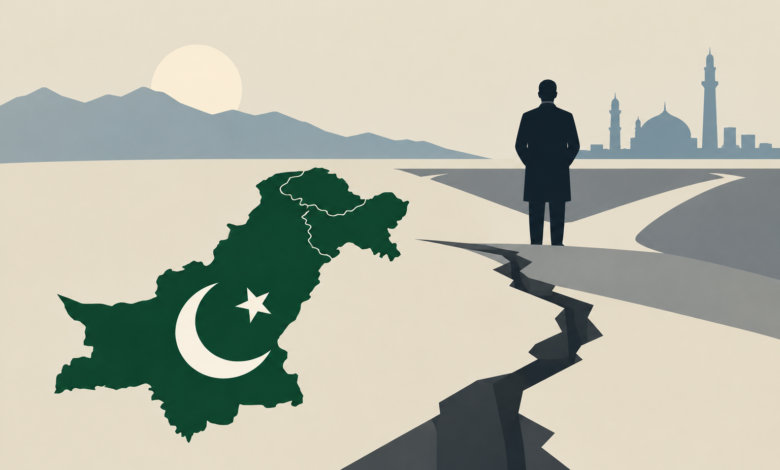
Pakistan is passing through a crucial phase of its history, and an urgency to decide and act does not warrant any delay. Though our history of 52 years is replete with mistakes and failures, recent developments have added to the exigency and call for timely decisions. On May 28, 1998, we conducted nuclear explosions to attain a sublime position among the comity of nations, but on July 4, 1999, receded to the extent that we prostrated in Washington, agreed to withdraw from Kargil heights, and beseeched India to enter into dialogue with us. On the other hand, India reciprocated by shooting down a Pak-Navy plane on August 10, resulting in the loss of 16 men in uniform, the Indian Prime Minister’s handing over of nuclear missiles to the Indian Army, his outburst on August 17 that India was incomplete without Pakistan and Kashmir, and his refusal to enter into any dialogue with Pakistan. This all has caused great concern and agony among the people of Pakistan. These events call for an impartial scrutiny of our present rulers and their policies, as well as framing an effective plan of action.
Whatever may be the appearances and political affiliations, Pakistan has always been ruled by a particular class of people. The same people have been at the helm of affairs in the country. Change of face did not mean change of thought and vision, or of approach and action. Whether it is the Muslim League’s present government or the leadership of the People’s Party, this makes no real difference. On several issues the Kashmir issue, nature of relations with India, economic development, interest-based or capitalist economy, administrative reforms and the style of governance, trade and the so-called globalization, defense and security, development of nuclear capability, Islamization or appeasement of the West, accepting American hegemony or beseeching the IMF and the World Bank for loans, nepotism, flouting of merit, corruption and self-aggrandizement both parties have exhibited destructive propensities and, therefore, stand exposed. Analyzing their performance, particularly over the last ten years, it becomes clear that the country, its freedom, its interests, and its institutions are not safe in their hands.
The two groups may engage in outward criticism of one another, but in fact both share an identical approach and creed. It can be observed particularly in the case of the Kashmir issue. Both have competed in lip service for political ends and, in fact, stabbed in the back of those who are struggling for freedom. They nullified the central position of the principle of the right to self-determination as well as the key role of the genuine Kashmiri leadership. Now, “bilateral talks” and “respect and sanctity of the line of control” have become the themes of their deliberations.
While at the peak of the Kargil battle, Ms. Benazir towed the American line by suggesting the opening up of the line of control and elections on both sides after a specific time; our foreign minister, now after the retreat from Kargil, is proposing the same in a different style. Prime Minister’s strong passion for trade and friendship with India is matched by Ms. Benazir’s desire for a “South Asian Common Market”. Both are trying to face the challenges of defense capability by raising illusory slogans of “roti, kapra, makan” and are indulging in boastful talk as if they would make the springs of milk and honey flow after cutting into defense expenditures, though the reality may tell otherwise: inability to protect freedom leads to political slavery, not to economic development.
Attempting to befriend India, acceding to American hegemony, and projecting oneself as liberal and moderate by causing a scare about “Islamic fundamentalism” and “religious terrorism”, efforts to curtail nuclear and armed capability, merger with the global economy, and adoption of Western culture are the ingredients that constitute the concept of Pakistan according to the leadership of the Peoples Party as well as the present rulers. They have no concern for the ground realities, the faith and aspirations of people, and the objectives of the Pakistan movement. They have only one objective: secure self-interests and amass as much as possible.
For this to achieve, they think Indian friendship and American patronage are essential, and view Islamic forces as an obstacle in their way to loot and plunder. Similarly, the Kashmir movement poses a great problem for them that they can neither reject nor pursue. Perhaps this is why they want to place it at the altar of the control line. They sniff danger from forces struggling for an Islamic system and the army as well. Therefore, they endeavor to weaken them and ultimately remove them from the scene. In his speech in the defense of Washington declaration, the Prime Minister’s main argument was that avoidance of war and reduction in defense expenditure were a must for economic prosperity. Does he not know the fact that the greatest burden on the budget is the amount of interest on the debts against which he, his cronies, and predecessors have mortgaged the country and the nation? Irony is that this cruelty has been committed in the name of economic development for which friendship with India, American patronage and compromise on defense capability are being sought.
Retreat from Kargil, anxiety for dialogue on Kashmir and sycophancy for America are the salient features of the model for the realization of which present rulers are bent upon damaging Pakistan. These bitter facts cannot be sugarcoated. Their staying in power would eliminate whatever is left of the concept of Pakistan presented by Iqbal and Quaid-e-Azam and for which Muslims of the sub-continent had paid great sacrifices. If we are to build Pakistan in accordance with its real goal and concept, we have to launch a struggle against the rulers. Also, after getting rid of the present coterie of rulers, the nation would have to struggle for building Pakistan according to its original concept and real objectives so that it becomes an abode of a free and dignified nation; and based on Allah’s commandments and His Prophet’s teachings, a society and state are established where justice and fair play hold sway.
The first prerequisite in this way is to reject the world-view America champions and wants to impose on the whole world in general and the Muslim world in particular. India is its close ally and partner in this game. What a senior advisor of the US State Department, Matthew P. Dale, has said while addressing a meeting in Washington clearly proves US-India collusion: “The intellectual construct of an even-handed balanced policy between India and Pakistan has been given up, if it ever existed.” Another official spokesman declared: “US relationship with India would be qualitatively stronger in the coming half century, compared to the preceding fifty years.”
On Aug. 15, the Indian Prime Minister declared that as long as there is disturbance in Kashmir, no talks are possible with Pakistan and that the Indian government is handing over nuclear missiles to the army. This is enough to show in which direction the wind is blowing. Now, there are only two options. One is to accept American and Indian hegemony and, consequently, lose political freedom, ideological identity and military strength in the name of economic prosperity. The second is to resolve to protect freedom, to safeguard our faith and ideology, and not to barter them away even if it calls for great sacrifice.
Despite all their glib talk and double-play, the rulers are quite exposed now. If we are to opt for a course different from theirs and want to live honorably as a nation and as its individuals, we have to get rid of the present rulers and bring in such a leadership which is both a champion of the objectives of the Pakistan movement and capable of translating the dreams of Iqbal and Jinnah into reality. Now the real issue is to get rid of a failed and unfaithful leadership and to install in power such a reliable leadership that may establish an alternative new order.
We have no hesitation in saying that without a radical change in leadership, Pakistan cannot come out of the mire it finds itself in. So far, the same clique of people seeking self-aggrandizement has been coming to power in different guises. The prevailing electoral system helps them perpetuate their rule, and if fundamental changes are not introduced, then any other segment of this clique may find its way to power and frustrate efforts to bring about real change. Therefore, radical changes in the present electoral system, transparent and across-the-board accountability of those who have been in power and, thus, are responsible for deterioration, are urgently needed.
The new leadership must emerge from among common masses and be answerable to them. The ‘musical chairs’ among the ruling classes should come to an end. Of course, the change must come through democratic means; but if the change is to be real and radical, it is necessary that the popular mass movement is allowed to determine the constitutional and legal changes needed for that purpose, as happened in Bangladesh before its last elections.
A question is raised as to where the third force is. To us, this question is a contrivance of those elements who want to retain power in their hands by prolonging the prevalent oppressive system. This country is a trust with 130 million people and not a dole out to a clique of fortune-seekers. It should be recalled that before the Partition, the Britishers and the Congressites used to say that there were only two forces. They were not prepared to acknowledge that Muslims were also a force. But Quaid-e-Azam challenged this, and in the shape of the Pakistan movement, Muslims emerged as a force to reckon with and prevailed on the political horizon.
Even today, those who raise this question forget that real power lies with the people of the country and not those who happen to wield it. These classes have lost both credibility and utility. In such circumstances, it is but natural that a new power must emerge.
The obtaining situation calls for a countrywide movement for change in leadership and for the establishment of a new order. This struggle should continue till success and take in its folds all well-wishers of Pakistan, its integrity and its Islamic character. It should be noted that a consensus on mere ‘negative targets’ would not bear fruit. A consensus on and cooperation for bringing about the required change and establishment of the desired order are also a must, and should include:
- Pakistan and Islamic ideology are inseparable. Islam builds up whole life’s structure on the foundations of virtue, righteousness and justice, but this ideal can be fully achieved only by establishing the supremacy of Quran and Sunnah. Our objective, therefore, is to struggle sincerely and honestly for this end.
- Across the board and ruthless accountability of those who have held power and are responsible for rot.
- Rectification of the electoral system so that fortune-seekers can be got rid of and such an environment is ensured where common people can really exercise their right to vote, and their real representatives can come to power, according to section 62 of the Constitution. These elections should be conducted by an independent Election Commission and an impartial interim government.
- ∙ Justice for all people of all provinces and of all areas. Power should not be concentrated in the Center but justly distributed among the provinces and local administrative units in a balanced manner so that the requirements of each individual and area are met according to the rules of justice and fair play.
- The pattern of economic development should be such that it can lead to self-reliance, judicious distribution of wealth and opportunities to all to share in economic prosperity and meet their basic needs with honor and freedom. Doing away with the debt-based economy within a specified time-frame, such a banking and financial system should be evolved that is based on profit-loss-sharing, mutual cooperation, and financial stability.
- Assurance of basic human rights, provided by Islam, to all without discrimination and hindrance. Guarantee of rights to the oppressed segments of society, and women in particular.
- Respect for the rights of non-Muslims.
- Independent Judiciary, free from political interference in administration and police. An effective system of accountability and assurance that all citizens get justice without delay.
- Eradication of corruption from politics and administration, participation of people in all spheres of life, compliance with Islamic principles of consultation, freedom of the press, continuation of political process (including enforcement of democratic principles within the internal systems of political parties).
- Full support for the movement in Kashmir and all possible steps for achieving the right of self-determination for the people of Jammu and Kashmir according to the United Nations’ resolutions.
- Efforts to protect freedom and integrity of Pakistan and to establish relations with all countries on an equal basis. No to domination, in any form: political, ideological, economic or military, of any country or institution. Strengthening of defense and nuclear capability to the extent that protection of freedom and sovereignty is ensured.
- Independent foreign policy based on the principles of justice and focused on the unity and progress of the Muslim world.
To ensure Pakistan’s honorable existence and stability, we should forge unity in our ranks and resolve to struggle for the establishment of a new just order according to these principles. This is possible only by bringing in a committed and capable leadership through a popular movement. The sooner, the better. This is the call of the hour. It should be very clear that while the launch of such a movement is the need of the hour, there is no shortcut to this end i.e. rectification of the worsened situation. It demands struggle, sustained effort, and sacrifice. We have to act with grit and sagacity to carry this struggle to its logical conclusion: the security of Pakistan, a bright future for 130 million people, freedom for the people of Jammu and Kashmir, and building this country anew according to the life-giving and justice-based principles of Islam.