
Electoral System Joint or Separate
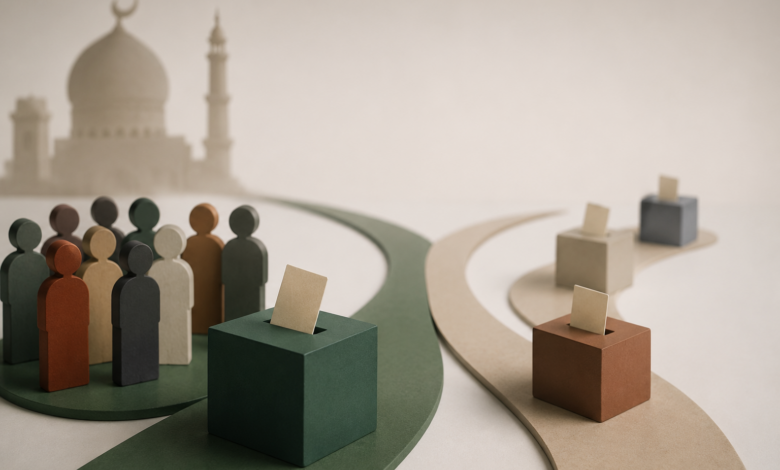
By Prof. Khurshid Ahmad
Pakistan enjoys a unique position in the recent history of the Muslims. This country has come into being as a result of a conscious, popular and democratic struggle a struggle of the Muslims of the subcontinent.
There can be no doubt that Pakistan is the homeland of all those who are settled here and that under a social contract the rights of all are to be respected. It was a popular struggle not only of those Muslims who used to inhabit those areas where the flag of freedom was hoisted; it was rather a struggle of the Muslims of the entire subcontinent. It is the result of the sacrifices of all these people and all have equal rights in it.
Foremost is the fact that it was not a matter of independence of an area; it was a struggle for the solution to the subcontinent’s political imbroglio, for the clear identification of destination for the Muslim of the subcontinent and their future, and finding the road to that destination. This movement was a covenant with Allah, the Muslim nation, and the history itself, that resulted in the shape of the independent state of Pakistan.
The plan for the division of the subcontinent was clearly an act of dividing a country along ideological lines that was accepted by the British government, Muslims of the subcontinent and the Congress. After long discussions and debate, reconciliation and understanding. Under a social contract, two independent states came into being, each with its own distinct identity.
This identity of Pakistan was given a legal and practical shape first in the Objectives Resolution and then in the Constitutions of 1956 and 1973. It rests on three pillars, which are symbols of the nation’s consensus: the state’s Islamic identity, its democratic order, and its federal system. These three points are agreed upon and uncontroversial. These are mutually coordinated and contribute to each other’s strength, and their importance is in the order in which they are written in the Objectives Resolution and the Constitution.
The issue of the system of election concerns all three of these foundations. Those who are talking of joint electorate are knowingly or unknowingly harming the foundations of Pakistan. They cannot be allowed to continue with this game. This game was played in connection with the issue of blasphemy and the same condemnable game is being played again with respect to the issue of the system of election. It is necessary to face this challenge.
In the history of the subcontinent, the issue of the system of election had assumed importance well in the beginning of the 20th century. With the question of the people’s representation in government bodies, it was quite natural to ask as to who would represent whom? And what would be the foundation for this? While the British and the Hindu leadership of the Congress were talking of a single system of elections for all those who lived in India, Muslims were asserting that theirs was a dis- tinct national identity and that the system of joint electorate on the basis of so-called neutrality, in exclusion of religion, culture, civilization and separate national interests, would practically amount to their disenfranchisement since Hindu population was three times larger than them. Till then, there was no talk of the country’s division.
It was said that religion was a private matter, having nothing to do with politics, state, and the electoral process. Whereas the Muslims claimed that their religion (Deen) was not restricted to individual’s beliefs and worship; it is also the basis of their nationhood and shapes their collective character. The West’s liberal and secular democracy cannot be the destination for the Muslims. The democracy that the Muslims champion is rooted in Allah’s sovereignty and the framework of Shariah, and that Deen and politics (religion and state) are not about two different entities. Just like worship, their politics is regulated by Deen (teachings of the religion).
Iqbal summed up this in his historical address of 1930. He explained the difference between western thought and civilization and Islamic ideology and history, and this became the basis of the Pakistan movement and its raison deter. He said: “What, then, is the problem and its implications? Is religion a private affair? Would you like to see Islam as a moral and political ideal, meeting the same fate in the world of Islam as Christianity has already met in Europe? Is it possible to retain Islam as an ethical ideal and reject it as a polity in favor of national politics in which religious attitude is not permitted to play any part?
“The nature of the Prophet’s religious experience, as disclosed in the Qur’an, however, is wholly different. It is not mere experience in the sense of a purely biological event, happening inside the experiment and necessitating no reactions on his social environment. It is an individual experience creative of a social order. Its immediate outcome is the fundamentals of a polity with implicit legal concepts whose civic significance cannot be belittled merely because their origin is revelational.
The religious ideal of Islam, therefore, is organically related to the social order which it has created. The rejection of the one will eventually involve the rejection of the other. Therefore, the construction of a polity on national lines, if it means displacement of the Islamic principle of solidarity, is simply unthinkable to a Muslim. (Thoughts and Reflections of Iqbal, pp. 166-7).
This unique bearing and historical role of Islam requires that the state system be based on Islamic identity and ideological unity of Muslims, and other nations and groups are guaranteed their rights to live, progress and play their collective role in the system. An Islamic state establishes its collective and political system on this very ideological consciousness. Neither is this identity of the Muslims weakened nor are other people deprived of their identity in the name of collectivity.
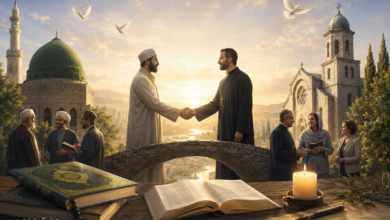
This is a state of nationalities, rather than a single nation. That is how collective cooperation and stability is achieved on the basis of credible pluralism. The system of organizations during the Ottoman Caliphate presents us with a historical example of this pluralism. In the subcontinent, the same objective was achieved through the system of separate electorates. And to realize these very objectives and aims after attaining independence, the Muslims of Pakistan tried to shape this system in such a way as to ensure full representation of the Muslim nation and to provide full opportunity to other nations and religions for sending their representatives to political institutions according to their own beliefs and concepts. This system is not based on any discrimination, rather it is a healthy and judicious effort to allow the real social plurality to flourish in the political sphere and play its due role.
The Quaid-i-Azam has elaborated this fact in clear words:
“We (the Hindus and Muslims) are different in everything. We differ in our religion, our civilization and culture, our history, language, our architecture, music, jurisprudence and our society, our dress in every way we are different. We cannot get together only in the ballot box. (Speech in November, 1945).
Even earlier, in 1938, while addressing a session of the Memon Chambers of Commerce and Memon Merchants’ Association, the Quaid-i-Azam explained the Muslim stance in detail. On the one hand, he declared that Qur’an is the source of guidance for the Muslims’ collective life, and, on the other, exposed the conspiracy of the Congress for imposing the joint electorate system on Muslims. He said: “There is no need to find a programme for Muslims. They have a complete programme for 13 hundred years and that is the Holy Qur’an. Besides our economic, civilizational and social reform and progress, the political programme is found in the Qur’an. I believe in this divine law and the freedom I want lies in acting upon this divine word. The Holy Qur’an demands of us three things: freedom, equality and brotherhood. As a Muslim, I wish to achieve these three. Our salvation lies in (acting upon) the Qur’anic teaching and only with this can we cross over all the phases of progress.”
To ignore the specific political context of the Quaid’s speech of Aug. 11, 1947, and also his more than 200 statements on the subject, is academic dishonesty.
The 1954 elections in East Pakistan were held on the same principle, and Jugto Front’s 21 points had no mention of it. However, when the Hindus of East Pakistan gained leverage as a result of the plotting of secular elements in the East Pakistan Assembly and the central assembly, they tried to strike a blow to this principle.
Muslims have never accepted the joint electorate system, either when they were in minority in the subcontinent. Or when they are in majority in an independent state. That is why Islamic and ideological forces have tried to retain the system of separate electorate in Pakistan’s political system and in the Constitution.