
JAMAL UDDIN AFGHANI II
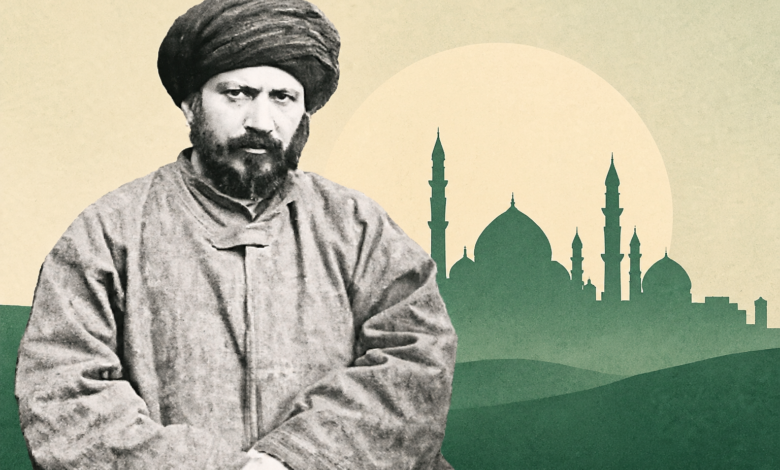
After leaving Iran, he went to London, from where he brought out a journal: “Ziaul Khafegeen”. From London, he tried to direct the freedom movement in Iran and other Muslim countries. On the request of the Turkish Caliph went to Turkey, from where he did not return. When he refused to play into the hands of the Turkish monarch, he was arrested. His death occurred because of poison administered to him by Dr Abul Huda. He breathed his last on 9th March, 1978.
Afghani’s Mission
Jamaluddin Afghani had immense love for Islam and Muslims. He lived a life of brisk revolutionary activity, and every word that flew from his mouth sparkled with the glow of his deep sincerity and sober thinking. His analysis was that the real cause of the decline of the Muslims was their disunity and internal feuds. He was an arch-enemy of imperialism and did his best to awaken the Muslim world to the approaching dangers of Colonialism. He was a firm believer in the Islamic principles of democracy and wanted to establish a Shoora-i-Nizam (consultative order). His objective is best reflected in the ideals for which the weekly Al-Urwatul-Wusga stood. They were as follows:
- To organise the Muslim countries into one organic whole and to cultivate in them the belief that the Western powers are exploiting their internal differences and rivalries for their imperialistic designs;
- To establish a system of collective security in the Muslim world so that if any one Muslim country is attacked, all the member countries would use their full force to meet the aggression.
- To encourage other Asian countries to revolt against the yoke of imperialism and to achieve freedom.
Freedom and Pan-Islamism
Jamaluddin’s greatest contribution was that he broke the hard crust of slumber and pioneered the freedom and Islamic revivalist movements of the Muslim world. It was he who organised the liberation movements in Egypt, Turkey, Afghanistan, Iran and a host of other countries. Thus, his activities were the aurora of the dawn of the new era of liberty, freedom and Islam.
He was trying to reform the kingship, but here he could not succeed, for the kings were not prepared to mend their ways and sacrifice anything for the ultimate good of the Muslims of the world.
He was a great champion of the cause of pan-Islamism. The fact is that cries of Islamic unity which we hear now and then are nothing but an echo of his powerful and resounding voice. Jamaluddin did not live to see the emancipation of the Muslim world, but he was glad to have laid a strong foundation for it. The last message that he gave to the Islamic world, which flowed from his mouth a little before his sad demise, is a message which must be read even today with great profit: It is of historical importance and is as fresh as tomorrow morning. We conclude this brief essay with these epoch-making words of the great pioneer of the Muslim renaissance:
“Now I am in such a state that I neither need the tidings of death nor the hope of life. Neither am I afraid of death nor grieved over my imprisonment. I am happy over this imprisonment, for my body is in prison in the cause of the freedom of the Muslims. I am being assassinated, but I am very happy over this death, for I am dying to give life to my nation. My oppressors are unaware of the fact that the death of one who stands for a noble mission is never the death of the mission itself. Nay, because of it rather the word of truth becomes imperishable.”
“Now I would let you know my last desire: Gird up your loins for the heroic fight for freedom! Never be afraid of trial or tribulation, arrest or assassination! Never bow before odds! Never worry over the sly artifices of the kings and monarchs! Carry on the fight with firm conviction and robust determination! Nature is with you and Almighty Allah is supporting you. The urge of freedom is moving at a heavy pace. It is going to sweep away the cobwebs of despotism and imperialism. In no time it is going to overcome the entire East and fill it with life as waters fill the ocean. Go ahead, I wish you good speed.”
These words of Jamaluddin Afghani moved a nation to new life. And even today, they beacon us.