
Pakistan’s Economy The Quaid’s Vision
For the Muslim Ummah in general, and the Muslims of Pak-India sub-continent in particular, the twentieth century has been a century of transition from political servitude to independence and search for a new tryst with destiny. Pakistan’s independence in 1947 represents a turning point. It heralded the emergence of over fifty independent Muslim states on the political map of the world. This global movement was inspired by two major ideas: political independence and Muslim identity. ‘Independence’ and the right of self-determination were known quantities in the governance of world politics. ‘Muslim identity’, however, was a new and somewhat challenging concept, particularly in contrast with the dominant westernizing political paradigm of secularism, territorial nationalism and capitalist democracy. Pakistan movement projected a new vision of polity and economy and as such acted as a catalyst for the emergence of contemporary Islamic renaissance. If the ideological and philosophic inspiration for this new movement came from luminaries like Jalaluddin Afghani, Muhammad Abduh, Mustafa Kamil, Rashid Rada, Amir Shakeb Arsalan, Prince Haleem Pasha, and more prominently Allama Dr Mohammad Iqbal, the statesman who piloted the practical strength to success in the sub-continent was Quaid-e-Azam Mohammad Ali Jinnah, who is bound to be acknowledged in history as the most outstanding political leader of the Muslim Ummah in the twentieth century: the founding father of Pakistan.
Quaid-e-Azam reigned prominently on the political horizon of the sub-continent for around half a century. He began his political career in the first decade of the century. By the end of the First World War he earned great esteem as a cool-headed politician, an upright national leader and an unbeatable constitutional lawyer. He was amongst the first Muslims to be elected to the Federal legislature. It was, however, in 1929 when he emerged into national prominence as the author of 14-points that defined the Muslim position in the future politics of the sub-continent. Gradually he emerged as the sole spokesman of Muslim India. Resolution set the goal for Muslim independence. He not only led to success the political struggle of the Muslims of India but also set the tone for the liberation movements of the Muslims in this century. That is how independence and Islamic identity became two sides of the same coin. He said:
“Pakistan not only means freedom and independence but the Muslim ideology, which has to be preserved, which has come to us as a precious gift and treasure hope, others will share with us”.(Message to Frontier Muslim: Students Federation; 18th June, 1945)
The author is a former Federal Minister for Planning (1978-79), a former Senator (1985-1997) and is presently Chairman, Institute of Policy Studies, Islamabad.
In another speech (Peshawar, 21 Nov. 1945), he said:
“Our religion, our culture and our Islamic ideals are our driving force to achieve independence”.
On 11th October, 1947 addressing the officers of Pakistan Government in Karachi he reaffirmed these two dimensions of freedom and ideology:
“The establishment of Pakistan for which we have been striving for the last ten years is by the Grace of God, an established fact today, but the creation of a state of our own was a means to an end, and not an end in itself The idea was that we should have a state in which we could live and breathe as free man and which we could develop according to our own rights and culture and where principles of Islamic social justice could find fair play”.
This vision was rooted on profound moral and philosophic foundation and was not merely an aspect of political expediency. The Quaid was firm and unequivocal about the nature of the new paradigm of polity and economy he stood for. As far back as 1939, in a talk broadcast on Eid day from All India Radio, Bombay (13 Nov. 1939), he said:
“Man has, indeed, been called God’s caliph in the Qur’an, and if that description of man is to be of any significance, it imposes upon us a duty to follow the Qur’an, to behave towards others as God behaves towards mankind. In the widest sense of the word, this is the duty to love and forbear. And this, believe me, is not a negative duty but a positive one…. All social regeneration and political freedom must finally depend on something that has a deeper meaning in life. And that, if you will allow me to say so, is Islam and Islamic spirit”.
In his Eid message on the eve of the struggle (Sept’ 1945) the Quaid said:
“Every Mussalman knows that the injunctions of the Qur’an are not confined to religion and moral duties.”From the Atlantic to the Ganges”, says Gibbon, “the Qur’an is acknowledged as the fundamental code not only of theology but of civil and criminal jurisprudence, and the laws which regulate the actions and the property of mankind are governed by the unmistakable sanctions of the will of God”. Every one, except those who are ignorant, knows the Qur’an is the general code of the Muslims. A religious, social, civil, commercial, military, judicial, criminal, penal code-it regulates everything from the ceremonies of religion to those of daily life; from the salvation of the soul to the health of the body; from the rights of all to those of each individual; from morality to crime; from punishment here to that in the life to come;…. is not merely confined to the spiritual tenants and doctrines or rituals and ceremonies. It is a complete code regulating the whole Muslim society, every department of life, collecting and individually”.
And a speech on the occasion of the Prophet’s (p.b.u.h.) birthday, addressing Karachi Bar Association on 25th January, 1948, he reasserted his vision:
“The Prophet (p.b.u.h.) was a great teacher. He was a great law-giver. He was a great statesman and he was a great sovereign who ruled. No doubt, there are many people who do not quite appreciate when we talk of Islam. Islam is not only a set of rituals, traditions and spiritual doctrines. Islam is also a code for every Muslim which reflects his life and his conduct even in politics and economics and the like. It is based on the highest principles of honor, integrity, fair-play and justice for all”.
The vision of the Quaid can be aptly summed up in his own words, as pronounced in his historic address at the Lahore session of the All India Muslim League in March, 1940:
“We stand for free Islam and free India”.
Quaid-e-Azam was not an economist, but he, as leader of the Muslim India and the founding father of Pakistan, had a very clear and vivid perception of economic priorities as they were to be pursued by the people and the leadership of Pakistan. The Quaid did not live long to steer Pakistan towards the goals he had set, but the goals were spelled out with clarity and precision. It is instructive to recollect the economic ideas of the Quaid fifty years after his death, as they constitute a sad commentary on the mess into which the Pakistan economy has been lodged by the successive leadership of the country, who instead of drawing inspiration from the Quaid and the sources of guidance he held in esteem, went after the panaceas that were sold to them by Western political and economic policy makers.
Quaid-e-Azam was fully conscious of Pakistan’s economic potential. He was also aware of the problems of the people and their aspirations. He also had a very realistic perception of the obstacles and the role of the exploiters who have traditionally sapped the resources of the people and made hay at their cost. He was also concerned about the global economic forces and their selfish objectives. He had seen the devastation inflicted upon the people by state regimentation under communism and unbridled exploitation of the poor under capitalism. He wanted Pakistan to steer clear of the Scylla and Charybdis of socialism and capitalism. It is a tragedy that his ideas were not allowed to influence economic policy-making and management in the country he founded. Instead, those very persons and factors which he had the vision to warn against ruled the roost. Let us see what the vision of the Quaid was about the future shape of our economy.
First and foremost, the Quaid was deeply concerned about the economic backwardness of Muslim India and the exploitative system that dominated it for over a century. In his historic concluding address to the Muslim League Legislators Convention held in Delhi in April 1946 the Quaid said:
“What are we fighting for? What are we aiming at? It is not a theocracy, not for a theocratic state. Religion is there and religion is dear to us. All the worldly goods are nothing to us when we talk of religion; but there are other things which are vital…. social life, our economic life; but without political power, how can you defend your faith and your economic life”.
He emphasized the key issue of domination and exploitation in this address:
“We Muslims have got everything-brains, intelligence, capacity and courage-virtues that nations must possess. But two things are lacking, and I want you to concentrate your attention on these. One thing is that foreign domination from without and Hindu domination here, particularly on our economic life has caused a certain degeneration of these virtues in us”.
Earlier the Quaid and the League leadership, particularly Nawab Bahadur Yar Jang, had addressed to the economic issues at the Karachi session of Muslim League (December 1943). Economic uplift of the Muslims was a central issue. The Quaid spoke of the welfare of the fanners and deplored the government policy of enrichment of the “landlords” at the cost of the farmers. (See Sharifuddin Pirzada (ed) Foundation of Pakistan, Vol. 11, Karachi, 1970, p.454). That had to be reversed. He was conscious of the grim reality of Muslim poverty and underdevelopment of the regions with Muslim majority. He wanted the new state of Pakistan to bridge the class of exploiters and ensure honorable living conditions for all as demanded by Islam. In his presidential address in Delhi (24 April, 1942) he said:
“Here I should like to give a warning to the landlords and capitalists who have flourished at our expense by a system which is so vicious, which is so wicked and which makes them so selfish that it is difficult to reason with them. The exploitation of the masses has gone down into their blood. They have forgotten the lessons of Islam. Greed and selfishness have made these people subordinate to the interest of others in order to fatten themselves….. have visited villages. There are millions and millions of our people who hardly get one meal a day. Is this civilization? Is this the aim of Pakistan? Do you visualize that millions have been exploited and cannot get one meal a day? If that is the idea of Pakistan, I would not have it. If they are wise they will have to adjust themselves to the new modern if they don’t, God help them; we shall not help them. Therefore, let us have faith in ourselves. That is our goal. We are going to achieve it.
In an interview to the representative of Associated Press of America (8 Nov. 1945) the Quaid threw light on his vision of the Pakistan economy. He expressed the hope that Pakistan’s “national resources and population would be sufficient to make it a great world-power”. Explaining this vision, he said:
“There would be ample revenues from equitable taxation, levied in a manner consistent with social justice, to finance “good government” and allow us to have a state as good as any in the world and better than many sovereign countries! On the map of the world today”.
He further said:
“I believe in these “modem day’s key industries” ought to be controlled and managed by the state. That applies also to certain public utilities, but what is a key industry and what is a utility service are matters for the law-makers to say, not for me”.
While laying the foundation stone of Valika Textile Mills, Karachi (26th Sept. 1947), he spelled out some of the economic priorities he had in view;
“If Pakistan is to play its proper role in the world to which its size, manpower and resource entitle it, it must develop industrial potential side by side with its agriculture and give its economy an industrial bias. By industrializing our state, we shall decrease our dependence on the outside world for necessities of life, give more employment to our people, and also increase the resources of the state. Nature has blessed us with a good many raw materials for industry, and it is upto us to utilize them to the best advantage of the state and the people”.
Quaid-e-Azam was shocked and grieved not only over the poverty of the people but also on the deprivation of the refugees who were forced into Pakistan. Establishing the Quaid-e-Azam Relief Fund (22 Feb., 1948) he said:
“We do not want merely to keep these unfortunate people alive as a drag on society we want them to live as self-respecting, self-relying and useful members of society”.
The Quaid was also conscious of inflation and its devastating consequences for the common man. In the policy speech, he said:
“The policy of the Pakistan Government is to stabilize prices at a level that would be fair to the producer as well as to the consumer. I hope your efforts will be directed in the same direction in order to tackle this crucial problem with success”. (Quaid-e-Azam Mohammad All Jinnah.”
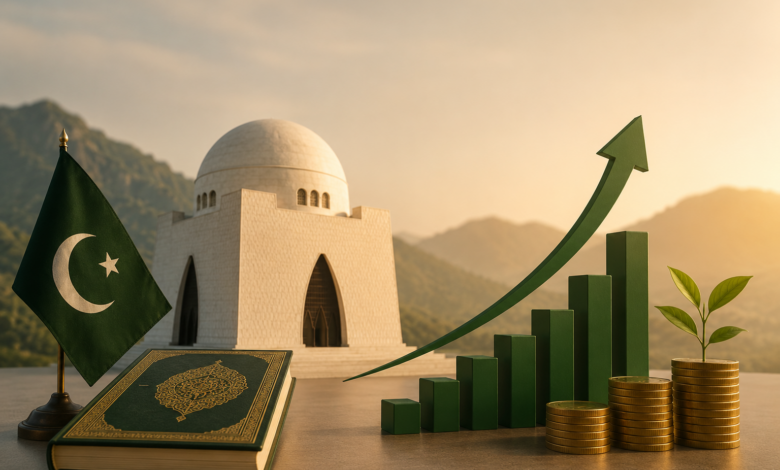
One of the clearest statements of the Quaid’s vision of the economy finds articulation in his historic address at the inauguration of the State Bank of Pakistan on 1st July, 1948. The Quaid never wanted the perpetuation of the capitalistic system in Pakistan. He wanted a new model of economy based on Islamic values of justice and fair play. The best summing up of this vision comes in his own words:
“I shall watch with keenness the work of your Research Organization in evolving banking practices compatible with Islamic ideas of social and economic life. The economic system of the West has created almost insoluble problems for humanity and to many of us it appears that only a miracle can save it from disaster that is now facing the world. It has failed to do justice between man and man and to eradicate friction from the international field. On the contrary, it was largely responsible for the two world wars in the last half-century. The Western world, inspite of its advantages of mechanization and industrial efficiency is today in a worse mess than ever before in history. The adoption of Western economic theory and practice will not help us in achieving our goal of creating a happy and contented people. We must work our destiny in our own way and present to the world an economic system based on true Islamic concept of equality of manhood and social justice. We will thereby be fulfilling our mission as Muslims and giving to humanity the message of happiness and prosperity of mankind”.
This was the vision of the Quaid. Has economic policy making and management over the last fifty years brought us any nearer to this vision? Sadly the answer is not positive. Pakistan’s dependence on the outside world has increased manifold. Total gross international indebtedness is over $ 40 billion, over and above a staggering disaster debt-binder of some 1400 billion rupees. Agricultural self-sufficiency in which we used to take pride at the advent of independence is no longer there. Poverty has increased and the latest data shows that around 38 percent of the population is below poverty line. Distribution of income and wealth has also become more inequitable; rich are becoming richer and the poor are becoming poorer. Unemployment is increasing, with a significant chunk languishing outside the wage and income stream. Inflation is making life unbearable for the poor and low income groups to an extent that for the first time in Pakistan’s history an increasing number of people are committing suicide, something rare in Muslim history. Landlordian, capitalist exploitation, corruption, cronyism, and economic mismanagement at a colossal level are responsible for our economic crisis. The political leadership that have ruled over the country have by and large ignored the guidelines given by the Quaid for the economic and ideological reconstruction of Pakistan. It is the leadership that has failed, not the vision. The vision still has the power to regenerate the economy and reconstruct the future. But this vision can be translated into reality only if there emerges a leadership that is truly and fully imbued with this vision and enjoys credibility with the people. The Quaid-e-Azam succeeded not only because of the clarity and authenticity of the vision, but also because of his unimpeachable character, integrity and credibility.