
Pakistan-India talks for what and for whom
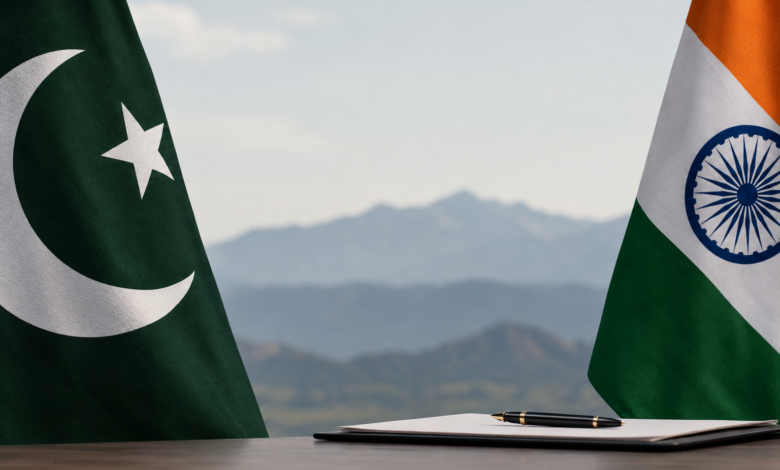
The Pakistan-India secretary-level talks are taking place against the background of the consistent claims of India that Kashmir is its integral part. Pakistan had very bitter experience of talks with India. There is every reason to believe that India has come to the negotiation table only avert world pressure against it in the wake of its brutalities in the occupied territory.
At a time when Kashmiris resistance movement has reached Its climax and Kashmiris are being subjected to continued repression by the Indian security forces, the talks could not be successful. The talks are an effort to gain time for India to contain Kashmiris struggle for freedom from Indian clutches. This is a farce played by India also in 1948 and 1962 when the Kashmiris struggle had entered into a decisive phase and India was under pressure to let Kashmir secede. The Pakistan government should not be duped by the Indian ruse of talks and give a signal to Kashmiri freedom fighters that it would never compromise on the Kashmiris’ right to self-determination. A review of the issue and Its background at this moment may help reader find a true picture
The Kashmir dispute has been brought to the forefront of world agenda by the heroic struggle of national realstance in Kashmir during the last years. Over 30,000 people have been martyred and over 60,000 permanently disabled while bracing the Indian terror machine against Jehad in Kashmir, the generation of the Muslims of Jammu and Kashmir have resolved to rebel against India’s illegitimate occupation whatever be the cost. Even half a million personnel of Indian armed and security forces, with all the brute technological force at their command, have been unable to silence the urge for freedom and self-determination. The future of Kashmir is destined to be decided in accordance with the wishes of the people of Jammu and Kashmir.
Instead of falling prey to Indian talks ploy, there is need to focus the attention not only of Pakistani people and government, but also of the world at large, on the issue of Kashmir, which despite increasing suffering of the Kashmiri people had lied buried under the mountains of papers at the United Nations Security Council and which even the government and people of Pakistan had ignored too long.
Muslims Muttahida Mahaz’s illustrious campaign in 1987 to mobilise mass support for restoration of this right to self-determination and the collapse of the ballot box in 1087 represents a water-shed. It was as a result of the elections to the Kashmir Legislative Assembly that the people of Jammu and Kashmir became totally disappointed with the prevailing sham of the constitutional and political process, which had been continuously managed and blatantly rigged by the Indian government and its collaborators in the state of Jammu and Kashmir.
The engineered defeat of Muslim Muttahida Mahaz represents a turning point. The people of Kashmir took to the other strategy of national resistance. Their answer was Jehad to seek freedom form Indian occupation and decide their own future in accordance with the accepted yet neglected principles of self- determination enshrined in the charter of the United Nations, the resolutions of the Security Council and its different commissions and the principles on which the partition of India took place in accordance with the 3rd June 1947 plan and the Indian Independence Act of 1947.
The November 1989 elections were boycotted—demonstrating that 98 per cent of the registered voters refused to continue to be to be part of the Indian system. It was a national referendum, with a thumping negative vote.
In January 1990, armed resistance began, and continues unabated. Men, women and children of Jammu and Kashmir have resolved not to tolerate Indian occupation and decide their future in accordance with the accepted principles of national resistance and liberation.
Since uprising over 35,000 people have been killed; some 40,000, 50,000 are missing and 45,000 imprisoned. An equal number of people has even disabled by police and army torture. About 3,000 women have been raped. Some 500,000 Indian troops and border forces personnel are posted in a Valley whose population is four million: for every in civilians there is one soldier with sophisticated arms,
Indian Imperialists in occupied Kashmir as surpassing brutalities of the apartheid regime in South Africa and those of the Nazis. The systematic and deliberate attacks against the people, murder, torture and rape, destruction of houses and businesses, disappearance of hundreds of young people and keeping detainees in concentration camps and torture cells are part of a vicious plan to break the will of the people.
The Kashmir administration is paralyzed and most of the officials are aiding with the mujahideen. Police are no longer under the control of Delhi or even the state governor Army troops are demoralised. The Indian army chief had to make a statement banning the use of army for political or policing purposes, it was followed by an uproar in the Indian parliament and the defence minister had to hush up the issue. On occasions police and army clashed with each other. There were incidents where army personal surrendered before the mujahideen.
As far as Pakistan’ interference is concerned it has the right to intervene as a party. Rather, it is its duty; it would miserably fall in its duty if it chose to become a passive, unconcerned spectator. In international law, the narrow concept of nation-state and non-interference is changing. The Helsinid accord represents a fresh approach towards all issues which are common concern of the humanity. If human rights are being violated, right of self- determination is being denied, and national struggle for liberation is taking place, our support should be for those who are struggling. International law and practice, an accepted by the United Nations and the Non-Aligned Movement, differentiate between “terrorism” and “national resistance for liberation from foreign occupation.”
Contrary to Indian claims, the state of Jammu and Kashmir has been a disputed territory ever since the Indian forces marched into it in October 1947, The UN resolutions accepted it as a disputed territory whose future had to decide in accordance with the will of the people of Kashmir. Even the Shimla accord acknowledges that “a final solution” to the Kashmir problem is yet to be made. Just the Indian government has adopted a purely colonial attitude and turned back on all commitments it had made to Pakistan, to the United Nations and to the world community at large. It is this Indian colonial intransigence that lies at the root of the Kashmir problem.
The people of Kashmir on the other hand have never accepted Indian hegemony as legitimate and de jure. They had never lost any opportunity to articulate their feelings, despite the terror machine under which they have languished throughout these forty-six years. They even refused to accept the Indian standard time as a symbol of their solidarity with Pakistan.
There is enough evidence to show that there was a collusion between the British and the Indians on the eve of Partition. Official papers of Radcliffe Award, now open to inspection, conclusively show that it was a political decision to provide India access to Kashmir for playing a role vis-a-vis China and Russia. Alastair Lamb in one of his recent papers says that Indian forces had reached Kashmir not on Oct 27, 1947 but on Oct 26, the day the maharajah wrote his initial letter. It was a day before the alleged instrument of accession was accepted.
India is making effort for total political integration of the state of Jammu and Kashmir into Indian system and holding it in that position by force through central rule. Whenever there has been possibility of a major dissent there was direct intervention from Delhi.
There also has been an economic subjugation creating dependence of the Valley on India in such a manner that the Kashmiris could never move towards self-reliance. Their traditional sources of income or economic strength of resources were tailored in a way that they became rooted in Indian interest.
A conscious effort is made for bringing about a demographic change in the Valley; it is not merely a BJP plan. In 1942, the Muslim population was 80 per cent. In 1971, it was reduced to 67 per cent. The 1981 census reported it at 63 per cent.
Furthermore, here has been a cultural invasion of Kashmir through Hindu mythology in education, art, literature, entertainment and in cultural life. A systematic plan has been in operation for the de-Islamisation of the population.
Presently, there are two major dimensions to the Kashmir problem which deserve to be considered. First, are the massive and wanton violations of the human rights by the Indian occupation forces. Kashmir today is one of the bleeding sores on the face of the human race. While the agony and sufferings of the Kashmiri people are now being increasingly acknowledged, the world opinion has failed to exert enough pressure on India to stop the heinous violations of human rights its forces are com mitting on a mass scale, spread over such a long period. This is the first and the most pressing aspect and it is time all countries of the world particularly the Muslim world use their diplomatic and economic pressure on India to bring to an immediate end the reign of state terror and restore civil and political liberties of the people of Jammu and Kashmir.
While this aspect is urgent, this cannot in itself lead to the final resolution of the dispute. The heart of the problem is Kashmiri peoples’ right to self-determination. There cannot be a substitute to that. The legal, moral and political basis of their struggle is the unfinished agenda of Partition. The only peaceful solution to this problem through holding a free and fair plebiscite under international auspices, giving to the people of the state of Jammu and Kashmir an opportunity to decide their future in accordance with the UN resolutions.
There is now an increasing realisation that India has lost Kashmir. A leading Indian Intellectual, Khushwant Singh, writing in an Indian newspaper as recently as the last week of November 1993 admits:
“Our part of Kashmir has had many elections and many chief ministers. None of the elections were as free and fair as we know in our other states. Consequently, none of the chief ministers could be described as popular rulers. They were chosen in Delhi and when found inconvenient, summarily dismissed and the state put under governor’s ruled. People who have visited beauty spots in the Valley of the Jhelum or have Kashmir Muslim friends will bear me out that right from the beginning they were reluctant to admit they were Indians. Though they carried Indian passports, they referred to us as “you Indians” and to themselves as we Kashmiris…. Though undoubtedly exaggerated it cannot be denied that human rights have been increasingly violated. Not many people put faith in the Human Rights Commission recently set up by our government. Face the facts squarely. One fact is that we have totally forfeited the sympathies of Kashmiri Muslims, the other is that we have no moral right to impose ourselves by physical force on a people who do not want us.”
The fact is that Kashmir, as the London weekly Economist has recently observed is on longer ruled by India, even though it is sill controlled by it; this state of affairs cannot continue for long, facts have to be faced and faced squarely. And the sooner they are faced the better India will have to come to the negotiating table to resolve the issue and no solution of the Kashmir dispute is possible which is outside the framework of the UN resolutions and which does not give to the people the right to decide their future freely. A meaningful and constructive Pakistan India dialogue is possible only when:
- India stops forthwith its atrocities in occupied territories and the Indian troops withdraw to the barracks first, and eventually withdraw from the valley;
- The real Kashmiri political leadership is set free and participates in the talks;
- The talks find a way for giving the people of Jammu and Kashmir an opportunity to decide their political future through a free plebiscite according to the United Nations resolutions; and
- The talks focus on UN resolutions and are not mixed up with Siachen or other bilateral issues.
This is the way to peace in Jammu and Kashmir and peace and prosperity for the subcontinent.