
Professor Khurshid’s View on the G7 Meeting
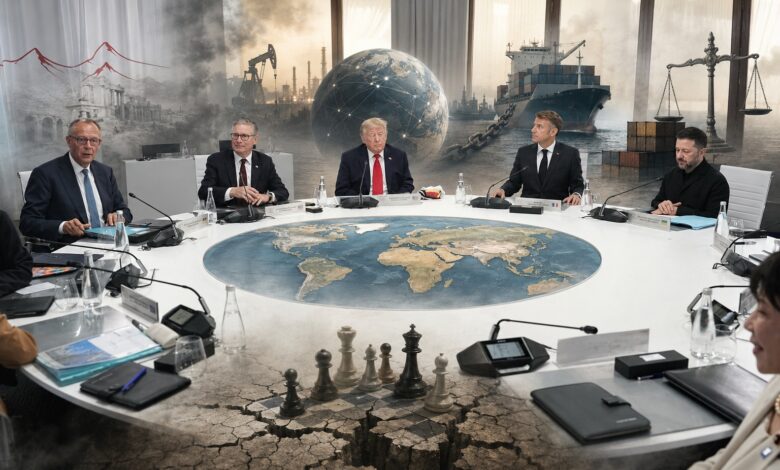
Professor Khurshid’s core critique is that Global North leadership structures inherently reproduce a “master-servant dynamic” rather than fostering an equal, justice-based partnership. Applying his thought to the current G7 actions regarding Iran reveals critical mismatches.
1. Deconstructing the Évian G7 Agenda: Strategic Interest vs. Moral Integrity
Professor Khurshid’s writings draw a sharp line between “instrumental mediation” (peacekeeping driven by a desire to preserve the status quo) and “moral mediation” (peacekeeping driven by absolute justice).
When the G7 leaders meet in Évian-les-Bains to draft resolutions on Iran, their primary tools are economic leverage: secondary sanctions, maritime security coalitions, and energy price caps. Professor Khurshid would argue that this approach views the Iranian crisis purely through a lens of geopolitical expediency.
For the G7, a wider conflict involving Iran is a catastrophic variable for Western markets because of its impact on oil prices and the security of the Strait of Hormuz. He would argue that by reducing a deep-seated historical and political conflict to a “risk-management exercise for global markets,” the Global North strips the crisis of its human and ethical dimensions. Real peace cannot be engineered through the lens of protecting Western economic hegemony; it requires addressing the core grievances and sovereign rights of the nations involved.
2. The Évian Summit as a “Master-Servant” Echo chamber
A central pillar of Professor Khurshid’s thought is that Western-dominated policy forums inherently reproduce colonial-era hierarchies, even if they use modern diplomatic language. The G7—an exclusive club of industrialized Western powers (plus Japan)—is the ultimate expression of this exclusive architecture.
When this exclusive group issues unilateral mandates to Iran or establishes the “acceptable parameters” for Middle Eastern security, it operates entirely within the master-servant dynamic that Professor Khurshid spent his life critiquing.
- Cultural Assimilation as a Prerequisite: He noted that the Global North often conditions normal diplomatic and economic relations on the Global South adopting Western political templates or dropping distinct ideological frameworks.
- The Application to Iran: The G7’s framework treats Iran not as a sovereign regional power with its own distinct civilizational identity, but as a “disruptive actor” that must be disciplined until it conforms to Western-centric norms. Professor Khurshid would argue that true conflict resolution is impossible when one side demands that the other abandon its core identity as a prerequisite for entering the room.
3. Ethical Globalization vs. Coercive Sanctions
As an economist who pioneered Islamic economic models, Professor Khurshid looked closely at how international financial systems are weaponized. The G7’s primary weapon against Iran has long been the global financial architecture—disconnecting banks from SWIFT, freezing foreign assets, and embargoing trade.
Professor Khurshid argued for “ethical globalization,” where economic interconnectedness is used to uplift populations rather than to starve sovereign states into political submission. He would view the G7’s collective economic warfare against Iran with extreme skepticism, pointing out two major flaws:
- It inflicts widespread suffering on ordinary citizens, which violates the Islamic principle of absolute justice.
- It reinforces Western hegemony over global financial networks, proving that the current international order is designed to penalize any nation that attempts to chart an independent economic or political course.
4. The Path Forward: Asserting Muslim Agency
Professor Khurshid’s philosophy was never purely reactive; he always offered a proactive vision. He would argue that Iran, its neighbors, and the wider Muslim world should not merely react to the declarations coming out of France. Instead, they must actively bypass them.
He would call for a “moral reawakening” in regional diplomacy, urging the following steps:
- Alternative Regional Frameworks: Rather than waiting for G7 or Western-led mediation, regional powers should utilize and strengthen independent bodies (like a revitalized Organization of Islamic Cooperation or regional South-South coalitions) to mediate conflicts internally.
- Intellectual Agency: Muslim scholars and policymakers must formulate their own definitions of security, deterrence, and peace, rather than adopting the terminology of the Global North (such as “rules-based international order,” which he viewed as a euphemism for Western-defined rules).
If Professor Khurshid Ahmad were assessing the current G7 summit’s impact on the Iran crisis, he would warn that the West cannot build a stable peace using the tools of domination. The Évian declarations will ultimately fail to resolve the conflict because they attempt to manage symptoms rather than heal the disease. True stability will only emerge when the Global North stops acting as a global overseer and accepts the Muslim world as an equal, irreplaceable partner in global governance.