
Professor Khurshid Ahmad on the current Kashmir issue
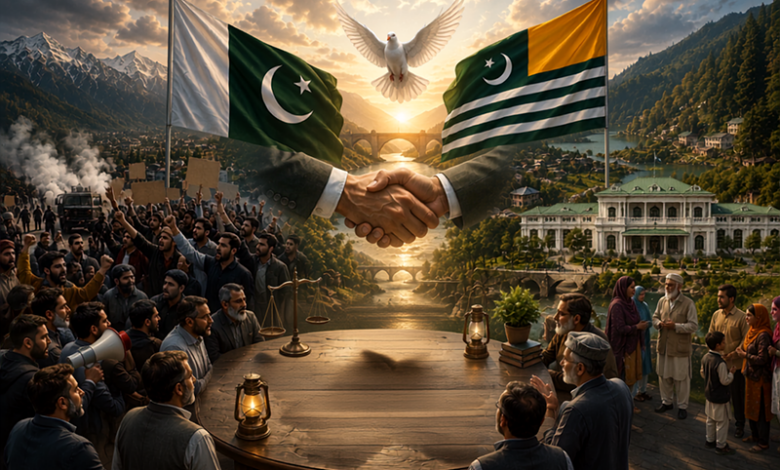
Applying Professor Khurshid Ahmad’s comprehensive socio-political framework to the current situation in Azad Jammu and Kashmir (AJK) reveals a stark tension between his idealized vision of a unified, consultatively governed strategic partnership and the ground realities of political unrest.
The recent waves of unrest led by the Jammu Kashmir Joint Awami Action Committee (JKJAAC)—marked by severe friction over economic subsidies, regional autonomy, and legislative representation (specifically the controversy surrounding reserved seats for refugees ahead of the July 2026 elections)—can be critically analyzed through the late Professor’s core principles.
1. The Crisis of Institutional Collaboration and Consultation
Professor Khurshid Ahmad heavily advocated for a structured, consultative approach between Islamabad and the AJK leadership to avoid misunderstandings. He proposed that decision-making should be inclusive, taking local sentiments into full account to maintain a unified national vision.
The current friction in AJK—exemplified by the breakdown of talks between the federal ministerial team and grassroots leadership, followed by security crackdowns and communication blackouts—represents the exact breakdown of the “structured consensus” he urged both sides to build. When political agreements (such as the October 2025 accord regarding local governance, infrastructure, and legislative structural adjustments) encounter delays or implementation deficits, it validates his warning: a lack of transparent, institutional dialogue breeds deep public alienation rather than strategic alignment.
2. Grassroots Grievances vs. Strategic Mislabeling
A core element of Professor Khurshid’s view was that the relationship between Pakistan and the Kashmiri people is fundamentally ideological and moral. Therefore, managing this relationship requires deep empathy and high-caliber leadership capable of respecting local sentiments.
The recent heavy-handed state response—including the temporary proscription of local rights-based coalitions under anti-terrorism laws during the peak of the protests—directly contradicts his philosophy of treating Kashmir as an inseparable part of Pakistan’s moral consciousness. In his framework, dismissing or aggressively suppressing internal civil governance demands as external stability threats damages the civilizational bond. A peer-level, respectful acknowledgment of AJK’s economic and political grievances is necessary to honor the divine trust (Amanah) of looking after the region.
3. Subverting the Global Case for Self-Determination
Professor Khurshid emphasized that the shared responsibility of Pakistan and AJK is to present a strong, unified case for the right of self-determination on international platforms. He believed that internal solidarity is the prerequisite for effective global diplomacy.
When the Pakistani side of Kashmir experiences recurring periods of internal instability, internet blackouts, and governance deadlocks, it directly weakens the broader diplomatic narrative on the global stage. From the Professor’s point of view, to champion the Kashmiri cause internationally with full moral authority, the base of operations—Azad Kashmir—must reflect a model anchored in justice (Adl), stable local autonomy, and thriving socio-economic rights.
The Definitive Realignment:
Looking through Professor Khurshid Ahmad’s lens, the solution to the ongoing friction in AJK does not lie in administrative coercion or mere financial packages. It demands a return to genuine institutional partnership. By embracing his vision of a highly competent, passionate, and deeply collaborative leadership framework, the state can bridge the current trust deficit—ensuring that the domestic governance of AJK strengthens, rather than strains, the ideological bond connecting the Kashmiri people to Pakistan.
4. The Rejection of Violence and the Danger of Ideological Egoism
To directly address the tactical side of the crisis, a crucial dimension must be added to Professor Khurshid Ahmad’s framework: the absolute moral and strategic imperative for Kashmiri stakeholders to reject violence, set aside institutional or political ego, and return to the negotiating table.
From Professor Khurshid’s point of view, this shift is not just pragmatism—it is a core requirement of the Islamic socio-political ethos.
The Moral Duty of Restraint over Ego and Violence
- Violence as a Disruption of Sabr and Strategy: Professor Khurshid Ahmad’s entire ethical paradigm is built on the pursuit of Divine Pleasure and long-term moral evolution. In this worldview, resorting to violent clashes, rioting, or damaging public property is a severe transgression. It distorts legitimate grievances into lawlessness, which violates the Islamic principle of Sabr (steadfast, disciplined persistence) and strategic wisdom (Hikmah). Violence plays into the hands of detractors who wish to see the region destabilized.
- Subjugating Personal and Collective Ego (Nafs): The Professor frequently emphasized that public service and ideological movements require the subjugation of the individual and collective ego (Nafs). When negotiations stall because leaders or activist coalitions prioritize personal prestige, rigid stances, or emotional rhetoric over practical outcomes, they commit a profound moral failure. Feeding political ego at the expense of public peace directly harms the very people they claim to represent.
- The Sanctity of the Shura (Consultative Table): In the Islamic tradition that Professor Khurshid championed, dialogue and consultation (Shura) are sacred duties. The negotiating table is not a place of surrender, but the primary venue where justice (Adl) is hammered out. Kashmiri stakeholders, including the grassroots leadership and local committees, have a moral obligation to channel their passions into rigorous, peaceful, and constructive dialogue rather than prolonged street agitation.
The Structural Realignment: For the ideological bond between Pakistan and Kashmir to remain unshakable, both sides must act with maturity. While the state must listen with empathy, the Kashmiri stakeholders must completely disavow violent tactics and the paralysis of political ego. Returning to the consultative table with a spirit of mutual respect is the only path that honors the historical and moral weight of the Kashmiri cause.