

Economic and Business Reviews
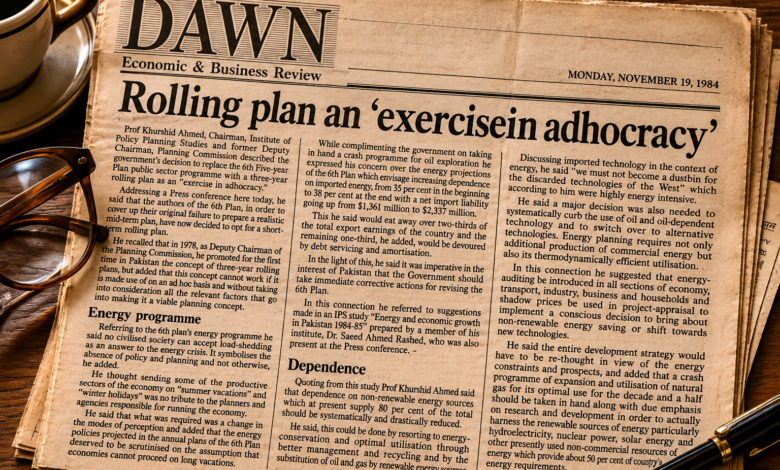
Prof Khurshid Ahmed, Chairman, Institute of Policy Planning Studies and former Deputy Chairman, Planning Commission described the government’s decision to replace the 6th Five-year Plan public sector programme with a three-year rolling plan as an “exercise in adhocracy.”
Addressing a Press conference here today, he said that the authors of the 6th Plan, in order to cover up their original failure to prepare a realistic mid-term plan, have now decided to opt for a short-term rolling plan.
He recalled that in 1978, as Deputy Chairman of the Planning Commission, he promoted for the first time in Pakistan the concept of three-year rolling plans, but added that this concept cannot work if it is made use of on an ad hoc basis and without taking into consideration all the relevant factors that go into making it a viable planning concept.
Energy programme
Referring to the 6th plan’s energy programme he said no civilised society can accept load-shedding as an answer to the energy crisis. It symbolises the absence of policy and planning and not otherwise, he added.
He thought sending some of the productive sectors of the economy on “summer vacations” and “winter holidays” was no tribute to the planners and agencies responsible for running the economy.
He said that what was required was a change in the modes of perception and added that the energy policies projected in the annual plans of the 6th Plan deserved to be scrutinised on the assumption that economies cannot proceed on long vacations.
While complimenting the government on taking in hand a crash programme for oil exploration he expressed his concern over the energy projections of the 6th Plan which envisage increasing dependence on imported energy, from 35 per cent in the beginning to 38 per cent at the end with a net import liability going up from $1,361 million to $2,337 million.
This he said would eat away over two-thirds of the total export earnings of the country and the remaining one-third, he added, would be devoured by debt servicing and amortisation.
In the light of this, he said it was imperative in the interest of Pakistan that the Government should take immediate corrective actions for revising the 6th Plan.
In this connection he referred to suggestions made in an IPS study “Energy and economic growth in Pakistan 1984-85” prepared by a member of his institute, Dr. Saeed Ahmed Rashed, who was also present at the Press conference. –
Dependence
Quoting from this study Prof Khurshid Ahmed said that dependence on non-renewable energy sources which at present supply 80 per cent of the total should be systematically and drastically reduced.
He said, this could be done by resorting to energy conservation and optimal utilisation through better management and recycling and by the substitution of oil and gas by renewable energy sources.
Discussing imported technology in the context of energy, he said “we must not become a dustbin for the discarded technologies of the West” which according to him were highly energy intensive.
He said a major decision was also needed to systematically curb the use of oil and oil-dependent technology and to switch over to alternative technologies. Energy planning requires not only additional production of commercial energy but also its thermodynamically efficient utilisation.
In this connection he suggested that energy-auditing be introduced in all sections of economy, transport, industry, business and households and shadow prices be used in project-appraisal to implement a conscious decision to bring about non-renewable energy saving or shift towards new technologies.
He said the entire development strategy would have to be re-thought in view of the energy constraints and prospects, and added that a crash programme of expansion and utilisation of natural gas for its optimal use for the decade and a half should be taken in hand along with due emphasis on research and development in order to actually harness the renewable sources of energy particularly hydroelectricity, nuclear power, solar energy and other presently used non-commercial resources of energy which provide about 50 per cent of country’s energy requirements.