
The real significance of Soviet occupation of Afghanistan is yet to be realized. The crossing of the line of Oxus by over five divisions of the Russian army in December 1979 does not merely constitute a map-changing geo-political upheaval, it represents a turning point in the history of West Asia, making Afghanistan and the countries of the region major subjects, rather than being objects, of international politics. After enjoying a rather low profile for about half a century, the region has once again emerged on the chessboard of the ‘big game’ and may eventually become a major theatre of war in the future. Even though the Afghan Mujahideen have been able to successfully bear the brunt of the Russian offensive and have rendered into an ugly stalemate an operation that was planned as a blitzkrieg, the politics of the region has been transformed to an extent that status quo ante is now out of the question. The situation calls for careful observation, candid reflection and continuous strategic thinking to influence the course of events.
Certain aspects of the Afghan situation deserve to be noted with clarity and precision. Soviet invasion of Afghanistan is unique in the sense that it represents the first major mobilization of Russian troops outside the Warsaw Pact region. Although Russia had been helping all the world over anti-imperialist (Western) and Left-revolutionary movements in a number of covert ways and their surrogates were actually fighting under the flag of Cuban volunteers? It is the first occasion when Russia has demonstrated its willingness to engage its own troops in the outside world. Three points deserve to be noted:
hirst, is Russia’s perception of its own power and role in world politics undergoing a change? Does this event represent a new confidence and a new willingness in the Super Power to step out of its borders and play a more active role in changing the geo- political map of the world? Does it suggest that Russia is now feeling so confident as to use direct intervention as one of the instruments of its foreign policy in the region?
Secondly, Russian perception of the region, and not merely of Afghanistan, that is about the whole of West Asia and the Middle East, particularly of Iran, Pakistan and the Gulf, of South Asia and its policy towards Islam and the Muslim World are undergoing a fundamental change. Furthermore, it also suggests that the Russian approach towards ‘detente’ is either undergoing a change and Russia is prepared to stake ‘detente’ for the sake of political conquests or that its conception of ‘detente’ is different for Europe and for Asia and Africa. To what extent direct intervention in Afghanistan is an indication of some basic changes in Soviet attitudes and policies and to what extent an active role is being contemplated by the Russian strategists in the area, deserves to be examined and analyzed.
Thirdly, Russia’s direct intervention in Afghanistan is indicative of another aspect of its foreign policy: its dependability as a friend and an ally and its preparedness to take risks to protect its interests. This is important in the context of the other big power’s rather poor showing on this count.
Along with careful examination of these aspects of Russian perceptions and policies, the central issue that has to be squarely faced is the “right” of a super power to create geo-political “facts” at its discretion, to invade and implant governments of its choice in sovereign but smaller and weaker nations by sheer use of force, and make the people of that country and the whole world accept these concocted and counterfeit “facts” as fait accompli.
The central question for all nations and for all peoples to consider is whether they can acquiesce and passively accept the “right” of a super power to arbitrarily change the political map of the world? Or violation of the rights of one nation is tantamount to violation of all. If encroachment on one people is not fought back by all, no one would be safe in the world. This is the real issue which should be squarely faced by all the peoples and all the nations of the world. It is a test case, not only for world conscience, but also for the future of small nations’ independence and sovereignty.
The way the Afghan people have braced this crisis represents another important dimension of the problem. Afghanistan is a unique case where a small nation, a Muslim and non-aligned country, was brazenly invaded by a super power, which could not achieve an easy walk-over. A people, poor and ill-equipped but conscious of their freedom and self-respect, have put up heroic resistance to a super power, arrogant and armed to the teeth with the most sophisticated weaponry. ‘
The Afghan episode has no parallel in contemporary history. There is no doubt that the Vietnamese people have proved their mettle in our own times but the parallel does not go far enough. In Vietnam two super powers were involved: America from one side and Russia and China from the other. The invading power was in a position of disadvantage, the supply line of the forces of resistance was direct, uninterrupted and overflowing.
In Afghanistan the clash is not between two super powers, not even indirectly, but between a super power and a small resistance movement of the people. Yet Russia has not been able to penetrate into the hinterland. Its writ is confined to the big cities and the national channels of communication. Even some of the cities are under the control of the Mujahideen or have changed hands a number of times (e.g. Jalalabad, Herat, Kandahar). Russia and its puppet government in Kabul control only the central apparatus of the state, while the Afghan society and the upcountry are controlled by the Mujahideen. The entire Punisher Valley, Badakhshan, and Koner Valley are under the suzerainty of the Mujahideen who run a parallel government in those areas with their own administration and judiciary. This situation is suggestive of two very important facts.
First, even a super power does not enjoy absolute authority in changing the political map of a region if the people are cognizant of their strength and are prepared to fight back. In Iran, a highly developed and firmly entrenched system of civil and military control could notcontain the majestic fury of the people, once it was unleashed. In Afghanistan the direct political and military intervention of a super power could not change the political realities in the direction of her choice.
The limitations of the political and military capabilities of the powerful have been abundantly exposed in the Afghan stalemate. To contain Russia and stop it from achieving total control over Afghanistan is no less a victory for the Mujahideen. It has once again proved that war is not merely a matter of strength of numbers and weapons. In the final analysis, it is the will of the combatants, their moral motivation and the strength of their cause that play a decisive influence. It is clear beyond any shadow of doubt that what the Russia and Afghan forces are facing in Afghanistan is a national resistance, spearheaded by the Islamic forces, the Mujahideen.
Secondly, this national resistance has brought into sharp focus a new model of resistance before the people of the world, particularly ‘the wretched of the earth’ subjected to imperialist domination and exploitation in different parts of the world, capitalistic as well as socialistic. In this respect it represents a situation very similar to the Algerian struggle of National Liberation, which not only sparked off a number of liberation movements all over Africa, Asia and Latin America, but also provided a model for resisting colonialism, if the predominantly peaceful and constitutional struggle for freedom of India and Pakistan represented one end of the spectrum of freedom movements, against Western imperialists, the Algerian model of armed struggle represents the other end. Soviet imperialism is facing its moment of truth in Afghanistan and Poland.
The two models represent two modes of resistance, both having far reaching consequences for vast areas in Asia and Europe, throwing out many lessons for different people in the world faced with different forms of despotic rule. That is why we submit that the Afghan episode is a multi-dimensional phenomenon and deserves to be examined with great care from different angles by people belonging to different disciplines, by theorists as well as the practitioners of politics and social change.
Russia’s Real Motives
How Russia is handling the Afghan situation and what are her real motives and ambitions? A number of theories have been propounded, fitting in facts and events in two major scenarios: one emphasizing the defensive nature of the whole effort, and the other highlighting the offensive character of the enterprise. It is our humble submission that the two explanations are NOT mutually exclusive. Russia, and for that matter any super or even less than super power, is beset with a number of threats, real and imaginary.
The conventional fear of encirclement by the capitalist or other anti- Russian forces, including China, cannot be ruled out summarily. It has been a factor prominent in Russian thinking and must not be ignored. But the revolution in Iran has weakened that circle of containment. The India-Russia alliance has strengthened Russia against China, her alleged rival in the area. In this background the defensive theory is important, but does not tell the whole story.
Russia’s historical thinking about the future of the region, starting from the period of the Czars and continuing till today, cannot be brushed aside. If the Czars were motivated by Russian nationalism, the present-day Russia has added an ideological dimension to the strong crust of nationalism. Russia’s southward move is not a figment of imagination; it is a historical reality. Of course, Russia would not be foolish to act unless the scenario is congenial, but the motives and the ambitions are undeniable.
The situation in Iran and the American reaction to that in November-December 1979 created the conditions which Russia exploited callously but expeditiously. The Afghan Mujahideen’s resistance has spoiled Russia’s immediate gains, but there should be no mistake about Russia’s resolve as well as her capabilities, which constitute a standing warning to all nations of the region, as also to all those peoples interested in the area.
The Western world’s reaction has been confused, lukewarm and ineffective. Russia has been partially contained by the Mujahideen’s heroic struggle, which has put Russia on the defensive but it cannot be taken to suggest that Russia’s strategic thinking about the area has changed. It can change if it is confronted by a different set of realities. But the cost which is being paid by Russia presently seems to be an “acceptable” one. And as long as this state of affairs continues, stalemate, however, ugly, is the only practical possibility.
It would not be correct to assume that Russia is not and would not be prepared to review and rethink her own position. It is important for Russia to examine Afghanistan in the context of her overall foreign policy objectives ideological, political and economic. A careful examination of the Russian policy in Afghanistan shows that on the one hand she is trying to firmly entrench herself in the occupied territory, but on the other is also eager to keep the options open.
Soviet penetration of Afghanistan has a chequered history spread over half a century. The decade of the 1970s witnessed an increasing tilt towards Russia. Afghanistan drifted more and more into Russia’s area of influence. Efforts to rectify this over-dependence and to diversify the sources of economic aid, military and administrative training, and political and cultural support prompted the Russian surrogates in Afghanistan to stage coup and counter-coup. Firm support of Russia to her allies within Afghanistan and finally her military intervention are indicators of her resolve to keep Afghanistan in her area of influence.
Afghanistan was accepted as a buffer by Czarist Russia and the British Empire. Soviet Russia tacitly accepted this position, yet slowly and systematically tried to change the situation, and bring Afghanistan into her area of influence. America and countries of the region did not act at the right time. They realized the danger too late. It was only in the second half of the 1970s that some efforts worth the name were made to bring about a new equilibrium. But these efforts were made without enough preparation and without effective planning to face the counter-attack from Russia and her allies in Afghanistan.
With the result that Russia achieved many successes and was emboldened to even go for direct military intervention in 1979. The only force that can frustrate Russian onslaughts is the Islamic movement of Afghanistan. This was the position from the very beginning but this factor was totally ignored by all those who were interested in the area. Russian successes are also an index of the misconceptions, misplanning and misadventures of her adversaries.
Peoples’ resistance in Afghanistan spread over the last five years and divided into two phases, the period of limited resistance during the period of Daoud, Taraki and Hafizullah Amin and the national resistance after the direct Russian intervention and the installing of the Karmal regime, have conclusively shown that it is only the’ people of Afghanistan who can fight the Russian imperialism and that the people can fight this battle only under the banner of Islam, led by an Islamic leadership.
Islam and Afghan Resistance
This is the message of the Afghan experiment. In spite of the hard crust of ideological insularity built around Russian policy makers and the proverbial incapability of ideologues to see things in perspectives different from the ones which condition their thinking, there are indications that the Russians are becoming conscious of the Islamic dimensions of the issue.
The socialistic line of Taraki has been played down by the present regime in Kabul, which is trying to use many an Islamic symbol to confuse the people. The red flag of the party was turned into green. Karmal’s speeches begin with Bismillah (in the name of Allah) and are interrupted with the slogans of Allah-o-Akbar (Allah is the Greatest). The government has established an office of “Islamic teachings” directly in the office of the “President”.
A number of religious conferences and seminars have been organized. Many religious delegations have been sent to Central Asia. It has been claimed that ‘respect for (the) sacred religion of Islam’ is part of the government policy. (Karmal’s speech, June 18, 1980. See Foreign Broadcasting Information Services, Daily Report: South Asia, Washington D.C. June 20, 1980.) There is an explosion in religious broadcasts from Central Asia, telling the Afghan peoples that Islam and the Muslims are in good shape in Russia and that America, Britain and China are the real enemies of Islam.
This twist in policy is indicative of the fact that Russia and the Kabul regime are trying to change their tactics to face Islam and Islamic forces. Similarly, many other acts of appeasement, including confining the military pressure within certain limits, are indicative of the fact that there is room for flexibility in Russian policy. It may, however, be added as a footnote here that while the ideologically committed Communist Russia is prepared to show some tactical flexibility on the issue of Islam, the Western countries and even some of the so-called Muslim countries fail to see the reality and are still trying to foist a secular, nationalist leadership on the resistance movement. Nothing would be more disastrous to resistance than an effort in this direction. The secular and nationalist elements can never lead this resistance; they can only divide and weaken it.
Too much should not be read in Soviet strategy of limited appeasement and flexibility. Russia has used every opportunity to further integrate Afghanistan with the Russian mainland. Wakhan Valley has been annexed. Afghan economy is becoming more and more dependent on Russia, not only because of aid and foreign trade, but also through hundreds of joint projects and through further integrating the entire Afghan system of communication with Russia. Similarly Russian training for Afghan civil and military personnel is an important instrument of indoctrination, depending Afghan dependence on Russia. This entire framework has to be kept in view while considering some of the major contours of Russian policy in Afghanistan and her policy for Pakistan, Iran and the Middle East.
Our analysis so far establishes the fact that the only valid framework for an analysis of the Afghan problem is provided by the ideological-cum-geopolitical policies of Russia and by the Islamic framework of the resistance. The heart of the problem is that the clash is growing into a clash between two ideologies and religion political systems and this provides the key to the future.
Pakistan and Iran are in a very sensitive position, not merely for geopolitical reasons but also for ideological considerations. If Afghanistan becomes another ‘Mongolia’, the politico-ideological situation of the region would change dramatically. That is why these two Muslim countries cannot remain neutral or insensitive to the developments in Afghanistan. Both have long frontiers with Afghanistan, both have close religious, cultural, political, economic and historical relationships. Both are hosting large numbers of refugees on their soil and are supporting them at huge economic costs. And both, in their own way, symbolize different aspects of Islamic resurgence, representing colors in the universal spectrum of Islamic Revival, to which also belong the Islamic Resistance Movement of Afghanistan.
These and many other considerations unequivocally determine Pakistan’s response to the challenge. In principle, we cannot accept the “right” of a super power to militarily intervene in a sovereign country at her own discretion, and to install a government of her own choice. Pakistan and all countries committed to the norms of international law and the Charter of the United Nations must oppose the Russian control of Afghanistan and support the peoples’ resistance against this imperialistic adventure. The moral and even material support of the Liberation Movement is legitimate.
Those who equate Karmal government with other non-elected governments of the region try to confuse the issue. The cardinal issue is not one of despotic or democratic government. If that were the issue then the question would not merely be that the Kabul government but also of one in Moscow and many other capitals of the communist and non-communist world.
The issue involved is more fundamental: there is a super power making military intervention in another sovereign country and installing and keeping in power that puppet regime. political and humanitarian act, acceptable in international law. Were this not so, how could the support of many countries, including Soviet Russia, to a number of liberation movements in different parts of the Third World be justified and accepted as genuine, within the framework of the United Nations? Russia has gone to the extent of openly involving herself not only in Ethiopia where it is with a government, but also in Angola, Mozambique, Erriteria (at least till her Volte face in Ethiopia), Rhodesia (now Zimbabwe), Namibia and a host of other countries, if all these did not constitute ‘foreign intervention’ how could Pakistan and other countries’ support for the liberation movement in Afghanistan be termed as ‘foreign intervention’.
Pakistan’s interest in Afghanistan is also prompted by certain internal considerations. Russia and India have played upon the “Pushtoonistan” issue for over three decades. Now the tables have been turned. Pakistan, the so called ‘enemy’ and ‘usurper’ of the Pushtoon rights has become the sanctuary of the Pushtoon lives and honor, while Russia, the great champion of Pushtoon rights is there in Afghanistan using all brute force against Pushtoon people, destroying their habitations, violating their women, spilling the innocent blood of their children, driving them away from their homes and hearths. Russia’s hands and claws are red with Afghan blood. The reality of Pakistan’s affinity with the Afghans has been demonstrated and for the first time a possibility has appeared that after liberation from Russian yoke the people of Afghanistan and Pakistan would live as brothers and good neighbors, each one being a source of strength to the other.
Russia as well as communism have been exposed in Afghanistan. They have posed for too long as the champions of the weak and the under-privileged. Now their true colors have been revealed. The entire Third World has seen how Russia is supporting a repressive regime and is using it to enslave a freedom-loving people. The greatest price Russia has to pay for her Afghan adventure is not in terms of lives lost in the struggle or economic burden she had to shoulder; it is in the shape of a tarnished image all the world over.
In the light of all these considerations, I would like to submit that Pakistan, Iran and the Muslim World must develop a long period perspective on the issue and evolve a policy in keeping with our ideals and aspirations. It is my considered view that we must not embroil ourselves in the super power conflicts in the area. Instead, we must develop an active foreign policy, supported by well-thought-out defense and Economic policies for the region so as to influence the course of events in the direction we want them to take.
This policy does not mean that Pakistan or Iran should become ‘front-line states’. ‘Front-line state’ is a misnomer in this context. We have no design against any state, super or otherwise. There is no military confrontation between Pakistan, Iran and Russia. Mere geographic proximity to a big power is not enough to make these countries ‘front-line countries’. But to be small is no crime or disgrace. After all, over 100 of the U.N. members are so ‘small’ that their population is under 10 million.
Pakistan has a land area equal to or bigger than that of most of the West European states and a population (around 83 million) much larger than most of the European, African and South American states. In fact, on this count, we are the seventh largest state in the world. Why should we suffer from any psyche-phobia about smallness? Our policies should be a careful blend of idealism and realism and must not be cast under the shadow of super power tutelage or confrontation or of complexes about ‘bigness’ or ‘smallness’. Our real ‘size’ would be determined by our loyalty to our ideals, by the success and beneficence of the politico-economic system we establish and by the preparedness of the people through their active participation in different areas of national life.
Continuous strategic thinking for the area is needed and mechanisms for mutual consultation and review of policies should be created. The perspective policy would have two dimensions, one for each state, and the other for the whole region. Similarly, there should be short period or immediate, and medium and long period policies within the framework of the perspective policy.
Muslim Policy for Afghanistan
Now I would like to make a few submissions in respect of Pakistan and the Muslim World’s policy on Afghanistan.
1. Total refusal to compromise on the principle of any country’s superior or mini ‘right’ to arbitrarily intervene militarily in any other sovereign country and to install, support or manipulate its political regime. It is the sovereign right of every people to decide their own system of government and to choose their political leadership.
2. Resistance movement to Russian-cum-Karmal rule in Afghanistan to be launched exclusively by the Afghan people. They should be supported morally, politically and materially, but as far as the armed struggle is concerned it is and must be the exclusive responsibility of the Afghan people.
3. There should be extensive humanitarian support to the Afghan resistance, commensurate with the gravity of the Situation. Humanitarian aid should be welcomed from any source but it is primarily the responsibility of the Muslim World to meet the needs of their Afghan brethren. Monetary support should be extended to the Mujahideen and it is their discretion to use or to acquire from the international market, whatever capabilities they need.
4. The success of the Resistance Movement would depend on four factors, each one of which must be taken care of:
(a) The Islamic character of the struggle. It is only in the ideological framework that this fight can be fought to a successful end, however long the struggle may be. As such, any effort to secularize the movement, to impose a nationalistic umbrella over it, to try to foist the old establishment under whatever new garb, or even to internationalize the issue would have disastrous consequences.
(b) Learning from the experiences of earlier movements in Central Asia and other parts of the world, the unity of the resistance movement is going to be a crucial factor in the success of this struggle. Factionalism and tribal, sectarian and ethnic loyalties must be contained within strict limits and the entire movement must be launched under one command, and one leadership.
A great weakness of the Communist movement of Afghanistan (Peoples Democratic Party) lies in its disunity and factionalism. The Mujahideen were also divided and it was the effort of Russia, the Kabul government and the leftist forces that they remain disunited. Now a real Alliance of the Islamic Forces has been achieved and every effort must be made to strengthen it. The governments of Pakistan, Iran and other Muslim countries as well as Muslim organizations and peoples should use their good offices to keep the unity and further cement it. This is going to be a decisive factor in the future of the struggle.
(c) Again, learning from the experiences of the past, it is essential that the disparity between. the quality of technology physical as well as skills and logistic supports – between the invaders and freedom-fighters should be bridged. The main sources for these are bound to be three: first, whatever the Mujahideen can snatch away from the Russian and Afghan troops; second, international market; and third, help and assistance particularly in training personnel and other logistic supports by volunteers from the world, particularly the Muslim World. Proper mechanisms for this would have to be developed. Afghans are a martial people. They have proved their mettle in the fight so far.
They have shown that the Mujahideen are better fighters than the Russians, who avoid direct confrontation and try to fight from their sophisticated steel-cocoons of tanks, and gun-ships. There is every reason to believe that with little training and enough logistic support the Mujahideen can significantly increase their pressure on the Russian occupation forces, by making their stay more and more costly. Similarly pressure within the urban centers of Afghanistan would have to be increased to further destabilize the occupation forces. This is the only way to bring the forces of occupation to any reasonable solution of the problem. In the final analysis, it is going to be a negotiated solution, but it is only the resistance and pressure from outside, which are going to bring the occupation forces towards an acceptable position.
Fourthly, proper organization of international pressure and increasing use of all national and international forums to expose Russian occupation is essential to increase for Russia the political cost of its occupation of Afghanistan.
Russia being an ideological state cannot afford to face this peaceful international pressure for long. As such, this should be an important plank of any strategy seeking liberation of Afghanistan from Russia.
5. Any genuine basis for the solution of the Afghan problem has to be within the framework of the following four points:
(i) The total withdrawal of Russian forces from Afghanistan.
(ii) The restoration of the Islamic and non-aligned status of Afghanistan.
(iii) Respect for the right of the Afghan people to determine “their own system of life, and to choose their own form of government and leadership in accordance with their own wishes, without external interference.
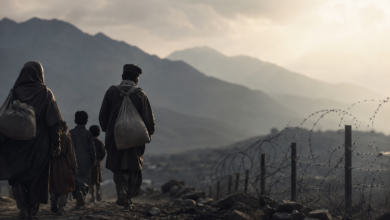
(iv) The creation of conditions which would permit the Afghan refugees to return to their homes in safety and honor.
This is the framework for a political solution, which must be worked out between the occupying forces and the leaders of the Resistance Movement, with the assistance of the governments of Pakistan, Iran and the United Nations. To bring Russia to the above bargaining position it would be necessary to make her realize that if she does not come to this framework the price, she has to pay to continue her occupation would become unbearable and that the liberation movement has the potential to spread beyond Oxus River.
These five points of policy should be backed by intensive home work to strengthen Pakistan, Iran and the Arab world and to coordinate their economies, defense planning and production, and build a system of collective self-reliance to act as a bulwark for peace. There has also to be an extensive diplomatic effort all over the world to increase pressure on Russia and make it unavoidable for her to come to negotiating framework outlined above. This is the direction in which our Afghan policy should move.
With these ideas I take great pleasure in introducing the extremely valuable and perceptive study “Afghanistan Crisis: Implications and Options for Muslim World, Iran and Pakistan” produced by my brother and colleague Mr. Tahir Amin, a trained social scientist with specialization in the field of International Politics. Mr. Tahir Amin has examined the problem in depth, has spelled out the historical context of the crisis, shown how the communist influence was consolidated in Afghanistan, what are the major objectives as well as constraints on Russian foreign policy vis- a-vis Afghanistan and how the Resistance Movement emerged and is playing its role in history. Mr. Tahir Amin has also spelled out policy options for Pakistan, Iran and the Muslim World. I am sure his analysis would be read with interest and profit with all those persons who are interested in the problem, including the leaders of the Mujahideen, and by the policy-makers in Pakistan, Iran and the Muslim World.
20th May 1982.
Islamabad.
KHURSHID AHMAD