
Apparent Boom & Bitter Truth
By Prof Khurshid Ahmed
Soon after assuming power in 1999, President General Musharraf announced a 7-point agenda for his government. Economic recovery and improvement were an important point in this agenda.
Ever since coming to power, the present regime has been claiming great achievements in this regard. It would be useful to analyze the state of the economy in general and scrutinize the claims and avowals of the government in particular. This would enable us to grasp the situation as it actually is.
During his referendum campaign, Musharraf presented his economic reforms and performance in the most exaggerated terms. His ministers, colleagues, and cohorts are all presenting the rise in forex reserves and securing of loans and assistance with pride unconfined. One ‘expert’ even went to the extent of claiming that all the indicators needed to gauge economic performance are positive and bright. To us, this picture of the economy is incomplete, self-serving, and, to a large extent, biased.
We do not deny that the economic performance of the past political governments was not at all something to be proud of. They were continuously pushing the country into a debt trap and were ignorant of real economic reforms for short-term benefits. But we have no hesitation in saying that the economic team of this government has not taken the trouble of introducing basic reforms either. This team is dominated by bankers, and they may be good bankers, but the problem is that running the economy of a country is not similar to that of running a bank. Unless real solutions are found for economic problems, the situation will remain volatile, and problems and difficulties will not be overcome.
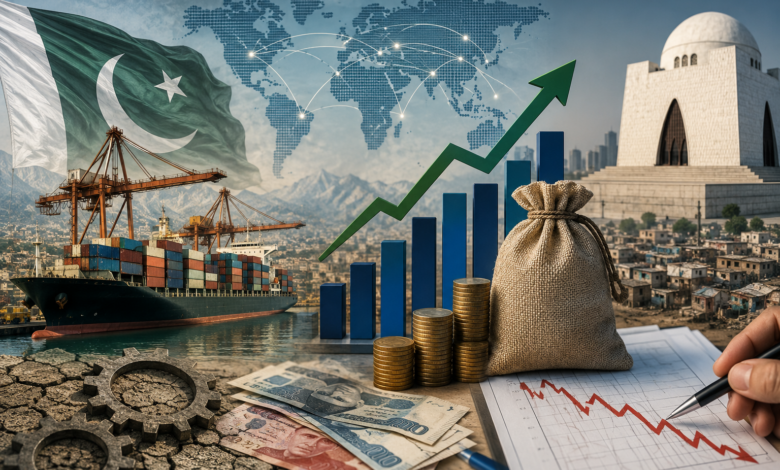
It is true that due to smart banking and the result of us becoming the darling of loan donors, forex reserves have bulged significantly. These reserves had fallen dangerously in 1999, and the ruinous step of freezing foreign currency accounts (FCAS) in 1998 had severely damaged our credibility in the world. The position in this field is much better now, and the forex reserves reached $5.3 billion in May 2002. But the conclusions that are being deduced from this single indicator and the credit being taken for it is an exaggeration. The balance of payments is indeed positive for the first time in the last 20-25 years, but it is so only from a certain perspective.
If the official transactions that are grants or loans from foreign countries are included, then the balance of payment shows a surplus of Rs331 million. But excluding official transactions and limiting the balance of payments to trading and other financial transactions, the deficit shoots up to Rs508 million.
This is far less than the average deficit of $3 billion in the past. Its credit goes to the government to a certain extent, as its main reason is a fall in trade deficit because of the fall in imports rather than a rise in exports. Moreover, remittances of overseas Pakistanis have been doubled in the wake of the international situation, their capital’s becoming unsafe in America, and a ban on unofficial transactions in the Arab Emirates.
Behind this apparent boom, there are many bitter truths pertaining to national sovereignty, security and strategic matters. But talking from an economic point of view, the most important point is the stagnation of exports. The country’s exports were set to reach $10 billion before 1998, and it was the target for this year as well. But exports stand at $7.3 billion in the first ten months and, if all-out efforts are made, they are expected to be between $8.5 to $9 billion. This is 10-15 percent less than the expected target! Trade deficit has shrunk just because the fall in imports has been more than the fall in exports, i.e., 6.93 percent as against 1.7 percent.
It has improved the balance of payments and forex reserves position, but declaring it as healthy for the economy means being unaware of economic principles and factors affecting the economy. The decline in exports is, in fact, a result of stagnation in the economy and recession in production activity. GDP growth rate, which was 6.3 per cent in the 6th five-year plan (1983- 88), stood at 4.8 percent in the 7th plan (1988-1993), and 4.2 per cent in the 8th (1993-98). It fell to 3.6 per cent in 1999-2001 and is estimated to be 3 per cent or even less in 2001-2002. Likewise, the decline in imports would ultimately affect national growth. So, a decrease in deficit is not that beneficial a deed.
Added to this is the fact that the State Bank raised foreign exchange reserves by purchasing dollars from the open market. Sure, it has helped the forex reserves situation, and the value of the rupee against the dollar became stable, but the reserves obtained in such a way are not the result of real growth or production activity. Rather, the amount of Rs200 billion used for the purpose has gone into a non-productive process. If this amount were used for investment in the country, it could have been helpful in employment generation, poverty alleviation, and a boost in growth.
Increase in production and exports, distribution of wealth (based on justice), provision of employment, rise in investment and per capita income, along with expansion of economy and increase in tax revenues, are the real standards to gauge the economy of a country. The economic situation looks dismal, no matter what indicator is taken up to gauge its health. Investment in the country is decreasing. Receding from 17-18 percent of the GDP during the last few years, it now stands at less than 13 percent.
There were high expectations regarding foreign investment, but these were not realized. In 1995-96, foreign investment exceeded $1.5 billion, but fell to $600 million in 1999. It further fell to $180 million in 2000-2001. It has surged to $287 million for the current year, yet it is far less than the target of $500 million.
The slow growth can also be seen in the fact that commercial use of energy decreased in 2000-2001 as compared to 1999-2000, and it has decreased even further during the current year. The same is the situation with the use of gas and electricity. This is the situation for all energy resources and is proof of economic stagnation and recession. Agriculture is facing serious problems, and apart from the production of sugarcane, sugar, and, to some extent, cement, both agriculture and industry are in the throes of recession. Development expenditure in social sectors (education, health) and the public sector is falling continuously. Use of credit by the private sector has fallen to half of last year.
All these are the signs of stagnation of the economy, not its growth. This is the reason why the government’s target of tax revenue has not been achieved despite all attempts at tax surveys and efforts by the CBR, the government, and the army. The target has been revised downwards five times this year, from Rs 457 billion to Rs 414 billion. The estimate is that practically Rs400 billion or at the most Rs 404 billion would be collected, and the budget deficit would shoot up to Rs60 billion.
This has been the situation in spite of the infamous tax survey that has resulted in a war-like situation between traders and the government for months. The army was called in, and promises were made that tax revenue would rise unprecedentedly. But how could the tax revenue rise with no growth in economy, freezing investment and increasing poverty (all evident from the reports of international institutions)? The extent of increase in poverty can be gauged from the fact that 17 per cent of the population were living below the poverty line in 1980, which rose to 37 percent in 1997 and 39 per cent in 2001. Suicides and deaths due to a lack of food, due to poverty, and indigence are happening for the first time in Pakistan.
Per capita income in the country is decreasing continuously, and our per capita income has for the first time become less than that of India. In 1996-97, per capita income was $493, which fell to $446 in 1999-2000 and just $429 in 2002. Annual growth rate of GDP has fallen from 3.89 per cent to 2.39 per cent, and the unemployment rate has increased from 5.89 to 7.82 per cent of the labour force in the current year. The ratio of national savings and national investment has also decreased. National savings were 15.4 per cent of the GDP in 1999-2000, which fell to 14.5 per cent in 2000-2001. It has decreased further in the current year. The same is the situation with national investment, which was 15.8 per cent of the GNP in 1999-2000 but declined to 14.9 per cent in 2000-2001. It too is still on the decline this year.
Dearness has reached a backbreaking situation. Electricity, gas, and petroleum are particular targets, and their prices rise three or four times a year. Salaried-class and low-income families are crying, and pensioners are wailing, but there is nobody to attend to their woes. Even when the prices of petroleum are increased in the country even when they fall in the international market. Now the prices have been increased by 17 percent just before the budget that has forced the transporters of Baluchistan to go on strike.
The debt burden has also risen, though the pace of rise has slowed down. This has been possible because of the ‘affectionate view’ of international donors and rescheduling of loans for political reasons.
There has been no real development regarding poverty alleviation and the setting up of a just and prosperous society. No worth-mentioning steps have been taken for the elimination of Riba, for which the deadline given by the Supreme Court is ending on June 30, 2002. There are reports that the government is all set to request the court for more time or suspension of the earlier verdict.
In short, no sector of the economy presents a situation that can be termed satisfactory. The overall economic scenario is as gloomy today as it was before the present government came to power; rather, it has deteriorated even further from many perspectives. The above-mentioned statistics are enough to expose the reality of good-sounding official claims of economic development. Dreaming of economic revival or development through these so-called reforms is delusive.
The first phase of the steps needed to come out of the present quagmire and reconstruct the economy is to have a correct vision of the economic system and its objectives and priorities. The next step is the formulation of a comprehensive policy and economic strategy in the light of this vision.
The third and most important requirement is to have a new political and economic leadership. No doubt that the economy can not be isolated from the whole system. Therefore, such a leadership is the need of the hour that can, on the one hand, start effective accountability of the past leadership and, on the other, strive for setting up a new system. This is the only way to come out of the present economic crisis.