
An Introduction to Islamic Economics
Although Islamic Economics is still in its early stages of development as an academic discipline, there is a constant flow of useful and valuable literature on its different aspects and themes relating to Islam’s economic teachings. There is also a rich scholarly tradition from whose womb this nascent discipline has emerged. In all ages and times, Muslim scholars have written on the economic teachings of Islam. The current century, however, has been particularly prolific. Theologians, legists, fuqaha’, social thinkers, and reformers have profusely written on economic themes and have tried to identify what guidance could be drawn from the Islamic sources, namely the Qur’an, Sunnah, Fiqh, social thought, and historical experience. Lurid light has been thrown on certain aspects, like prohibition of riba, dynamic potential of zakat, concept of property and enterprise, role of state, etc. Reflection and discussion continue on many more aspects, from the micro level to the global issues. It is in the context of this rich intellectual background that the Muslim economists are trying to develop what can be described as ‘Islamic Economics’.
There is also an increasing realization that Islamic economics cannot be studied in isolation-it can seek flowering only in the context of a whole social system. Contemporary Muslim economists have, on the one hand, gone deep into the original sources to understand the Islamic ideals and targets and, on the other, to realistically comprehend the process through which the Muslim society is passing i.e. a status quo that is a complex of vestiges of the great historic traditions, polluted and corrupted by a colonial past, during which a host of foreign values, laws, institutions and consequent distortions were imposed upon it. As such, the problems of transition are beginning to attract more and more attention from researchers and scholars.
More fundamental is the debate on the future of the very paradigm of economics. The economic paradigm, which has held sway for the last two centuries, is not only showing cracks beyond repair; its very theoretical foundations, underlying assumptions, and capacities to predict future modes of behavior are being challenged. Discussion is no longer confined to changes within the paradigm; the current debate is moving more and more towards a need for change in the paradigm itself. “Challenged”, writes Amitai Etzioni, “is the entrenched utilitarian, rationalistic, individualistic, neo-classical paradigm which is applied not merely to the economy but also, increasingly, to the full array of social relations, from crion to family”.
The economic paradigm is being challenged at its very core: the neo-classical paradigm does not merely ignore the moral dimension, but actually opposes its inclusion. The new emerging paradigm, on the other hand, visualizes assigning “a key role for moral values.” Then alone may it be possible, underscores Etzioni, to “seek both what is right and what is pleasurable”. Cristovam Buarque, a well-known Brazilian economist and a former Rector of the University of Brasilia, makes a more dispassionate plea for this new approach to economics in his latest work: The End of Economics: Ethics and the Disorder of Progress, translated by Mark Ridd. The failure of economics lies in ignoring social and ethical values. “Social objectives”, he asserts, “have been subordinated and viewed as a consequence of technical progress rather than as the purpose of civilization. Ethical values, meanwhile, have been discarded”. What is needed is a fundamental change of approach and a total reordering of the priorities. He concludes:
“Just as physics stumbled upon the need for regulatory ethics, the moment it became aware of its catastrophic potential, so Economics sorely needs to rediscover Ethics.”
The present dilemma will not be dispelled merely by re-evaluating the means and totting up new costs, as one does in project assessment. Rather, it is a matter of changing the core objectives of the social process, delivering it from the economistic strait-jacket of the last two centuries.
Without subverting the traditional notion of progress, it will be impossible to grapple with the problem of growing poverty and inequality, and impossible to incorporate ecological balance into social purposes. The issue of economic development thus demands a fresh theoretical approach founded on three pillars: an ethics for redefining the very objectives of civilization; a new definition of the object and field of study, capable of taking in the ecological dimension; and a new rationale for Economics as a discipline.
The result of this approach would be that: “Technological options must be determined by an economic rationale subordinate to social objectives formulated by ethical values. The hierarchical order: technical values/economic rationale/social objectives/ethical values, would thus be reversed”.
Coming to the ground situation of the world economy, it deserves to be noted that the socialist economic experiment has miserably failed, while the capitalist economies, despite long strides in the fields of economic growth and technological transformation, are in the throes of an ever-deepening crisis. Modern economy has failed to ensure distributive justice, sustained growth and social harmony for a vast majority of mankind and is confronted at home and abroad with the menaces of prolonged recession, persistent unemployment, stagflation, unrestrained monetary expansions, staggering mountains of domestic and foreign debts, and co-existence of extremes of affluence and stark poverty within as well as among the community of nations. The link between moral values and economic judgment and behavior, both at individual as well as governmental levels, which had sustained humanity through the millennia, had been torn asunder during the age of secular capitalistic ascendance, and the economists as well as the common man are now trying to rediscover that missing ethical link. ‘Islamic economics’ represents a systematic effort by Muslim economists to cast a fresh look on the entire economic problem and methodology, and come up with fresh solutions to old and persistent problems. We are aware that the Muslim economists have a long way to go, but there is no doubt that a beginning has been made in this direction. This beginning bears great promise for the future.
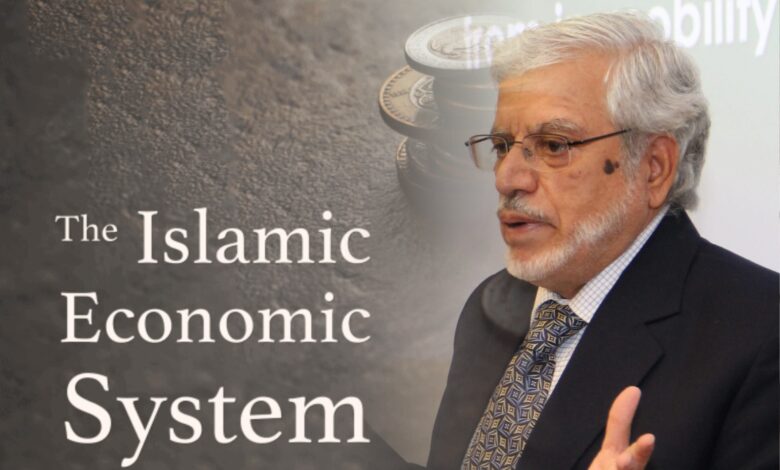
Brother Mohammad Akram Khan is one of those scholars who have shown keen and persistent interest in Islamic economics. He has already produced an extremely useful annotated bibliography on Islamic economics. He has also written quite extensively on several substantive issues, particularly in the fields of banking, performance audit, and rural finance. His present study covers a rather vast area, from Islam’s worldview and basic economic concepts to several policy prescriptions. The value of the book lies in its simplicity, directness of style, unapologetic approach, and reliance on sources to develop Islamic perspectives on several economic concepts, issues, and problems. I am confident that “An Introduction to Islamic Economics” will be of great assistance to the uninitiated reader, particularly for students of economics. It will help the reader develop familiarity with a large number of issues that go to make up the current matrix of Islamic economics. I welcome the publication of this short but useful book and am also happy to record that its publication marks a new phase in the history of cooperation between the International Institute of Islamic Thought, Washington/Islamabad, and the Institute of Policy Studies, Islamabad, which have jointly sponsored its publication.
Islamabad
October, 1994
KHURSHID AHMAD